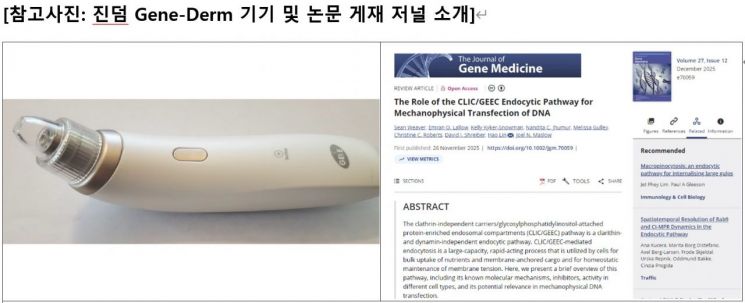
Genexine (Co-CEOs Ko Kwangyeon and Han Woogeun) announced on December 18 that a research paper systematically analyzing the molecular and cellular mechanisms (Mode of Action, MOA) by which DNA is delivered into cells following its proprietary suction-based intradermal DNA vaccine delivery technology (Gene-Derm) has been published in the latest 2025 issue of the international peer-reviewed journal, The Journal of Gene Medicine.
The published paper, titled "The Role of the CLIC/GEEC Endocytic Pathway for Mechanophysical Transfection of DNA," was led by Dr. Joel N. Maslow, Chief Medical Officer (CMO) of Genexine, in collaboration with Professor Hao Lin's research team at Rutgers University in the United States.
This paper comprehensively presents, based on previous research and literature, that the clathrin-independent endocytic pathway known as CLIC/GEEC (Clathrin-Independent Carriers/GPI-AP Enriched Endocytic Compartments) may play a major role in the process by which DNA is delivered into cells through mechanical or physical stimulation such as suction or electroporation.
Electroporation, a widely used conventional DNA vaccine delivery method, induces DNA uptake by applying electrical stimulation to the cell membrane. While it is highly efficient, pain and procedural burden have been cited as drawbacks. In contrast, Genexine's suction-based delivery method applies and then releases a momentary negative pressure to skin tissue, enabling efficient DNA delivery without electrical stimulation, and has been evaluated as a differentiated approach.
According to the paper, when the suction stimulus applied to the skin is released, cells actively take up external substances as they return to their original state. In this process, the CLIC/GEEC endocytic pathway is likely to be activated, and this is proposed as a key mechanism that explains how DNA vaccines are efficiently delivered into cells.
Furthermore, the CLIC/GEEC pathway, unlike other uptake mechanisms, is discussed as being less likely to expose DNA to rapid degradation within the cell, allowing DNA to remain longer and thus be more advantageous for the production of antigen proteins.
Genexine has previously demonstrated in clinical studies of its COVID-19 DNA vaccine (GLS-5310) that the use of a suction-based intradermal injector induced an antibody response equal to or greater than that of electroporation or needle-free jet injection methods, and significantly higher T-cell immune responses. This paper is significant in that it provides the most convincing mechanistic framework at the cellular and molecular level to explain these clinical results.
A Genexine representative stated, "This paper is highly meaningful as it systematically organizes the scientific evidence supporting the clinical efficacy of suction-based DNA vaccine delivery technology," adding, "We expect it to serve as an important reference explaining the mechanism of action for vaccination methods in the development of infectious disease vaccines and personalized anticancer DNA vaccines using Gene-Derm in the future."
Meanwhile, The Journal of Gene Medicine is an international journal specializing in gene therapy and gene delivery, recognized for its expertise and practical value among researchers and technology developers in the field. Genexine, through its U.S. subsidiary VGXI, possesses cGMP manufacturing capabilities for clinical and commercial-scale plasmid DNA and mRNA pharmaceuticals, and plans to continuously strengthen its competitiveness in nucleic acid-based drug development based on the mechanistic research summarized in this publication.
© The Asia Business Daily(www.asiae.co.kr). All rights reserved.

















