Vehicle Restrictions, Expanded Remote Work
Emergency Measures Include Suspension of In-Person Classes
New Delhi, the capital of India, has effectively come to a standstill due to record-high levels of air pollution. As the Air Quality Index (AQI) soared to the 'severe' category, the highest level of emergency response measures have been implemented, including vehicle operation restrictions, expanded remote work, and school closures.
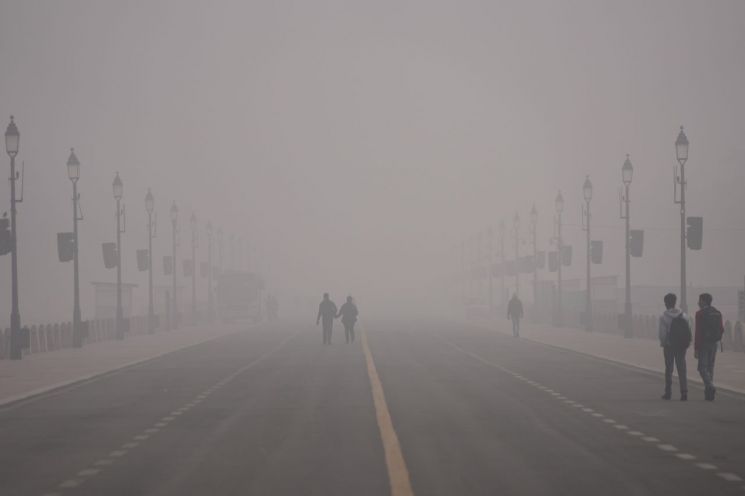
According to the Times of India (TOI) and other sources on December 18, the Commission for Air Quality Management (CAQM) in India simultaneously activated both Stage 3 and Stage 4 air pollution responses on December 16, after the AQI in the New Delhi area reached the 'severe' level.
On the morning of the activation, at 10 a.m., New Delhi's AQI stood at 401, prompting the implementation of Stage 3 measures. By 8 p.m. the same day, the index exceeded 450, leading to the addition of Stage 4 measures.
The Commission for Air Quality Management stated, "The AQI continued to rise because wind speeds were low, the atmosphere was stagnant, and meteorological conditions deteriorated, preventing pollutants from dispersing. Therefore, Stage 4 measures were implemented to prevent further deterioration."
As a result, in New Delhi and surrounding areas such as Delhi, Gurugram, Faridabad, Ghaziabad, and Gautam Buddh Nagar, the operation of BS Stage 3 gasoline vehicles and BS Stage 4 diesel four-wheelers has been restricted. Non-essential freight trucks using non-clean fuels have also been banned from entering New Delhi.
The New Delhi government, based on the Environmental Protection Act, has ordered 50% of all private and government employees in the city to work from home, with some exceptions. For schools, classes for grades 9 and 11 and below have shifted to a hybrid system combining remote and in-person learning.
Construction and demolition work has also been completely halted. Previously exempted linear public projects such as roads, bridges, and power and telecommunications infrastructure have also been suspended with the activation of Stage 4 measures. Registered construction workers whose livelihoods have been affected by the work stoppage will receive compensation of 10,000 rupees (approximately 164,000 won).
The Commission for Air Quality Management has advised children, the elderly, and those with chronic illnesses to refrain from outdoor activities as much as possible. Authorities will monitor future weather conditions and air quality changes before deciding whether to extend these measures.
© The Asia Business Daily(www.asiae.co.kr). All rights reserved.
![Clutching a Stolen Dior Bag, Saying "I Hate Being Poor but Real"... The Grotesque Con of a "Human Knockoff" [Slate]](https://cwcontent.asiae.co.kr/asiaresize/183/2026021902243444107_1771435474.jpg)











