Step-by-Step Customized Support for the Labor Market
AI Engineer Training Program for Young People
Training Support for 2,000 Small and Medium-Sized Enterprises
254 Billion Won Budget Next Year to Benefit 240,000 People
The government will allocate a budget of 254 billion won next year to provide systematic artificial intelligence (AI) vocational training for 240,000 people. The plan is to support the step-by-step development of AI skills for citizens entering, participating in, or transitioning within the labor market, with the aim of educating more than 1 million people over the next five years. In particular, a project to nurture AI engineers in specific fields will be launched for young people at the entry stage. To encourage participation, the monthly allowance for young participants will be increased to a maximum of 800,000 won.
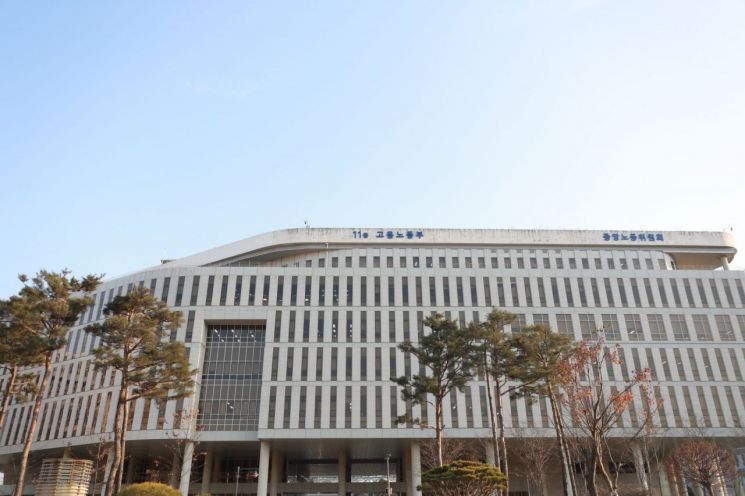
On December 18, the Ministry of Employment and Labor announced the "Labor Market AI Talent Development Plan: AI+Competency Up Project" at the 2nd Meeting of Ministers Related to Science and Technology held at the Government Complex Seoul. This measure follows up on the Ministry of Employment and Labor's work report presented on December 11. Under the vision of "Realizing an AI Transformation Together with Labor," the goal is to support the development of AI vocational skills for more than 1 million citizens in the labor market over the next five years and to lay the necessary groundwork. A key feature of this plan is the provision of step-by-step support for entry, participation, and transition stages in the labor market.
First, at the entry stage, an "AI Competency Enhancement Model" will be introduced for young people and job seekers, covering basic understanding of AI, job application, and solution development, with training support provided. To ensure that AI-related content is included throughout vocational training, the number of participants in the basic AI understanding and application courses under the National Learning Card general training program will be expanded to 56,000. In addition, the number of participants in advanced remote AI training courses will be significantly increased to 33,000.
For example, the K-Digital Training (KDT) program, a youth vocational training initiative, will be upgraded to nurture AI engineers in specific fields. Next year, 133.8 billion won will be invested to establish the KDT AI Campus Program, aiming to train 10,000 key job engineers in areas such as AI system development and AI application software development. To boost youth participation, the monthly participation allowance (trainee support fund) will be raised from the current uniform amount of 316,000 won to 400,000 won in the Seoul metropolitan area, 600,000 won in non-metropolitan areas, and 800,000 won in regions with declining populations starting next year.
At the participation stage in the labor market, systematic AI training will be provided to enhance the skills of workers at small and medium-sized enterprises (SMEs) and improve corporate productivity. In collaboration with the Ministry of Science and ICT, the Ministry of SMEs and Startups, and the Ministry of Trade, Industry and Energy, SMEs interested in AI training will be identified, their training needs assessed, and tailored training packages delivered. Next year, 2,000 companies will be targeted, and for those with little training experience, free online AI education will be offered to 100,000 people.
At the transition stage, AI education and training will be strengthened to support new challenges for middle-aged individuals and those changing or transferring jobs. Through the Middle-aged Employment Network, including employment centers and Middle-aged Tomorrow Centers, as well as 17 regional human resource development committees, the demand for AI education among the middle-aged will be assessed. Basic AI application education will be provided for 28,000 people across all courses at 39 Polytech campuses nationwide. In addition, job transition training and AI transformation (AX) training courses will be offered to 1,500 people.
Efforts will also be made to expand infrastructure, promote inter-ministerial collaboration, and link various projects to establish a foundation for AI training. To expand regional AI training infrastructure, 10 billion won will be invested to set up four factory-type physical AI labs matched to local industries, which will be opened to local SMEs and universities. For example, a machinery+AI field will be established at the Polytech Changwon Campus. In addition, 20 new "AI Specialized Joint Training Centers" will be designated to share large enterprise training infrastructure and programs with SMEs. Next year, 10 billion won will be invested for this purpose.
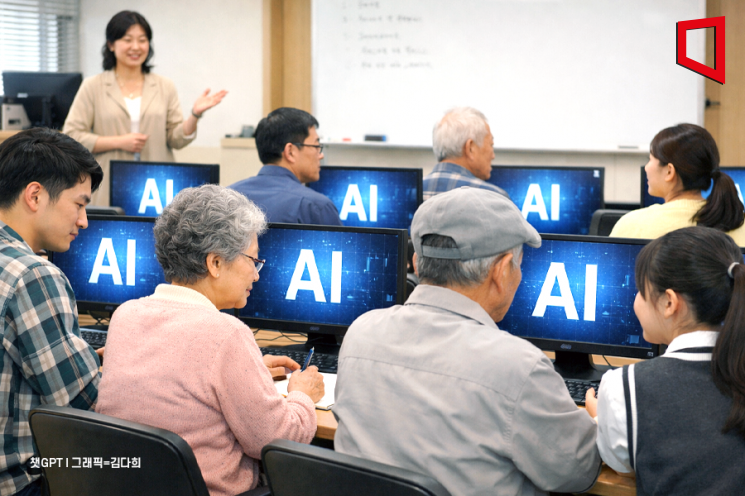
Furthermore, a systematic approach will be taken to nurture instructors through the AI Teacher Academy program. In addition to training new instructors, the AI skills of existing instructors will be enhanced, with the goal of training more than 12,650 people next year. Korea University of Technology and Education, together with Polytech and the Human Resources Development Service of Korea, will take the lead in this effort. AI education curricula tailored to major job categories will also be developed and distributed next year.
To implement the measures announced today, the Ministry of Employment and Labor will allocate a total budget of 254 billion won next year to train 240,000 people. This accounts for about 10% of the total vocational training budget of 2.7 trillion won. Going forward, an "AI Response Job Roadmap" analyzing the impact of the AI transformation on jobs and outlining responses will be released in the first half of next year, possibly as early as March. Minister of Employment and Labor Kim Younghoon stated, "We will support the enhancement of AI skills for everyone seeking job opportunities and for all those currently working."
© The Asia Business Daily(www.asiae.co.kr). All rights reserved.
![Clutching a Stolen Dior Bag, Saying "I Hate Being Poor but Real"... The Grotesque Con of a "Human Knockoff" [Slate]](https://cwcontent.asiae.co.kr/asiaresize/183/2026021902243444107_1771435474.jpg)

















