President Lee Questions Minister Jung on 'Oriental Medicine Infertility Treatment'
"Some Regional Support Exists, but Objective Proof Is Difficult"
Association of Korean Medicine Expresses "Deep Anger", Medical Association Says "Immediate Suspension
During President Lee Jaemyung's ministry work report, Minister of Health and Welfare Jung Eun-kyung stated, "Oriental medicine is difficult to prove objectively and scientifically, and (for support) it must demonstrate effects that everyone can acknowledge." In response, practitioners of oriental medicine have protested.
On the 16th, when President Lee asked whether there is national support for oriental medicine-based infertility treatment, Minister Jung replied, "Some regions do provide support," and made the aforementioned remarks. At that time, President Lee commented, "This is a question requested by the oriental medicine community," and also inquired whether there were any civil servants in the Ministry of Health and Welfare with a background in oriental medicine. Minister Jung answered, "There are about ten civil servants with medical licenses. None are at the bureau or division director level, but there is one at the assistant director level."
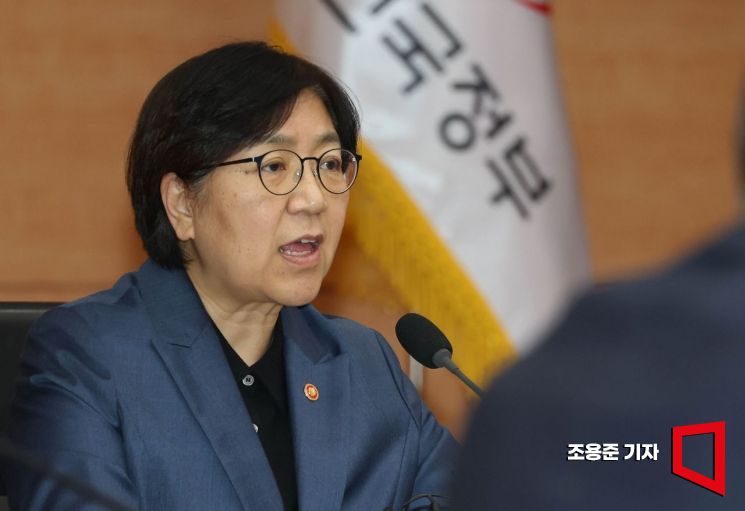 Minister of Health and Welfare Jung Eun-kyung stated, "Oriental medicine is difficult to prove objectively and scientifically, and (for support) it must demonstrate effects that everyone can acknowledge." In response, oriental medicine practitioners have protested.
On the 17th, the Association of Korean Medicine issued a statement saying, "We condemn Minister Jung's outrageous remarks and demand a sincere apology to the infertile couples in Korea who are overcoming infertility through oriental medicine, as well as to the oriental medicine community." They further asserted, "The Minister of Health and Welfare dismissed the clinical standard treatment guidelines for oriental medicine in infertility, which the ministry itself announced, by claiming that 'objective and scientific proof is difficult.' This is a typical baseless denigration of oriental medicine by Western medical practitioners, and the oriental medicine community expresses deep anger and strong regret."
The association argued that Minister Jung's remarks were incorrect, citing the "Clinical Practice Guidelines for Oriental Medicine in Female Infertility" previously published by the Ministry of Health and Welfare. According to these guidelines, herbal medicine treatment for women with diminished ovarian reserve was rated as having a "B/Moderate" level of evidence. For women who had undergone assisted reproductive technology, acupuncture was rated "A/High," while electroacupuncture, moxibustion, and herbal medicine all received a "B/Moderate" rating.
The association stated, "All of these are treatments with sufficient supporting evidence," and argued, "The Ministry of Health and Welfare has acknowledged that these are treatments with sufficient evidence, corresponding to the criteria used to select conditions for the ongoing pilot project for herbal medicine coverage under the national health insurance."
Based on this, it is reported that currently, 14 metropolitan governments and 72 basic local governments nationwide are conducting oriental medicine infertility support programs through local ordinances. The association also presented the case of Gyeonggi Province, where support for oriental medicine infertility treatment started at 500 million won in 2017 and increased to 972 million won in 2025. President Lee served as the governor of Gyeonggi Province from 2018 to 2022.
On the other hand, the Special Committee on Oriental Medicine Countermeasures of the Korean Medical Association evaluated Minister Jung's response by stating, "The government has, in effect, acknowledged that oriental medicine-based infertility treatment has not been sufficiently verified in terms of scientific evidence, effectiveness, and safety." They further argued, "'Oriental medicine infertility treatment' lacks objective and scientific evidence that is internationally recognized for its effectiveness and safety, and reliable clinical evidence is also insufficient. Implementing policies that use national health insurance funds or give the impression that the government guarantees the effectiveness of such treatments misleads the public and risks depriving infertile couples of the opportunity to receive proven medical treatment at the appropriate time."
They added, "The government and local authorities must immediately halt all oriental medicine infertility support programs and prioritize thorough verification, objective research, and transparent disclosure of data regarding these support programs."
© The Asia Business Daily(www.asiae.co.kr). All rights reserved.
![Clutching a Stolen Dior Bag, Saying "I Hate Being Poor but Real"... The Grotesque Con of a "Human Knockoff" [Slate]](https://cwcontent.asiae.co.kr/asiaresize/183/2026021902243444107_1771435474.jpg)
















