Inscription Procedures Begin for Tidal Flats and City Walls
International Declaration Planned, Joint Research to Expand
 Heo Min, Director of the National Heritage Administration, Attended the 20th World Heritage Committee Special Session Photo by Yonhap News
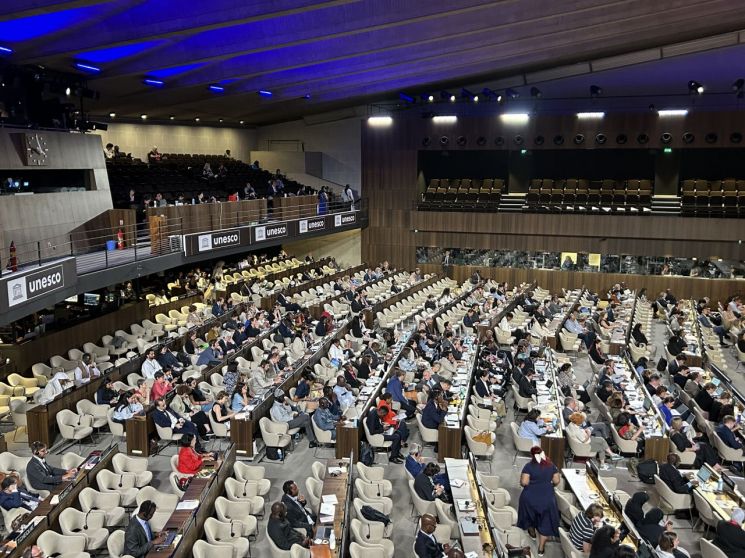
The UNESCO World Heritage Committee will be held in South Korea for the first time. This large-scale international event will see approximately 3,000 participants from around 200 countries.
On December 17, Huh Min, Director of the National Heritage Administration, announced the "2026 Major Work Plan" at the National Palace Museum of Korea, stating, "We will use this committee meeting as an opportunity to elevate the global status of K-Heritage and to strengthen our ability to address East Asian historical and cultural issues."
The 48th session of the UNESCO World Heritage Committee will take place at BEXCO in Busan from July 19 to 29 next year. During this meeting, a decision will be made on whether to inscribe "Korean Tidal Flats Phase 2" as a World Heritage Site. "Hanyang City Walls" is also awaiting an on-site inspection by a UNESCO advisory body.
In addition, decisions will be made in June on whether to inscribe the "Danwon High School 4·16 Archive" and "Suun Japbang and Eumsik Dimibang" on the Memory of the World Register. "Hanji Culture" will be reviewed for inscription as Intangible Cultural Heritage in December, and Taekwondo is undergoing procedures for joint inscription by both South and North Korea.
The National Heritage Administration aims to adopt an international declaration during this committee session, expressing a commitment to peace and cooperation in the field of World Heritage. The goal is to reach a level comparable to the "Budapest Declaration" of 2002 and the "Bonn Declaration" of 2015. The declaration will address contemporary social issues and major topics surrounding World Heritage. To this end, a pan-government preparatory committee will be formed, led by the Office for Government Policy Coordination, with participation from the Ministry of Culture, Sports and Tourism, the Ministry of Foreign Affairs, the National Police Agency, as well as a network of local governments with World Heritage sites and an expert advisory group.
As a side event, there will be comprehensive K-Culture promotions centered on K-Heritage. In collaboration with the Ministry of Culture, Sports and Tourism, the Ministry of Agriculture, Food and Rural Affairs, the Ministry of the Interior and Safety, and the Ministry of SMEs and Startups, the event will introduce all aspects of Korean culture. The response system for heritage-related disputes with neighboring countries will also be strengthened. Trends in UNESCO heritage inscription by Japan, China, and others will be analyzed, and major issues, such as the Sado Mine case, will be addressed in cooperation with the Ministry of Foreign Affairs and other relevant agencies. Efforts to ease conflicts will also be made through discussions on transboundary heritage, focusing on modern industrial heritage such as railways.
The National Heritage Administration will also work to establish international principles for the interpretation of World Heritage. A working group will be formed next year to develop these principles, and a practical guideline for field application will be published in 2027. This is intended to raise awareness among State Parties about World Heritage interpretation and to promote revisions to the Operational Guidelines for the Implementation of the World Heritage Convention.
International development cooperation (ODA) projects will continue. Projects totaling 10.9 billion won include the restoration of the pylon at the Ramesseum Temple of Ramses II in Egypt, preservation of castles in Ghana, conservation and restoration of Machu Picchu in Peru, maintenance and restoration of Angkor Wat in Cambodia, and the establishment of cultural heritage organizations and facilities in Laos and Pakistan. The aim is to disseminate Korea's heritage conservation and restoration technology through international cooperation projects.
Joint research on national heritage will also be expanded, including the excavation of the Kultepe site in T?rkiye (2025-2029) and joint studies of the Dunhuang Caves in China (2026-2028). Underwater heritage joint excavations will also be conducted, targeting the "Cheotuon Shipwreck" in Vietnam and the "Takashima No. 3" in Japan (related to the 1281 Mongol-Yuan invasion of Japan).

Efforts to recover overseas heritage will also be strengthened. Currently, about 240,000 Korean heritage items are located abroad, with approximately 44% (about 100,000 items) in Japan, 27% (about 60,000 items) in the United States, and 20% (about 40,000 items) in Europe. The National Heritage Administration will focus on conducting status surveys in regions with large concentrations and will work to create conditions for repatriation through public-private cooperation.
The National Heritage Administration will also hold events to commemorate the 140th anniversary of diplomatic relations between Korea and France. An exhibition in June will showcase diplomatic gifts and documents exchanged during the establishment of diplomatic ties in 1886. An international academic symposium on Seokguram Grotto and Silla heritage will be held in October.
Plans are also being considered for cultural heritage cooperation in anticipation of changes in inter-Korean relations. If relations improve, the resumption of the 9th joint South-North survey of the Goryeo Palace Site (Manwoldae in Kaesong) and other cooperative projects are being considered. The Ministry of Unification and other relevant ministries, as well as the private sector, are exploring ways to collaborate.
© The Asia Business Daily(www.asiae.co.kr). All rights reserved.
![Clutching a Stolen Dior Bag, Saying "I Hate Being Poor but Real"... The Grotesque Con of a "Human Knockoff" [Slate]](https://cwcontent.asiae.co.kr/asiaresize/183/2026021902243444107_1771435474.jpg)


















