Fundraising Reaches Only 72% of Last Year
Unable to Provide Heating and Living Expense Support
The Gyeongbuk Community Chest of Korea (Chairman Jeon Wooheon) announced on December 17 that the "Hope 2026 Sharing Campaign" is facing significant challenges in reaching its target this year, due to emergency fundraising for large-scale wildfires in the first half and the ongoing economic downturn caused by high exchange rates and inflation.
The Love Temperature Tower in the Gyeongbuk region remains significantly lower than in previous years. As of December 15, the total amount raised stood at 4.77 billion won, which corresponds to a Love Temperature of 27 degrees (72.6% of last year's figure). Although the campaign's target amount remains unchanged from last year at 17.67 billion won, the fundraising pace is considerably slower than in previous years, raising concerns that achieving the target may prove difficult.
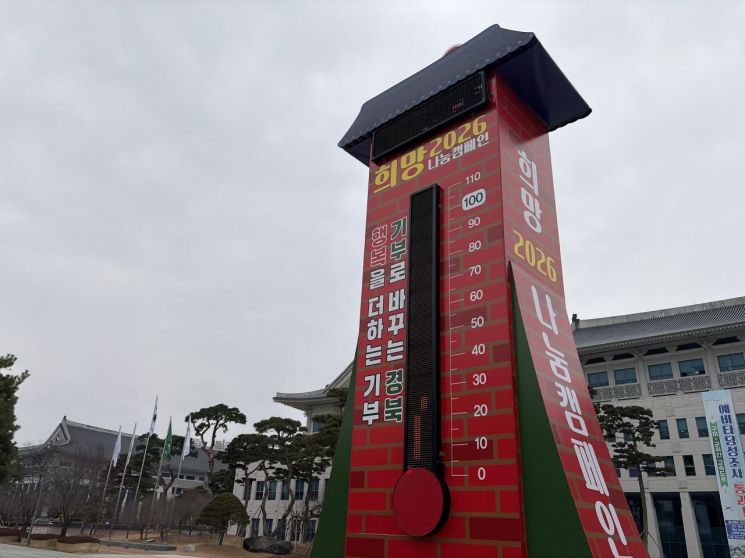 As it becomes more difficult to raise donations for helping neighbors during the economic downturn, the Love Thermometer is cooling down.
The Gyeongbuk Community Chest of Korea explained that this year's sluggish fundraising is not merely a matter of low performance, but could have a tangible impact on the essential welfare delivery system across all 22 cities and counties in Gyeongbuk. Each year, under the "Gyeongbuk Allocation Project Plan," the organization has worked with local governments to implement projects tailored to regional needs, such as providing winter heating and electricity support, emergency living expenses for families in crisis, living support for low-income households with disabilities, safety support for elderly and middle-aged single-person households, protection and care for children and youth, and identifying those in welfare blind spots.
With winter approaching, all 22 cities and counties in Gyeongbuk are seeing a rapid increase in consultations and requests for emergency support due to a lack of heating and living expenses among vulnerable neighbors. Reports continue to come in from both large cities like Pohang, Gumi, Gyeongju, and Andong, as well as rural and fishing communities such as Uljin, Bonghwa, and Yeongyang, stating, "It is difficult to get through winter due to a shortage of heating costs," and "We are facing sudden livelihood crises."
An official from a local administrative welfare center in Gyeongbuk commented, "Crises among vulnerable neighbors during the winter are directly linked to their immediate stability, so even a single day without support can be critical. If the current fundraising stagnation continues, there is a very real possibility that essential projects for households facing heating crises and residents in care blind spots will be reduced."
This year, in particular, the demand for heating cost support has surged as energy costs have risen compared to last year due to inflation. Local welfare agencies noted, "Requests for support are coming in much faster than in previous years," and have been consistently emphasizing the need for additional budget allocations.
Son Byeongil, Secretary General of the Gyeongbuk Community Chest of Korea, appealed, "If every Gyeongbuk resident contributes just about 7,000 won-roughly the price of one or two cups of coffee-we will be more than able to reach our goal. The participation of residents is crucial to maintaining the region's welfare safety net."
The Gyeongbuk Community Chest of Korea has made it easy for residents to participate in donations using mobile-based methods such as ARS donations (060-700-0060), credit card, bank transfer, and simple payment services. Various donation methods are clearly presented on the Gyeongbuk Community Chest of Korea website, and donations can also be made at local community centers and major media outlets throughout the province. The organization emphasized, "Even a small act of sharing from residents is a powerful force in safeguarding the local welfare safety net," and called for continued interest and participation.
© The Asia Business Daily(www.asiae.co.kr). All rights reserved.
![Clutching a Stolen Dior Bag, Saying "I Hate Being Poor but Real"... The Grotesque Con of a "Human Knockoff" [Slate]](https://cwcontent.asiae.co.kr/asiaresize/183/2026021902243444107_1771435474.jpg)
















