Ministry of Land, Infrastructure and Transport and Korea Transportation Safety Authority Announce This Year’s KNCAP Results
The Tesla Model 3 received a Grade 4 rating in a government-led vehicle safety assessment. This evaluation, known as the KNCAP (Korean New Car Assessment Program), is designed to encourage manufacturers to enhance vehicle safety and is divided into five grades, with Grade 1 being the safest.
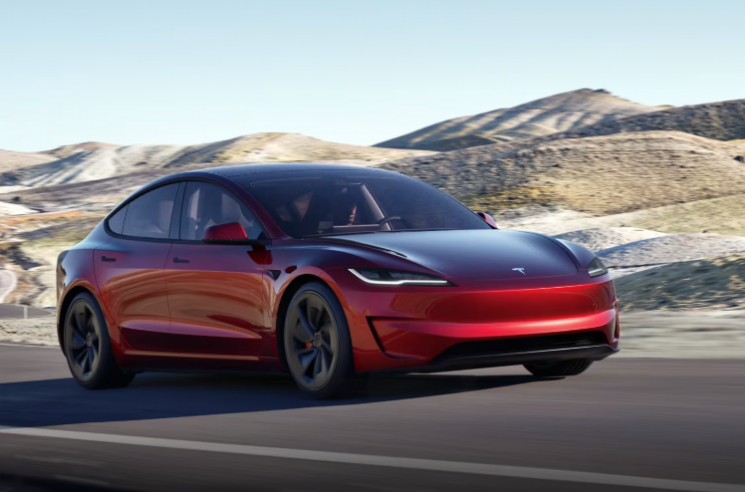
According to the KNCAP results announced on December 17 by the Ministry of Land, Infrastructure and Transport and the Korea Transportation Safety Authority's Automobile Safety Research Institute, the Model 3 scored highly in external pedestrian safety, achieving approximately 86%. However, it received a low score of 43% in accident prevention safety. The accident prevention safety category evaluates features such as Autonomous Emergency Braking System (AEBS), Lane Keeping Assist System (LKAS), Blind Spot Monitoring, Rear Cross-Traffic Collision-Avoidance Assist, and Intelligent Speed Limit Assist.
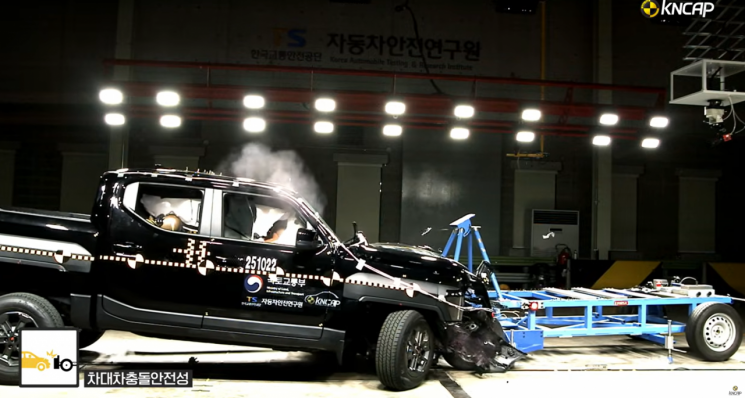 In the Kia pickup truck Tasman safety evaluation conducted last October, the vehicle-to-vehicle collision safety test. Screenshot from the KNCAP website video.
The Model 3, a compact electric sedan produced by Tesla, is considered one of the company's flagship models alongside the Model Y. The Model Y also received a Grade 4 rating in the same assessment last year. From the beginning of this year through last month, 8,476 units of the Model 3 were sold. It ranked second in sales among imported electric vehicles, following the Model Y. Including domestic electric passenger cars, the Model 3 was tied for sixth place with the Casper Electric.
The Kia EV4, which was also evaluated and announced on the same day, received high scores across all categories and was awarded a Grade 1 rating. Hyundai's hydrogen electric vehicle Nexo also received a Grade 1 rating. Including other models announced earlier, a total of four models out of the eleven evaluated this year received Grade 1, including the Hyundai Ioniq 9 and Palisade. The BMW iX2, KG Mobility Musso EV, and Kia Tasman received Grade 2. The Honda CR-V was rated Grade 3, while the BYD Atto 3 received Grade 4. The Ford Explorer was given the lowest rating, Grade 5.
This year, in consideration of incidents such as sudden acceleration accidents and electric vehicle fires that prevent occupants from escaping, the Ministry introduced a variety of new evaluation items in the collision safety category. New assessments were established for pedal misapplication prevention devices and event data recorders, and a new evaluation for post-collision escape and rescue safety in electric vehicles was also introduced.
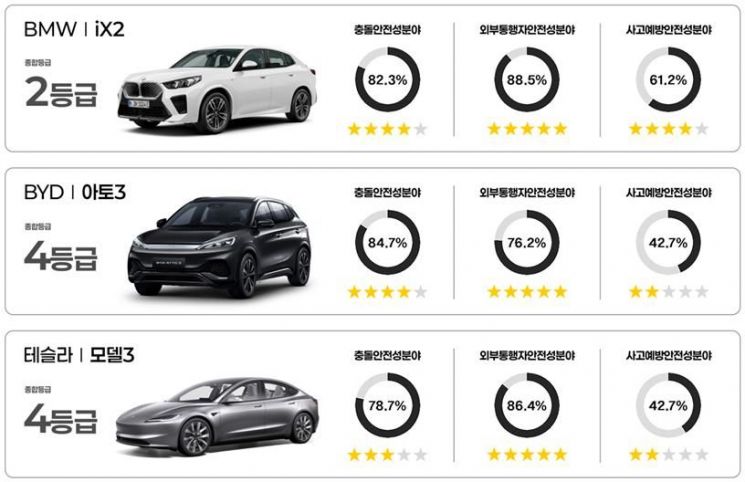
For electric vehicles, battery management system (BMS) safety functions were evaluated and graded separately. The Hyundai Ioniq 9, KGM Musso EV, Kia EV4, and Tesla Model 3 each received four stars. The BYD Atto 3 received three stars, while the BMW iX2 received two stars.
Kim Hongmok, Director General of Mobility and Automobiles at the Ministry of Land, Infrastructure and Transport, stated, "To alleviate public concerns, we plan to continuously identify and strengthen evaluation items related to electric vehicle battery safety and pedal misapplication," adding, "We will continue to fulfill the core role of the vehicle safety assessment program, which is to encourage the development and production of safer vehicles."
© The Asia Business Daily(www.asiae.co.kr). All rights reserved.
![Clutching a Stolen Dior Bag, Saying "I Hate Being Poor but Real"... The Grotesque Con of a "Human Knockoff" [Slate]](https://cwcontent.asiae.co.kr/asiaresize/183/2026021902243444107_1771435474.jpg)


















