Interview with U.S. Automotive News
Overcoming the EV Chasm with a Multi-Powertrain Strategy
60% Electrified vs. 40% Internal Combustion by 2030
Next-Generation Battery and EREV Launch in 2027
"Revolutionizing EV Adoption through Battery Innov
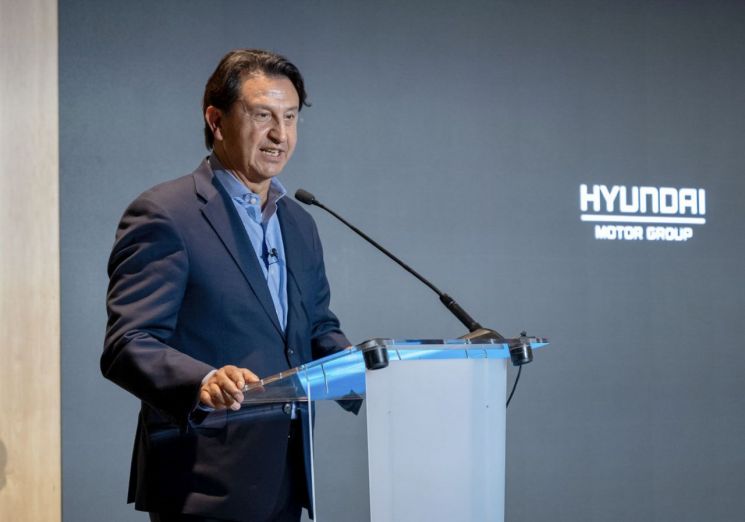
Jose Munoz, President and CEO of Hyundai Motor Company, has unveiled a strategy to increase the share of electrified vehicle sales to 60% by 2030. Amid a slowdown in the pace of electric vehicle adoption and signs of a return to internal combustion engines in some markets, Hyundai Motor Company plans to address the 'EV chasm'-a temporary stagnation in demand-by pursuing a multi-powertrain strategy that includes electric vehicles (EVs), hybrids (HEVs), and extended-range electric vehicles (EREVs).
On December 16 (local time), Munoz shared these plans in an interview with the U.S. automotive media outlet Automotive News. When asked about Hyundai Motor Company's powertrain investment direction, he stated, "We are not pursuing an either-or strategy," adding, "Our goal is to sell 3.3 million electrified vehicles-including EVs, HEVs, EREVs, plug-in hybrids (PHEVs), and fuel cell electric vehicles (FCEVs)-by 2030, which will account for 60% of our total sales."
He highlighted, "The fact that HEV sales in the United States recently increased by 85% year-on-year demonstrates that customers want a variety of choices," emphasizing, "Our flexibility is a source of competitive advantage."
Recently, the pace of electric vehicle adoption has slowed worldwide, as not only the United States but also Europe-once at the forefront of electrification-have begun to put the brakes on EV transition. In the United States, following the inauguration of the second Trump administration, the electric vehicle expansion policies pursued by the previous Biden administration have effectively been scrapped. The European Union is also considering withdrawing its plan to ban the sale of internal combustion engine vehicles by 2035.
With these changes making strategic adjustments inevitable across the entire automotive industry, Hyundai Motor Company has put forth a strategy to overcome the slowdown in EV demand by offering a diverse range of electrified powertrain options. The company aims to buy time for the electrification transition through HEVs, while simultaneously continuing to develop technologies to lower the cost and improve the performance of batteries, which are a core component of EVs.
Munoz stated, "The next-generation battery to be released in 2027 will reduce costs by 30%, increase energy density by 15%, and shorten charging time by 15%, bringing a revolutionary change to EV adoption."
He also revealed the launch schedule and specifications for the high-performance battery to be installed in EREVs. Munoz emphasized, "The EREV platform will provide a driving range of over 600 miles (approximately 966 km), and with our self-developed high-performance battery, it will deliver the same performance with only half the battery capacity."
Regarding collaboration with U.S. automaker General Motors, he stressed that Hyundai Motor Company is forming a broad product alliance covering platforms, vehicle segments, and regions. He said, "We are jointly developing five vehicle models with a target launch in early 2028, aiming to sell more than 800,000 units."
The collaborative lineup includes an electric commercial van for the North American market, as well as a compact sport utility vehicle (SUV), a compact passenger car, a compact pickup truck, and a mid-size pickup truck for the Central and South American markets. All vehicles are being designed to accommodate both internal combustion engines and HEV systems.
Industry observers view Hyundai Motor Company's multi-powertrain strategy as a move to secure both performance stability and mid- to long-term growth amid the slowdown in EV demand. Analysts see this as a strategy to maintain the direction of electrification while diversifying options to mitigate market risk.
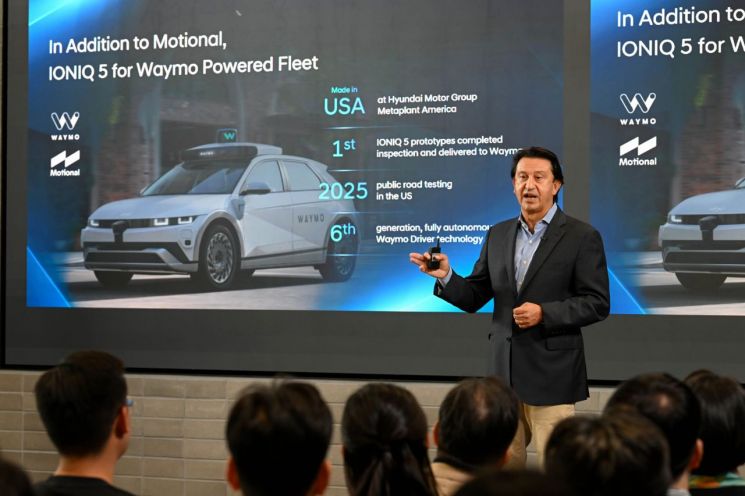
Since becoming CEO, Munoz has also shared his thoughts on Hyundai Motor Company's organizational culture and decision-making process. He said, "As the first foreigner to lead a major Korean conglomerate, I feel a responsibility not only to improve performance but also to respect the unique culture and values that have driven Hyundai Motor Company's growth, while strengthening our global competitiveness."
He particularly emphasized the balance between Hyundai Motor Company's characteristic rapid execution and strategic preparation. Munoz stated, "Speed is deeply embedded in Hyundai Motor Company's DNA, but the best decisions come when advance preparation and planning are combined." He explained that results are maximized when quick judgment and meticulous planning work together.
Regarding Hyundai Motor Company's consensus culture, he explained that it is not about unanimous agreement from all members, but rather about thoroughly gathering diverse opinions and, once a decision is made, having the entire organization fully commit to execution. He said, "Chairman Chung Euisun taught me that the loudest voice in the meeting room is not always right," adding, "Sometimes the quietest opinion contains the most important insight, and a culture that listens to such voices is making Hyundai Motor Company even stronger."
© The Asia Business Daily(www.asiae.co.kr). All rights reserved.
![Clutching a Stolen Dior Bag, Saying "I Hate Being Poor but Real"... The Grotesque Con of a "Human Knockoff" [Slate]](https://cwcontent.asiae.co.kr/asiaresize/183/2026021902243444107_1771435474.jpg)











