Operating Profit Plummets in Q3 Compared to Last Year
Struggles in Chinese Market... Market Share Drops from 39% to 29%
German media reported on December 15 (local time) that the German automotive industry has fallen into a slump, with operating profits dropping to their lowest level since the global financial crisis.
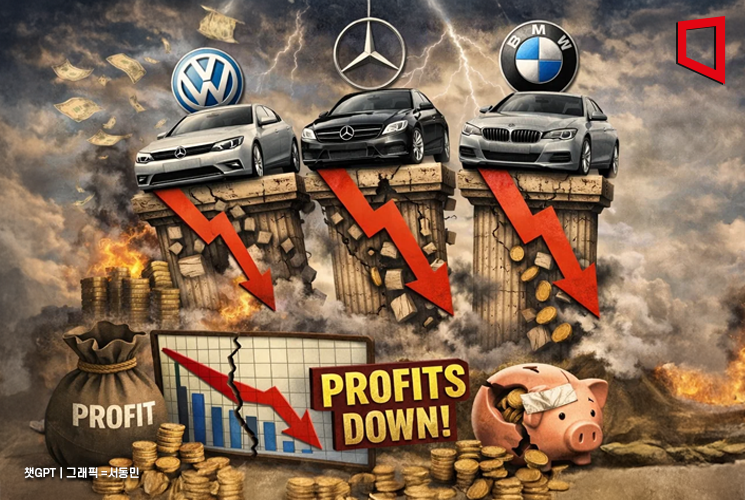
According to an analysis of financial data from 19 global automakers by consulting firm EY, the combined operating profit for the third quarter of this year for Germany’s three major automakers-Volkswagen, BMW, and Mercedes-Benz-was 1.7 billion euros (approximately 2.95 trillion won). This is the lowest level since the third quarter of 2009.
The operating profits of the three German companies plunged by 75.7% compared to the third quarter of last year. During the same period, Japanese automakers saw a 29.3% decline in operating profit, while American and Chinese automakers experienced decreases of 13.7% each, but these drops were relatively smaller than those of the German firms.
EY cited several reasons for the poor performance: weakened competitiveness in luxury lineups, U.S. tariff policies, unfavorable exchange rates, increased investment costs in electric vehicles, and restructuring expenses. Konstantin Gall, an automotive expert at EY, diagnosed that “all of these factors have created a ‘perfect storm’ for German automakers.”
The German automotive industry is especially struggling in China, the world’s largest market. The rapid growth of China’s automotive industry, combined with an economic slowdown, has led high-income Chinese consumers to turn away from German luxury cars.
The market share of German automobiles in China fell from 39.4% in the third quarter of 2020 to 28.9% in the third quarter of this year, marking the lowest level since 2012. Porsche, a luxury sports car brand under Volkswagen, reduced the number of its dealerships in China from 144 to 80.
As profitability deteriorates, German automakers are undertaking large-scale restructuring and are reinforcing their internal combustion engine vehicle lineups, thereby slowing the pace of their transition to electric vehicles. The German government is also asking the European Union to reconsider its plan to completely ban the sale of internal combustion engine vehicles within the bloc starting in 2035.
Gall said, “Expectations that electric vehicles would grow rapidly have hardly materialized, and at least in Western markets, sales are increasing only slightly.”
© The Asia Business Daily(www.asiae.co.kr). All rights reserved.
!["The Woman Who Threw Herself into the Water Clutching a Stolen Dior Bag"...A Grotesque Success Story That Shakes the Korean Psyche [Slate]](https://cwcontent.asiae.co.kr/asiaresize/183/2026021902243444107_1771435474.jpg)

















