Nonfarm Payrolls Increase by 64,000
Rebound After Sharp Decline of 105,000 in October; Unemployment Rate Rises to 4.6%
October Retail Sales Hold Steady at $732.6 Billion
After a sharp slowdown, the U.S. labor market showed some recovery last month, but the overall trend of deceleration continues, with the unemployment rate reaching its highest level in over four years. Amid job insecurity and the burden of high inflation, consumer spending, which had been expanding, has now stagnated, indicating that consumers are becoming more cautious about increasing their expenditures.
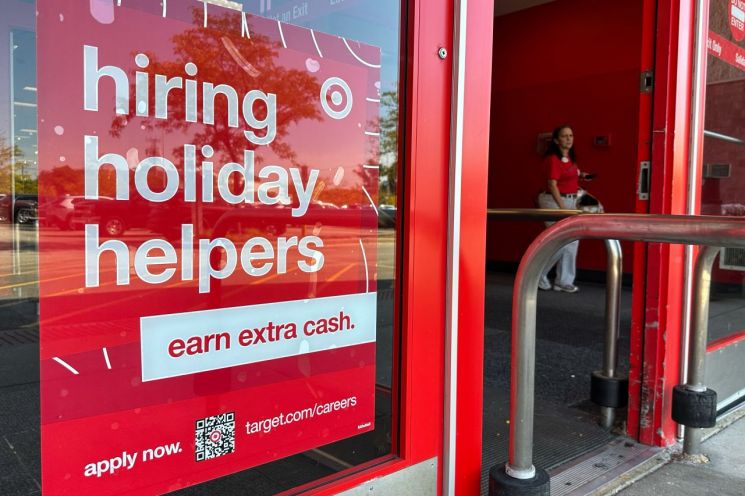 A job posting is displayed at a retail store in Arlington Heights, Illinois, USA. Photo by AP Yonhap News.
According to the U.S. Department of Labor’s Bureau of Labor Statistics (BLS) employment report for November, released on December 16 (local time), nonfarm payrolls increased by 64,000. This figure exceeds the market expectation of 45,000, as compiled by Dow Jones.
On the same day, it was also announced that nonfarm employment in October had decreased by 105,000. After a sharp drop from an increase of 108,000 in September, employment rebounded within a month. The sharp decline in October was largely due to workforce restructuring implemented by the Office of Government Efficiency earlier this year, with delayed retirements in the federal government being reflected in the statistics. In fact, government employment fell by 162,000 in October and declined by another 6,000 in November.
Despite job growth, the weakening of the labor market was clearly reflected in the unemployment rate. The unemployment rate in November was 4.6%, higher than both September’s 4.4% and the market forecast of 4.5%. This is the highest level since September 2021, during the COVID-19 pandemic, marking a four-year and two-month high. The broader unemployment rate, which includes those who have given up job searches or are working part-time for economic reasons, reached 8.7%, the highest since August 2021.
Wage growth also slowed. Average hourly earnings rose by 0.1% from the previous month and by 3.5% year-on-year, both lower than the increases in October (0.4% and 3.7%, respectively). In particular, the year-over-year wage growth rate fell to its lowest level since May 2021.
These employment indicators are consistent with the ongoing slowdown in the labor market. Previously released data from the Department of Labor’s Job Openings and Labor Turnover Survey (JOLTs) also supported this trend. In October, the number of hires was 5.149 million and the hiring rate was 3.2%, both down from September (5.367 million and 3.4%). In contrast, the number of layoffs increased to 1.854 million (layoff rate 1.2%) from 1.781 million (1.1%) in the previous month, reaching the highest level since early 2023. Analysts attribute this to companies being cautious about new hiring due to tariff policies and economic uncertainty.
Heather Long, Chief Economist at Navy Federal Credit Union, expressed concern, saying, "The U.S. economy has fallen into an employment recession," and noted, "Over the past six months, job growth has barely reached 100,000, and even this has been concentrated in the healthcare sector, which is always active due to an aging population."
With these clear signs of labor market weakness, the Federal Reserve cut its benchmark interest rate by 0.25 percentage points for the third consecutive time on December 10, bringing it to a range of 3.5% to 3.75%. This decision prioritized the risk of labor market slowdown over inflation. Fed Chair Jerome Powell stated at a press conference at the time, "There are significant downside risks to the labor market," and added, "The current economy is not in a phase where overheating in employment is fueling inflation."
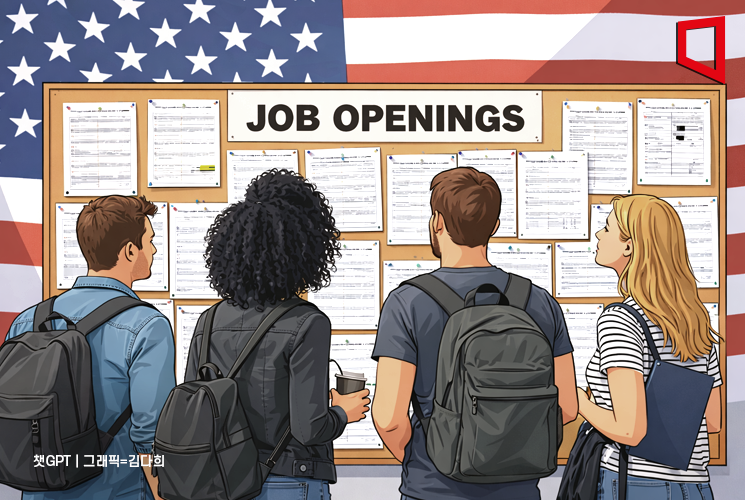
However, this employment report is not expected to be a decisive factor for the future path of monetary policy. Kevin O’Neill, Associate Portfolio Manager at Brandywine Global, commented, "This report provides enough signs of (economic) slowdown to justify previous rate cuts, but there is little evidence to support a much larger easing going forward." As a result, the December employment report, to be released in early January, is expected to be a more important indicator in determining the policy direction at the Federal Open Market Committee (FOMC) meeting scheduled for January 28.
Job insecurity is also affecting consumer sentiment, leading to stagnation in the consumer sector. According to the Census Bureau under the U.S. Department of Commerce, retail sales in October stood at $732.6 billion, unchanged from the previous month, falling short of Bloomberg’s forecast of a 0.1% increase. Weak sales of automobiles and gasoline were major factors. The combination of job insecurity, economic uncertainty, and the burden of high inflation has made consumers even more cautious about increasing their spending. The retail sales growth rate for September was also revised downward from 0.2% to 0.1%. However, some analysts note that since consumption has not contracted, it continues to play a buffering role for the economy.
© The Asia Business Daily(www.asiae.co.kr). All rights reserved.

![Clutching a Stolen Dior Bag, Saying "I Hate Being Poor but Real"... The Grotesque Con of a "Human Knockoff" [Slate]](https://cwcontent.asiae.co.kr/asiaresize/183/2026021902243444107_1771435474.jpg)















