The KOSPI index fell by more than 2% due to large-scale simultaneous net selling by foreign investors and institutions, breaking below the 4,000 mark at the close for the first time in 10 trading days. Amid ongoing concerns over an artificial intelligence (AI) bubble, heavy foreign selling led to a decline in the index.
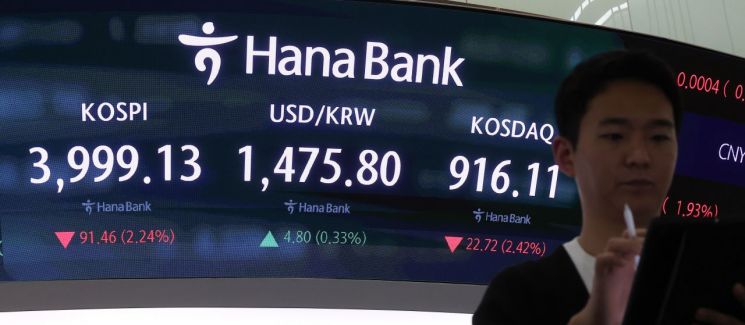
On December 16, the KOSPI closed at 3,999.13, down 91.46 points (2.24%) from the previous trading day.
On this day, the KOSPI opened at 4,093.32, up 0.07% from the previous session. Early in the session, it climbed to 4,099.01, attempting to reclaim the 4,100 level. However, as foreign investors and institutions began net selling from the start, the index quickly turned downward.
In the afternoon, intensified net selling further widened the KOSPI’s losses, ultimately pushing it below the 4,000 mark. This is the first time since December 2 that the KOSPI closed under 4,000.
By investor type, foreign investors and institutions recorded net sales of 1.1381 trillion won and 292.5 billion won, respectively. In contrast, individual investors made net purchases totaling 1.4398 trillion won.
Lim Jeongeun, a researcher at KB Securities, explained, "The trend reflecting AI-related anxiety following Broadcom’s earnings has continued, resulting in persistent foreign capital outflows. The combined net selling on the KOSPI on December 15 and 16 approached 2 trillion won, causing the index to fall below the 4,000 mark."
Most sectors declined. Metals plunged 6.82%. Construction, transportation equipment and parts, and electrical and electronics sectors all fell by more than 3%. In addition, medical and precision instruments also dropped. On the other hand, food, beverages, and tobacco rose by 1.76%.
Most of the major large-cap stocks also declined. Samsung Electronics dropped 2,000 won (1.91%) from the previous session to close at 102,800 won. LG Energy Solution plunged 5.54%, while SK Hynix and HD Hyundai Heavy Industries both fell by more than 4%. Hanwha Aerospace and SK Square also dropped by more than 3%. In contrast, Samsung Biologics rose by 1.02%.
On the KOSPI, 185 stocks rose, including five stocks such as Dongyang Express and TMC that hit the daily upper limit. Without any stocks hitting the daily lower limit, 716 stocks declined, while 27 stocks remained unchanged.
The KOSDAQ index closed at 916.11, down 22.72 points (2.42%) from the previous trading day.
By investor type, foreign investors and institutions recorded net sales of 410.6 billion won and 12.3 billion won, respectively. In contrast, individual investors made net purchases totaling 477.9 billion won.
By sector, finance plunged 6.37%. Non-metals and electrical and electronics fell by more than 4%. In addition, machinery and equipment, transportation equipment and parts, metals, chemicals, and other manufacturing sectors all dropped by more than 2%. Sectors that rose were limited to textiles and apparel, food, beverages and tobacco, and publishing and media reproduction.
Among the top market cap stocks, Alteogen fell 12,500 won (2.87%) from the previous session to close at 423,500 won. Ecopro plunged 8.08%, while Ecopro BM and Robotis fell by 7.90% and 6.87%, respectively. Kolon TissueGene, Rainbow Robotics, and LIG ChemBio also dropped by more than 3%. In contrast, D&D Pharmatech and Aimed Bio rose by 5.59% and 2.70%, respectively.
On the KOSDAQ, 317 stocks rose, including five stocks such as I-Gene and Nanoteam that hit the daily upper limit. Without any stocks hitting the daily lower limit, 1,381 stocks declined, while 52 stocks remained unchanged.
© The Asia Business Daily(www.asiae.co.kr). All rights reserved.