National Institute of Health Confirms Sharp Decline of Hormone in Elderly Muscles and Blood
Exercise Promotes Muscle Protein Synthesis in Experiments with Aged Mice
A domestic research team has discovered that 'Biglycan,' a muscle hormone secreted during exercise, is effective in improving sarcopenia and fatty liver caused by aging.
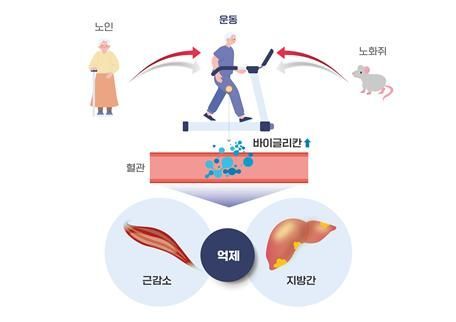 Schematic diagram of the muscle and liver damage improvement effects of Biglycan secreted through exercise. Korea Disease Control and Prevention Agency
The Korea Disease Control and Prevention Agency announced on the 16th that researchers from the Endocrine and Renal Disease Research Division at the National Institute of Health (Dasom Lee, Joohyun Lim, and Yujeong Lee) confirmed, through analysis of the National Center for Biotechnology Information (NCBI) transcriptome open dataset and plasma proteome, that the amount of Biglycan-a type of myokine-in the muscles and blood of elderly individuals is significantly reduced.
The research team initially focused on myokines, muscle hormones that decrease with aging, to investigate their effects on improving sarcopenia. Myokines are hormones produced in muscles during exercise and secreted into the bloodstream, playing a key role in enhancing muscle function, regulating inflammation and immunity within the body, and improving brain function.
In experiments using mice, aged mice showed lower levels of Biglycan in their blood and muscles compared to younger mice. However, after four months of exercise, the aged mice exhibited improved muscle function and increased levels of Biglycan in their muscles. The study also revealed that exercise-induced increases in Biglycan promote muscle protein synthesis, thereby alleviating muscle loss.
Notably, this study also identified that Biglycan secreted from muscles migrates to the liver, where it contributes to alleviating fatty liver associated with aging. The research findings were published online in the international medical journal 'International Journal of Molecular Sciences.'
The research team confirmed that Biglycan is a key factor in simultaneously alleviating age-related muscle loss and fatty liver, and expects that these results will serve as important scientific evidence for future anti-aging research and the development of strategies to prevent chronic diseases in the elderly.
According to a domestic meta-analysis, 13.1% of people aged 65 and older suffer from sarcopenia. Among those aged 70 to 84, 21.3% of men and 13.8% of women are affected by this condition.
Sarcopenia is not simply a phenomenon of aging, but a disease characterized by abnormal decreases in muscle mass, strength, and function with age. It is a risk factor that can lead to mobility impairment and geriatric chronic diseases, worsening prognosis and increasing the risk of death by more than three times.
Im Seungkwan, Commissioner of the Korea Disease Control and Prevention Agency, emphasized, "Preventing sarcopenia is essential for a healthy old age and improved quality of life," and added, "To maintain muscle health, older adults should continue personalized exercise and nutrition management even during the winter months."
© The Asia Business Daily(www.asiae.co.kr). All rights reserved.
![User Who Sold Erroneously Deposited Bitcoins to Repay Debt and Fund Entertainment... What Did the Supreme Court Decide in 2021? [Legal Issue Check]](https://cwcontent.asiae.co.kr/asiaresize/183/2026020910431234020_1770601391.png)
















