"Even as the Stablecoin Market Grows, the Essential Role of Card Companies Remains Valid"
"Capital Companies Must Lead Productive Finance by Redesigning Leasing and Installment Financing"
It is expected that new opportunities will open up in the stablecoin and rental·lease industry sectors for the credit finance industry next year.
Yoo Changwoo, Executive Director of Visa Korea, stated at the Credit Finance Forum held on the 15th at Bankers Hall in Jung-gu, Seoul, under the theme "2026 Credit Finance Industry Outlook and Directions for Rebound," that, "Although the institutionalization of stablecoins is accelerating overseas, the essential role that card companies have played will remain valid."
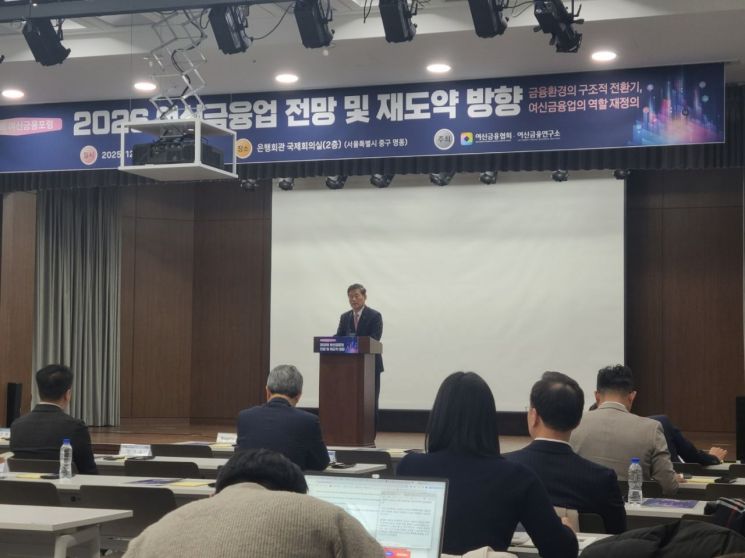 Jang Wankyu, Chairman of the Korea Credit Finance Association, is speaking as a presenter at the Credit Finance Forum held on the 15th at the Bankers Hall in Jung-gu, Seoul, under the theme "2026 Credit Finance Industry Outlook and Directions for Rebound." Photo by Choi Donghyun
According to Executive Director Yoo, the essence of the card business lies in providing payment services based on infrastructure such as payment·settlement systems and merchant networks. Even as the use of stablecoins becomes more widespread, linking with existing payment networks will remain important. Therefore, the ability to connect blockchain and payment networks will become a key factor in determining the competitiveness of card companies going forward.
Executive Director Yoo predicted that the domestic stablecoin market will evolve by combining the strengths of blockchain technology-such as cost, speed, and programmable money payments-with the universality and convenience of traditional card payments. He emphasized, "Securing initial partnerships is crucial when building various service models related to stablecoins," and added, "It will also be essential to internalize the capability to stably integrate and operate blockchain infrastructure with existing payment networks."
According to Visa's analysis, the global stablecoin payment volume this year is about 50 trillion dollars (approximately 7,356 trillion won). Of this, person-to-person transactions, excluding trading bots and smart contracts (blockchain-based automated contracts), amount to 10.3 trillion dollars. This represents roughly a 30-fold increase over the past five years.
Executive Director Yoo stated that the success or failure of the institutionalization of won-based stablecoins next year will depend on the legislative details. He noted, "If the law stipulates that issuers of won-based stablecoins must hold more than 90% of corresponding assets such as government bonds, the demand for won-based stablecoins will increase. Otherwise, dollar-based stablecoins will become the mainstream."
Seo Jiyong, Professor at Sangmyung University, who gave the second presentation, argued that capital companies should reinvent themselves as drivers of productive finance through the redesign of leasing and installment finance. As the new government emphasizes productive finance, he suggested that companies should actively leverage the current trend of regulatory easing, including relaxed limits on rental transactions, the allowance of mail-order sales, and the expansion of aftermarket services. Professor Seo said, "Capital companies should play a role in supporting eco-friendly and high-tech industries," and added, "There will be growth opportunities in the electric vehicle leasing and installment market."
For electric vehicles, the initial purchase cost is significantly higher compared to internal combustion engine vehicles, making the role of leasing and installment finance crucial. Professor Seo stated, "Capital companies should develop financial products dedicated to electric vehicles and advance battery residual value assessment models to manage risk," and continued, "They should also provide services linked to charging infrastructure to help expand the adoption of electric vehicles."
Regarding support for high-tech industries, Professor Seo said that capital companies should expand equipment leasing. He explained, "Future core industries such as semiconductors and biotechnology require expensive production equipment, but the initial capital burden is high. Capital companies should strengthen machinery and equipment leasing products and secure technology evaluation capabilities to support the growth of innovative companies."
Professor Seo also suggested that, for sustainable growth, capital companies must secure digital competitiveness by advancing alternative credit assessment based on artificial intelligence (AI) and big data, and by strengthening platform-based operations. He also mentioned the need to internalize ESG (environmental, social, and governance) management to secure long-term growth momentum.
Regarding the forum, Jang Wankyu, Chairman of the Korea Credit Finance Association, said, "This has been an opportunity to examine the challenges facing credit finance companies amid a rapidly changing domestic and international financial environment and to engage in in-depth discussions on business restructuring directions to secure future growth engines." He added, "Based on the issues discussed today, we will actively communicate with financial authorities, the National Assembly, and the industry to drive regulatory innovation and institutional support."
© The Asia Business Daily(www.asiae.co.kr). All rights reserved.












