In Response to U.S. Measures Against China’s Strategic Mineral Controls
Final Investment Decision to Be Made at Board Meeting on December 15
U.S. Department of Defense Participation Could Shift Dynamics in Management Rights Dispute
Korea Zinc is pursuing a plan to build a strategic minerals smelter in the southeastern United States, with an estimated investment of around 10 trillion won. The project is under discussion with the possibility of the U.S. government and local companies participating through direct investments totaling approximately 2 trillion won.
According to diplomatic and trade authorities on December 15, Korea Zinc is scheduled to hold a board meeting this morning to decide whether to invest in the U.S. smelter. If the investment proposal is approved, Korea Zinc will establish a joint venture with U.S. partners to construct and operate the local smelter. The total investment is expected to reach about 10 trillion won, with the joint venture raising funds locally through borrowing. The U.S. Department of Defense, Department of Commerce, and major defense industry companies are reportedly likely to participate by making equity investments of around 2 trillion won. This investment is known to have been actively pursued at the request of the U.S. side, in response to China’s tightening of strategic mineral export controls.
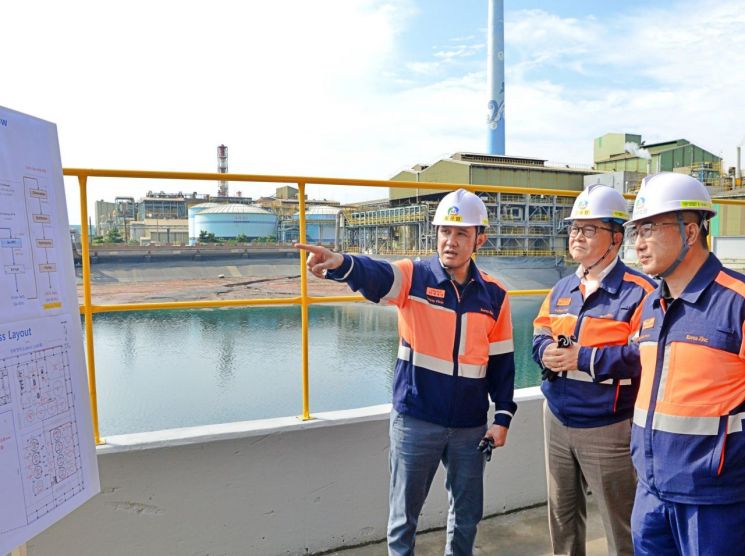 Yoonbeom Choi, Chairman of Korea Zinc, visited the Onsan Smelter in Ulsan last September to inspect the preparations for the establishment of a new germanium plant. Korea Zinc
The U.S. smelter is expected to serve as a hub for the local production and supply of key strategic minerals such as antimony and germanium, many of which Korea Zinc currently produces in Korea. Korea Zinc’s Onsan Smelter in Ulsan, with a site area of 430,000 pyeong (1.42 million square meters), is the world’s largest integrated smelter, producing 1.2 million tons of non-ferrous metals annually. It employs an integrated smelting process that combines hydrometallurgical and pyrometallurgical methods to simultaneously produce zinc and various strategic minerals. The U.S. smelter is also expected to adopt a scaled-down version of this integrated smelting model.
Korea Zinc’s management previously told The Asia Business Daily that they are considering implementing about two-thirds of the integrated smelting capacity of the Korean facility in the United States. At the time, the company explained that the U.S. is seeking the capability to simultaneously produce multiple strategic minerals, rather than just specific metals.
After reviewing more than 60 candidate sites with U.S. counterparts, a major city in the southeastern region has reportedly been tentatively selected as the location for the smelter. The area is considered suitable for smelter operations due to its reliable water and power supply. Korea Zinc has also recently briefed outside directors and government officials on this investment plan.
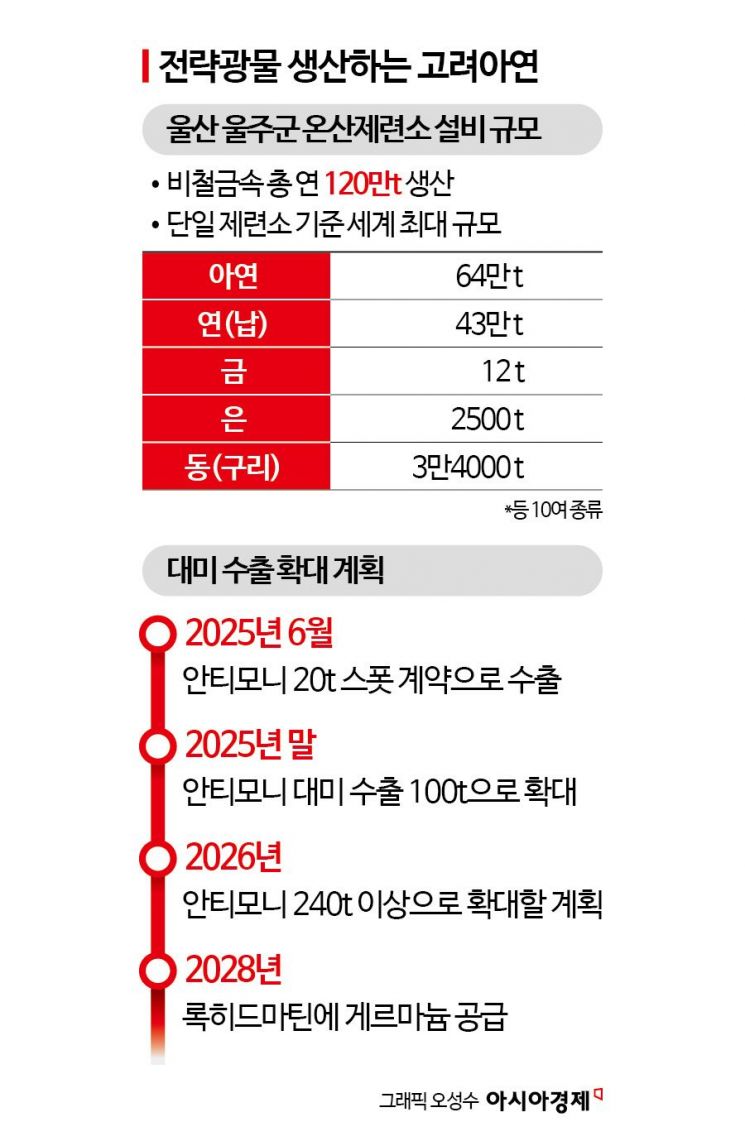
This investment is interpreted as the concrete realization of the “strategic minerals cooperation initiative with the United States” that Yoonbeom Choi, Chairman of Korea Zinc, mentioned during his visit to the U.S. as part of the economic delegation at the Korea-U.S. summit in August. At that time, Korea Zinc signed a memorandum of understanding (MOU) with Lockheed Martin, the largest U.S. defense contractor, for the supply and purchase of germanium and cooperation on critical mineral supply chains, and announced plans to establish new germanium production facilities in Korea.
Meanwhile, there is analysis that if the U.S. government participates as a direct investor in Korea Zinc’s U.S. smelter, it could affect the ongoing management rights dispute with Young Poong Group and MBK Partners. In particular, if the U.S. Department of Defense becomes a shareholder in a Korea Zinc-related entity, Korea Zinc would be seen not just as a private company but as a strategic asset within the U.S. economic and security supply chains.
As a result, this could become a complicating factor for future mergers and acquisitions (M&A) or changes in corporate governance involving Korea Zinc, and may also influence the decisions of the National Pension Service and minority shareholders during any management control contest.
© The Asia Business Daily(www.asiae.co.kr). All rights reserved.
![Clutching a Stolen Dior Bag, Saying "I Hate Being Poor but Real"... The Grotesque Con of a "Human Knockoff" [Slate]](https://cwcontent.asiae.co.kr/asiaresize/183/2026021902243444107_1771435474.jpg)












