Gwangju Youth Associations and Labor Night Schools of the 1920s and 1930s
Records of Anti-Japanese Organizations on Display from December 15
An exhibition focusing on Heunghakgwan, a building used by youth and social enlightenment organizations in Gwangju during the Japanese colonial period, is being held. Titled "Encountering the Gwangju Spirit: Heunghakgwan Exhibition," it will run from December 15, 2025, to January 31, 2026, at the Heunghakgwan Gallery Cafe on Munhwajeondang-ro in Dong-gu, Gwangju.
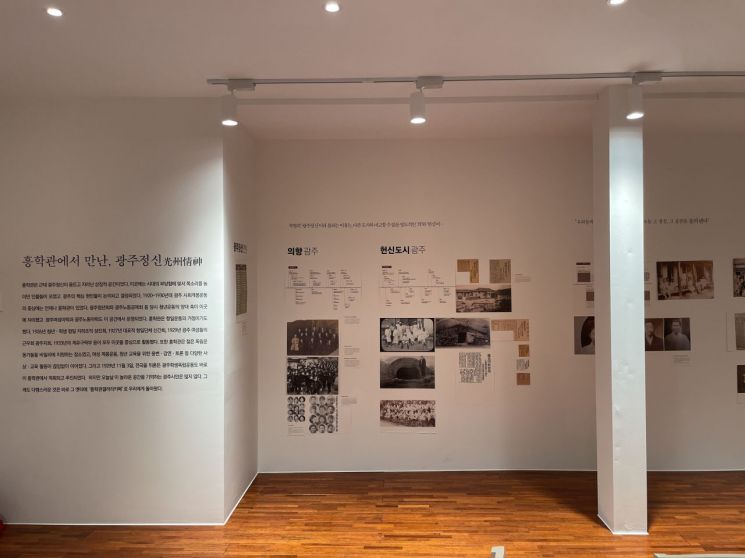 Exhibition space overview of "Gwangju Spirit," introducing the history and materials of Heunghakgwan.
Heunghakgwan served as a base for the Gwangju Youth Association and the Gwangju Labor Mutual Aid Association in the 1920s and 1930s. The Gwangju Women's Night School and the Gwangju Labor Night School also operated there. The early beginnings of Gwangju Jeil High School (formerly the private Gwangju Higher Common School), established in 1920, took place at Heunghakgwan.
Organizations related to the anti-Japanese movement were also active in this space. These included Seongjinhoe (1926), the Gwangju branch of Singanhoe (1927), the Gwangju branch of Geunwoohoe (1929), and Gyeyu Club (1933). Preparations for the 1929 Gwangju Student Independence Movement are also known to have taken place at Heunghakgwan.
The exhibition is being held at the former address of Heunghakgwan (8, Munhwajeondang-ro 35beon-gil, Dong-gu, Gwangju). The original building no longer exists, and this is the first exhibition at the Heunghakgwan Gallery Cafe, which has been established on the site.
Yang Sunghyun, the artist who curated the exhibition, explained, "This exhibition sheds light on the history of Heunghakgwan, which was the birthplace of the modern Gwangju spirit, the people who were active there, and Gwangju's unique historical culture." He added, "It is organized around records and materials related to Heunghakgwan."
Lee Hyeongcheol, the director of Heunghakgwan Gallery Cafe, stated, "We are opening our first exhibition at the very spot where Heunghakgwan stood 105 years ago," and expressed hope that "this exhibition will become a place where citizens can gather and share stories."
© The Asia Business Daily(www.asiae.co.kr). All rights reserved.












