Joint Roundtable on Political Reform with the Democratic Party of Korea
The four progressive parties aligned with the ruling bloc-the Innovation Party, Progressive Party, Social Democratic Party, and Basic Income Party-have called on the Democratic Party of Korea to fulfill its political reform commitments and to expand the share of non-negotiating blocs on the National Assembly's Special Committee on Political Reform.
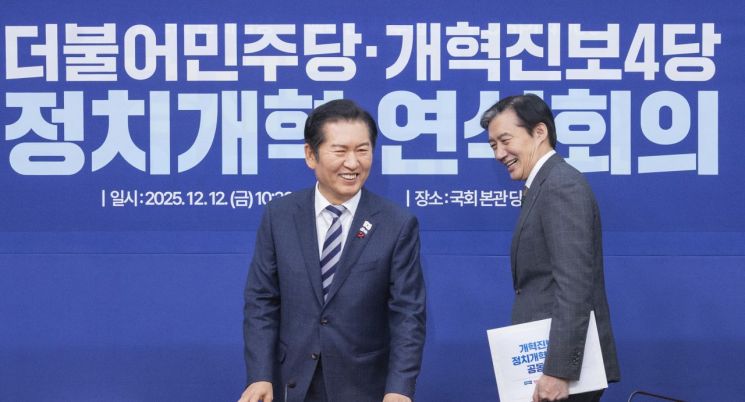 Jeong Cheongrae, leader of the Democratic Party of Korea (left), and Cho Guk, leader of the Innovation Party, are entering the joint political reform meeting of the Democratic Party of Korea and the four reform-progressive parties held at the National Assembly on the 12th. Photo by Yonhap News
On the morning of December 12, representatives from the four ruling bloc and progressive parties visited the office of the Democratic Party leader at the National Assembly and held a meeting with Jeong Cheongrae, leader of the Democratic Party of Korea, to discuss political reform proposals, including the easing of requirements for forming negotiation blocs.
Cho Guk, leader of the Innovation Party, told Jeong, "The more vehement the opposition from the remnants of the rebellion camped outside the National Assembly, the more essential this is for our people and for politics. It is undoubtedly the foundation for the success of the Lee Jaemyung administration and the reestablishment of a democratic government."
He continued, "I believe that victory is only possible by moving forward together with the Innovation Party and other progressive reform parties," adding, "Please make it a top priority to discuss and realize the roundtable agreement signed by the five reform parties, including the Democratic Party, and civil society in the Special Committee on Political Reform."
Jeong responded, "We have long joined hands to defend the Constitution and democracy, and historically, we are comrades working together for judicial justice and the protection of democratic constitutional values. While our five parties will compete fiercely to elect our own candidates in next year’s local elections, we remain allies in the pursuit of political reform."
He also said, "To end the filibuster by the People Power Party that is currently blocking the passage of livelihood bills, we must unite once again, as we always have. As the leader of the ruling party, I will work to build consensus on political reform and will actively participate in discussions within the Special Committee on Political Reform."
The four ruling bloc and progressive parties, together with the Democratic Party, agreed in a joint declaration at the roundtable in April this year to: ▲ease requirements for forming negotiation blocs, ▲introduce a runoff voting system, and ▲establish a special committee to investigate unconstitutional acts. This agreement was drafted under the leadership of then Democratic Party leader Lee Jaemyung and floor leader Park Chan-dae. However, since the Democratic Party's leadership changed to Jeong Cheongrae and floor leader Kim Byungki, discussions have stalled.
The four ruling bloc and progressive parties plan to maintain pressure through the launch ceremony of the Social Reform Committee and a policy forum on reform tasks scheduled for December 15.
The previous day, the four parties also visited National Assembly Speaker Woo Wonshik to urge an increase in the share of non-negotiating blocs on the Special Committee on Political Reform. According to the Innovation Party, Speaker Woo stated, "It is necessary to ease the requirements for forming negotiation blocs in the National Assembly," and expressed hope that active discussions would be held based on a standard of 15 members, which is 5% of the Assembly's total membership.
On December 10, the floor leadership of the Democratic Party and the People Power Party agreed to form the Special Committee on Political Reform with nine members from the Democratic Party, eight from the People Power Party, and one from the non-negotiating blocs. In response, the four ruling bloc and progressive parties stated, "While the agreement itself is welcome, it is difficult to accept that the two major parties have unilaterally limited the number of non-negotiating bloc members to just one."
© The Asia Business Daily(www.asiae.co.kr). All rights reserved.

















