In November, foreign investors became net sellers in the domestic stock market for the first time in six months, offloading more than 13 trillion won. In contrast, they returned to net buying in the bond market after just one month.
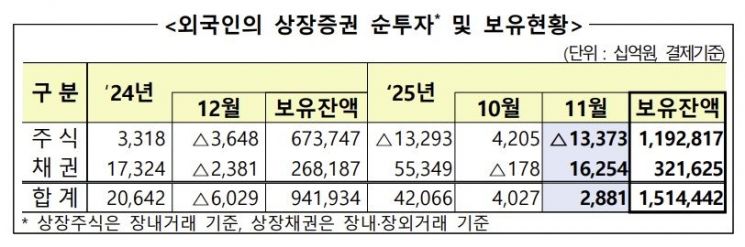
According to the “Trends in Foreign Securities Investment for November” released by the Financial Supervisory Service on December 12, foreign investors sold a net 13.373 trillion won of listed stocks last month on a settlement basis. They were net sellers of 13.491 trillion won on the KOSPI, but net buyers of 118 billion won on the KOSDAQ.
By region, Europe recorded the largest net selling at 5.7 trillion won, followed by the Americas at 3.6 trillion won and Asia at 2.7 trillion won. By country, the United Kingdom and the United States were net sellers of 4.5 trillion won and 4.1 trillion won, respectively. In contrast, Canada and Ireland were net buyers of 500 billion won and 400 billion won, respectively.
As of last month, the United States held the largest amount of domestic stocks at 489 trillion won, accounting for 41% of the total. Europe followed with 375.3 trillion won (31.5%), and Asia with 164.8 trillion won (13.8%).

In the bond market, foreign investors bought a net 17.622 trillion won and redeemed 1.368 trillion won upon maturity, resulting in a total net investment of 16.254 trillion won.
By region, Europe led with a net investment of 9.6 trillion won, followed by Asia (4.5 trillion won) and the Americas (1.7 trillion won).
By type, net investments amounted to 13.6 trillion won in government bonds and 2.9 trillion won in monetary stabilization bonds.
By remaining maturity, 3.7 trillion won was invested in bonds with a maturity of five years or more, 6.7 trillion won in bonds with a maturity of one to five years, and 5.9 trillion won in bonds with a maturity of less than one year.
As of last month, foreign investors held 69.1 trillion won in bonds with less than one year remaining to maturity, 110.5 trillion won in bonds with one to five years remaining, and 142 trillion won in bonds with five years or more remaining.
© The Asia Business Daily(www.asiae.co.kr). All rights reserved.

![Clutching a Stolen Dior Bag, Saying "I Hate Being Poor but Real"... The Grotesque Con of a "Human Knockoff" [Slate]](https://cwcontent.asiae.co.kr/asiaresize/183/2026021902243444107_1771435474.jpg)
















