Fed Cuts Rates by 0.25% for Third Consecutive Time
Powell: "Downside Risks in Labor Market... Tariff-Driven Inflation Is Transitory"
Remarks More Dovish Than Expected; New York Stock Indices Rebound
"We are in a good position to observe how the economy unfolds."
On December 10 (local time), Jerome Powell, Chairman of the United States Federal Reserve (Fed), signaled a cautious monetary policy stance after cutting the benchmark interest rate by 0.25 percentage points. The market had initially expected a "hawkish cut"-a rate cut suggesting a temporary pause in the easing cycle-but Powell's remarks were interpreted as more dovish than anticipated. As a result, expectations grew that next year's rate cuts could exceed the Fed's projection of just one, prompting a broad rebound in major New York stock indexes.
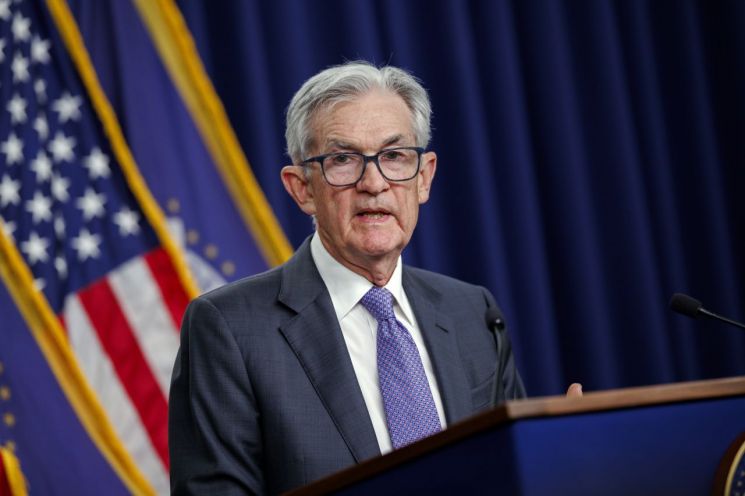
At a press conference held immediately after the Federal Open Market Committee (FOMC) regular meeting, Powell stated that the Fed would "need to wait and see" before taking further action, adding, "A significant amount of data will be released before the January meeting, and this will be an important factor in our decision-making."
On this day, the Fed lowered the federal funds rate by 0.25 percentage points to a range of 3.5% to 3.75% per year, marking the third consecutive cut following those in September and October. As expected, three out of the twelve voting FOMC members dissented, highlighting internal disagreements over the direction of monetary policy. This is the first time since June 2019 that three members have voted against the decision, reflecting a sharp division among committee members over policy priorities amid simultaneous signs of slowing employment growth and persistent inflation.
Powell explained that the current benchmark rate is estimated to be at a "neutral" level, meaning it neither stimulates nor restrains the economy. He also stated, "At this point, rate hikes are not part of anyone's baseline scenario," firmly ruling out the possibility of further tightening.
Regarding recent economic conditions, Powell assessed that there are greater downside risks in the labor market. On inflation, he said, "Excluding tariff factors, the inflation rate is in the low 2% range," and predicted, "After the impact of tariffs on prices peaks in the first quarter of 2026, it will weaken in the second half of the year." He emphasized that tariff-driven inflation is a one-off factor.
This aligns with the Fed's statement that cited slowing employment as the reason for the latest rate cut. In its policy decision statement, the Fed noted, "Since the beginning of this year, job growth has slowed and the unemployment rate has risen slightly through September," adding, "Recent data also support this trend." On inflation, the Fed diagnosed, "It has increased compared to the beginning of the year and remains somewhat elevated."
The market broadly interpreted Powell's press conference remarks as dovish.
Regarding the outlook for future rates, FOMC members projected one additional cut each in 2026 and 2027. According to the dot plot released that day, the median forecast for the federal funds rate at the end of 2026 is 3.4%, and for 2027, it is 3.1%, unchanged from the September forecast. This suggests that, amid a close split between advocates for further cuts and those favoring a pause, the pace of monetary easing could slow from next year.
However, the market focused on the fact that the Fed's statement, economic outlook, and Powell's press conference were more moderate than expected, further raising hopes for rate cuts next year. In its Summary of Economic Projections (SEP), the Fed raised its 2026 growth forecast from 1.8% to 2.3%, projected a year-end unemployment rate of 4.4%, and forecast a core PCE inflation rate of 2.5%. Notably, the Fed expects next year's inflation to be lower than the end of this year (3.0%), fueling market expectations for greater room to cut rates in the future.
Additionally, after deciding in October to end quantitative tightening (QT) starting in December, the Fed confirmed plans to resume short-term Treasury purchases. It will begin by purchasing $40 billion in short-term Treasuries and maintain a high level of purchases for several months before gradually reducing the scale.
Wall Street is expecting more than two rate cuts next year, which is higher than the Fed's projection of one. According to CME FedWatch, as of now, the interest rate futures market is pricing in a 70.6% probability that rates will be at least 0.5 percentage points lower by the end of 2026, up from 6.13% the previous day.
Some analysts even predict that there could be as many as four rate cuts next year. Anna Wong, an economist at Bloomberg Economics (BE), said, "We assess the overall tone of the statement and the revised economic outlook as dovish, given that the Fed raised its growth forecast, lowered its inflation outlook, and signaled Treasury purchases." She added, "Job growth is slowing, and there are few signs of inflation rising in the first half of the year. While the dot plot only indicates a single 0.25 percentage point cut in 2026, we expect the Fed to implement four cuts next year."
All three major New York stock indexes rose on this day. After fluctuating in early trading, the main indexes rebounded following the FOMC meeting: the Dow Jones Industrial Average closed up 1.05% from the previous session, while the S&P 500 and Nasdaq indexes rose 0.67% and 0.33%, respectively. At one point during the session, the S&P 500 even set a new all-time intraday high.
© The Asia Business Daily(www.asiae.co.kr). All rights reserved.

















