Co-hosted by the Korean Chamber of Commerce and Industry and Seoul National University
Carbon Neutrality and Energy Policy Seminar
Keynote Speech by Minister Kim
"We will lower renewable energy prices
to levels comparable to nuclear power in t
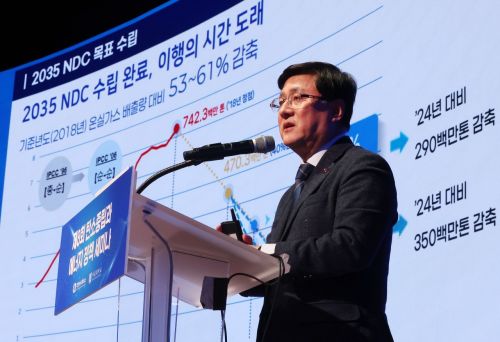 Kim Sung-hwan, Minister of Climate, Energy and Environment, is delivering the keynote speech at the Carbon Neutrality and Energy Policy Seminar held at the Korean Chamber of Commerce and Industry in Jung-gu, Seoul on December 10, 2025. Photo by Yonhap News
The government is set to announce a plan requiring all public enterprises to achieve RE100. The aim is to foster domestic industries by mandating the use of locally produced components and equipment. The government is also considering offering tax credits for solar power produced domestically.
On December 10, Kim Sung-hwan, Minister of Climate, Energy and Environment, delivered the keynote speech at the 8th Carbon Neutrality and Energy Policy Seminar, co-hosted by the Korean Chamber of Commerce and Industry and Seoul National University. He stated, "We will soon announce a policy requiring all public enterprises in Korea to achieve RE100," adding, "Public institutions will be required to use domestically produced products."
RE100 is a global campaign that calls for companies to source all of their electricity from renewable energy. There have been concerns in Korea about the high dependence on Chinese products in the supply chain for renewables such as solar and wind power. In response, the government aims to support the domestic renewable energy industry by having public institutions achieve RE100 using locally made equipment first.
Minister Kim emphasized the need to transition to renewable energy, stating, "We spend 180 trillion won annually on importing fossil fuels. If we can switch to renewable energy, this money will circulate within our country instead of flowing overseas."
To this end, Minister Kim presented three fundamental principles: electrifying everything, drastically lowering the price of renewable energy, and fostering green industries.
In particular, Minister Kim said, "By 2030, we will reduce the generation cost of solar power to 80 won per kilowatt-hour (kWh), onshore wind to 150 won, and offshore wind to 250 won. From 2035, we will lower prices to levels comparable to nuclear power so that people will no longer have to worry about electricity bills rising due to renewable energy."
The supply of renewable energy will be expanded from 34 GW at the end of 2024 to 100 GW by 2030. Specifically, the targets are set at 87 GW for solar power, 6 GW for onshore wind, 3 GW for offshore wind, and 4 GW for other sources. Minister Kim stated that the government is considering tax credit support for domestically produced solar power.
Minister Kim also said, "If we utilize the Baekdudaegan mountain range, there is significant potential for onshore wind power," and added, "With the completion of SK Innovation's offshore wind power project in Jeonnam scheduled for December 11, we plan to significantly expand offshore wind power."
Regarding electric power equipment, he noted, "Korea is strong in this field, but we are relatively weak in high-voltage direct current (HVDC) transmission." He continued, "The government will place orders in this sector so that companies such as LS Electric, Hyosung Heavy Industries, HD Hyundai Electric, and Iljin Electric can leverage their achievements in Korea to expand overseas."
Minister Kim stated, "To move toward a decarbonized society by reducing coal and liquefied natural gas (LNG) power generation, the only viable policy option for Korea is to use a mix of renewables and nuclear power." He added, "We will soon finalize plans for the two new nuclear power plants outlined in the 11th Basic Plan for Electricity Supply and Demand."
The Ministry of Climate, Energy and Environment also announced plans to make Gapado the nation's first carbon-zero island by 2027 and to transform the entire Jeju Island into a 'decarbonized green civilization island' that uses no fossil fuels by 2035.
Minister Kim further stated, "We will support the demonstration and commercialization of POSCO's hydrogen-based steelmaking so that hydrogen reduction steel plants can be exported, and we will apply carbon capture, utilization, and storage (CCUS) technology to the cement industry."
In the transportation sector, the government aims to achieve a 40% adoption rate of electric and hydrogen vehicles for new cars by 2030 and increase this to 70% by 2035. Minister Kim said, "We will strengthen support for the development of key parts for electric vehicles, tax reductions, and the reuse and recycling of used batteries to foster the industrial ecosystem."
For the decarbonization of building thermal energy, the government will supply solar and heat pump packages to around 500 villages by 2030. In 2026, heat pumps will be provided to 2,550 existing single-family homes equipped with solar panels.
© The Asia Business Daily(www.asiae.co.kr). All rights reserved.

















