Plans to Expand Transportation Capacity with Additional Alternatives
Increased Bus Services During Commuting Hours, Subway Operations Maintained at Weekday Levels
Strike Announced for Line 9... "100% Operation Possible"
In response to the strike announcements by the Seoul Metro labor union and the railway union (KORAIL), the Seoul Metropolitan Government will activate the Emergency Transportation Countermeasures Headquarters starting December 11, and will strengthen alternative transportation options such as city buses and subways.
On December 10, the Seoul Metropolitan Government announced that, with the Emergency Transportation Countermeasures Headquarters at the center, it will establish a 24-hour emergency communication system and implement phased responses in cooperation with Seoul Metro, KORAIL, the bus industry, and local districts, comprehensively considering the strike and overall transportation situation.
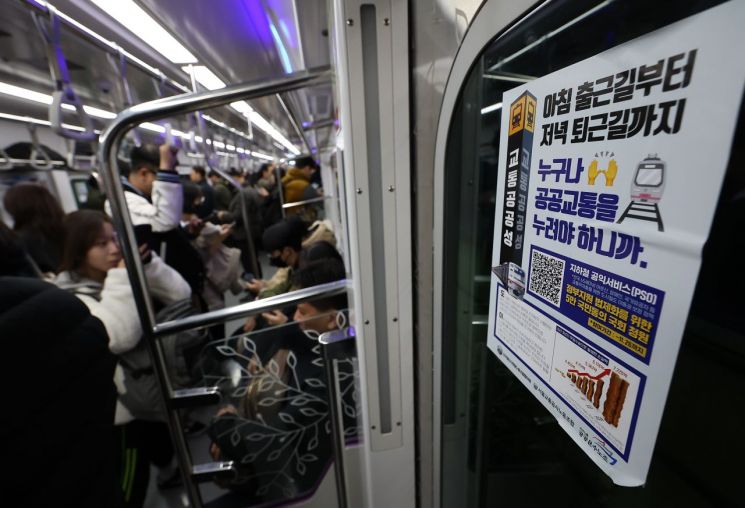 The labor union of Seoul Metro, which operates subway lines 1 through 8 in Seoul, has begun "law-abiding operation." On a train where law-abiding operation is being carried out, there is a public transportation poster put up by the National Railway and Subway Labor Union Council. Photo by Yonhap News Agency
First, the city will increase transportation capacity by deploying additional alternative means such as city buses. For city buses, the peak commuting time slots on 344 regular routes will be extended by one hour compared to usual. The city expects this to result in approximately 2,538 additional trips during commuting hours. To further support commuter movement, the operating hours of the Squirrel Bus and Companion Bus services will also be extended by one hour, focusing on providing alternative transportation options.
For the subway, from the first day of the Seoul Metro union strike on December 12, the city will maintain operations as close to normal as possible. During the morning rush hour (07:00-09:00), all lines from Line 1 to Line 8 will operate at 100% of normal capacity. During the evening rush hour (18:00-20:00), Lines 2 and 5 through 8 will also operate at 100% of normal capacity, with the overall operation rate maintained at about 88%.
Line 9 will operate normally as usual. Although the union for stages 2 and 3 of Line 9 has announced a strike for December 11, the city has secured the minimum personnel required for normal operations, ensuring 100% operation at all times, just as under normal circumstances.
If the railway union and the Seoul Metro union strike simultaneously, the city will also deploy additional vehicles to secure transportation capacity. The simultaneous strike is expected to begin on December 12, the start date of the Seoul Metro union strike.
For city buses, all reserve and shortened-route buses that are currently not in operation will be deployed across 161 routes, resulting in a total of 1,422 additional trips compared to usual. For the subway, five emergency trains will be on standby for Lines 2, 3, and 4 during the evening rush hour and will be immediately deployed as needed to alleviate train and station congestion.
The Seoul Metropolitan Government expects that even if both the railway union and the Seoul Metro union strike simultaneously, the operation rate will remain above 90% during the morning rush hour and above 80% during the evening rush hour. If additional emergency trains are deployed, the evening rush hour operation rate is expected to increase further.
Since the subway is designated as an essential public service, the Seoul Metropolitan Government plans to ensure not only the maintenance of operation rates but also thorough subway safety management, including the deployment of personnel for congestion and safety control. To this end, the city has secured about 13,000 personnel, which is about 80% of the normal workforce, including non-striking employees and partner company staff, to maintain subway transportation functions. Additionally, 124 Seoul city employees will be deployed to 31 major congested stations to support station operations and focus on on-site safety management.
Furthermore, the city states that even if the strike continues for more than eight days, the operation rate will be maintained at above 90% during the morning rush hour and above 80% during the evening rush hour. Jang Kwon Yeo, Director of the Seoul Metropolitan Government's Transportation Bureau, said, "We are making every effort to mobilize all available transportation resources from before the strike in order to minimize inconvenience for subway users. We hope that labor and management will reach an agreement as soon as possible with citizens as the top priority, and we will do our utmost to normalize subway operations."
© The Asia Business Daily(www.asiae.co.kr). All rights reserved.
![Clutching a Stolen Dior Bag, Saying "I Hate Being Poor but Real"... The Grotesque Con of a "Human Knockoff" [Slate]](https://cwcontent.asiae.co.kr/asiaresize/183/2026021902243444107_1771435474.jpg)
















