29,046,000 Employed in November
Marked Increase Driven by Service Sector
Employment Rate for Ages 15+ Rises 0.2 Percentage Points
Youth Employment Rate at 44.3%... Down 1.2 Percentage Points
Accommodation and Food Services Decline as Consumpti
Last month, the number of employed people increased by more than 200,000, bringing the employment rate to a record high of 63.4%. While the overall employment situation is not bad, the gap between positive and negative aspects is becoming more pronounced. The youth employment rate has declined for 19 consecutive months, and the number of young people not engaged in any activity has started to rise again after seven months. As the effect of the livelihood recovery consumption coupons has faded, the number of people employed in the accommodation and food service sector has started to decline, while sluggishness continues in the manufacturing and construction sectors.
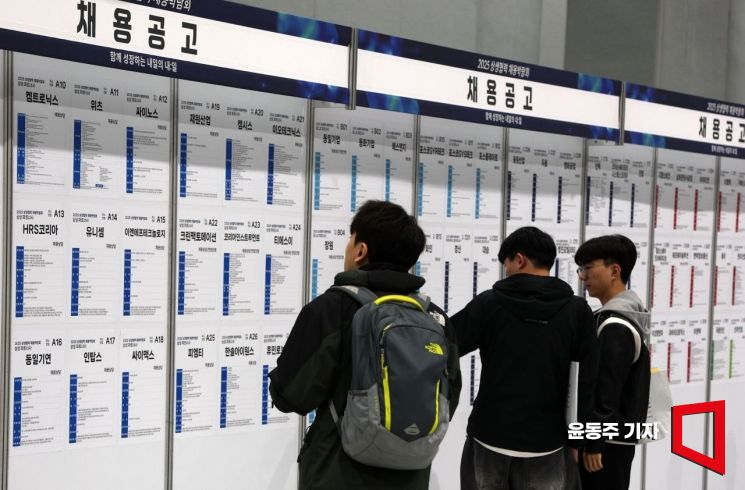 On the 21st, job seekers attending the '2025 Win-Win Cooperation Job Fair' held at COEX Magok in Gangseo-gu, Seoul, are checking the job postings. 2025.10.21 Photo by Dongju Yoon
According to the "Employment Trends for November 2025" released by the National Data Office on December 10, the number of employed people last month stood at 29,046,000, an increase of 225,000 compared to the same month last year. Except for May (245,000) and September (312,000), the monthly increase in employment this year had remained in the 100,000 range, but last month it jumped to the 200,000 range, showing a relatively strong growth trend.
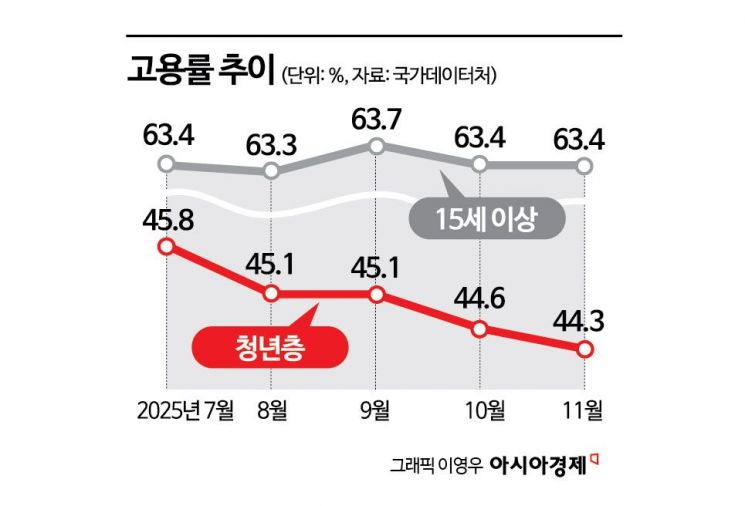
The employment rate also continued to rise. The employment rate for those aged 15 and older was 63.4%, up 0.2 percentage points, reaching an all-time high. The employment rate for those aged 15 to 64, the standard used by the Organisation for Economic Co-operation and Development (OECD), also hit a record high of 70.2%, up 0.3 percentage points. The labor force participation rate was 64.8%, up 0.2 percentage points. The unemployment rate (2.2%) remained at the same level as the previous year.
This result is due to the improvement in domestic demand and the increase in employment mainly in the service sector. The health and social welfare services sector, which has shown a marked increase recently, added 281,000 jobs (up 9.3%), while business facilities management, business support, and rental services, as well as arts, sports, and leisure-related services, increased by 63,000 (up 4.6%) and 61,000 (up 11.7%), respectively. In addition, the transportation and warehousing sector grew by 41,000 (up 2.4%).
Although overall employment is favorable, difficulties persist for the youth (aged 15 to 29). The number of employed people aged 60 and over increased by 333,000, those in their 30s by 76,000, and those in their 50s by 2,000, while the youth group saw a decrease of 177,000. Specifically, those in their 20s alone decreased by 192,000. Unlike the employment rates for those in their 40s (80.7%) and those aged 60 and over (47.9%), which are rising, the youth employment rate fell by 1.2 percentage points to 44.3%. This marks the 19th consecutive month of decline for the youth employment rate.
The decline in employment in agriculture, forestry, and fisheries (-132,000), construction (-131,000), and manufacturing (-41,000) also continued. In particular, construction has seen a decrease for 19 consecutive months, and manufacturing for 17 consecutive months. However, the decrease in manufacturing has somewhat slowed, thanks to improved domestic demand, strong exports of semiconductors, and improved corporate sentiment following tariff negotiation agreements. Meanwhile, due to the fading effect of consumption coupons, the number of people employed in accommodation and food services, which had been increasing since July (-71,000), turned to a decrease, dropping by 22,000, mainly in the restaurant sector.
An official from the Ministry of Economy and Finance stated, "The proportion of youth employed in the accommodation and food service sector is about 16 to 17%," and added, "The decline in accommodation and food service jobs is partly linked to the sluggish youth employment." The official also explained, "Overall, the employment conditions for young people remain difficult," and cited the dual labor market structure, the increase in ad-hoc hiring of experienced workers by companies, and the sluggish performance in construction and manufacturing as independent factors contributing to this situation.
The economically inactive population decreased by 10,000 (0.1%) to 16,142,000. Among them, the number of people who are neither working nor seeking work, classified as "resting," increased by 124,000 (5.1%) to 2,543,000. For the youth, this group increased by 7,000 (1.8%) to 416,000, marking the first rise in seven months. For those in their 30s (314,000), the number increased by 6,000 (2.0%), reaching the largest scale ever recorded for November.
The government plans to strengthen the virtuous cycle of growth and employment through domestic demand stimulation, a major transition to artificial intelligence (AI), and the realization of a super-innovative economy. In addition, it will prepare next year's economic growth strategy to expand future growth engines and fundamentally enhance job creation capacity. Tailored support to address youth employment difficulties will also be reinforced. The government will closely analyze trends and causes of youth inactivity by type and devise customized support measures.
An official from the Ministry of Economy and Finance pointed out, "There is significant heterogeneity even within the 'resting' group," and added, "It is necessary to conduct a detailed analysis of the types and causes of inactivity, and accordingly, it is important to review customized response measures." The official further stated, "We are currently reviewing response measures for the 'resting' group in cooperation with relevant ministries," and added, "The basic policy direction will be announced through the economic growth strategy."
© The Asia Business Daily(www.asiae.co.kr). All rights reserved.
![Clutching a Stolen Dior Bag, Saying "I Hate Being Poor but Real"... The Grotesque Con of a "Human Knockoff" [Slate]](https://cwcontent.asiae.co.kr/asiaresize/183/2026021902243444107_1771435474.jpg)

















