"You Cannot Access Case Records Unless It Is Your Own Case"
There has been analysis suggesting that the person who provided information to the media outlet that first reported on actor Jo Jinwoong's juvenile delinquency record may have been one of the members of the "Iljin group" who received protective measures alongside Jo Jinwoong. Given the legal restrictions on accessing juvenile court records, it is highly likely that the information was leaked by an insider.
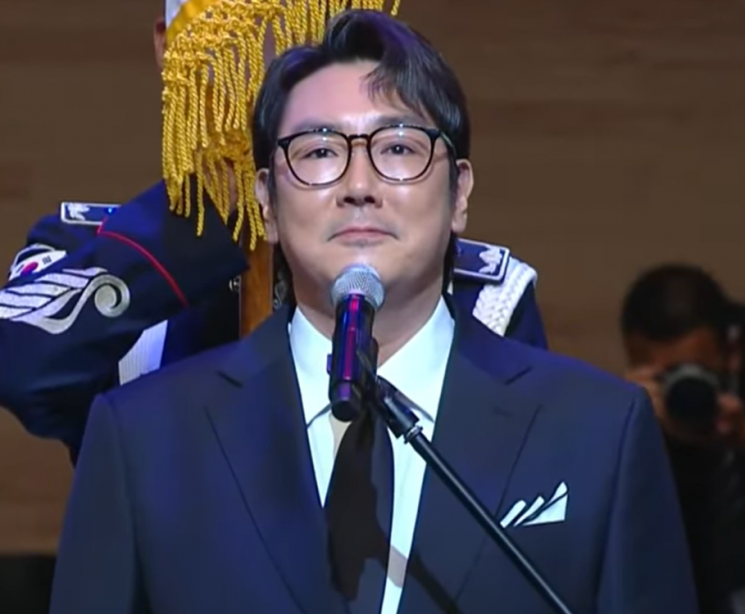 Actor Jo Jinwoong delivering a speech at the 80th Anniversary Liberation Day Celebration held last August. MBC
Attorney Song Jeongbin of Geonwoo Law Firm stated on News1TV's "Fact & View" on the 9th, "If it is not your own case, it is impossible to access the case records," adding, "There is a possibility that one of the perpetrators who received protective measures under the Juvenile Act together with Jo Jinwoong may have provided the tip."
On December 5, the online media outlet Dispatch reported that Jo Jinwoong received juvenile protective measures in 1994, when he was a second-year high school student, in connection with charges of robbery, rape, and vehicle theft. However, controversy has arisen regarding how Dispatch obtained this information. Article 70 of the Juvenile Act stipulates that all information related to juvenile court records and verdicts is considered official secret information.
Regarding the possibility that a court official provided verdicts or related information, Attorney Song commented, "It is difficult to believe that someone would comply just because they were asked to provide such information, but it cannot be ruled out entirely," and added, "It also raises the question of whether the media outlet that first reported the story really needed to go to such lengths to obtain the information."
He continued, "If there was a leak of such documents or materials, it is only natural that the institution responsible for the leak should be punished," and pointed out, "If a journalist requested the information, then that would constitute abetting a violation of Article 70 of the Juvenile Act, and the journalist could be subject to punishment."
Regarding whether this report aligns with the public's 'right to know,' he stated, "The right to know is a means to help realize national sovereignty and fundamental rights, but in terms of the public's right to know about a crime committed by an actor 30 years ago, it is questionable whether this truly applies," and added, "However, even if the court determines that it does not fall under the right to know, it would be difficult to use this as grounds to claim damages or seek criminal punishment against the media outlet."
© The Asia Business Daily(www.asiae.co.kr). All rights reserved.

















