December 10: Seoul Metropolitan Office of Education Proposes "Future-Oriented College Admissions System"
Essay-Type and Written-Response Assessments to Be Introduced in CSAT for 2033 Admissions
"CSAT to Be Gradually Abolished... Transition Needed to
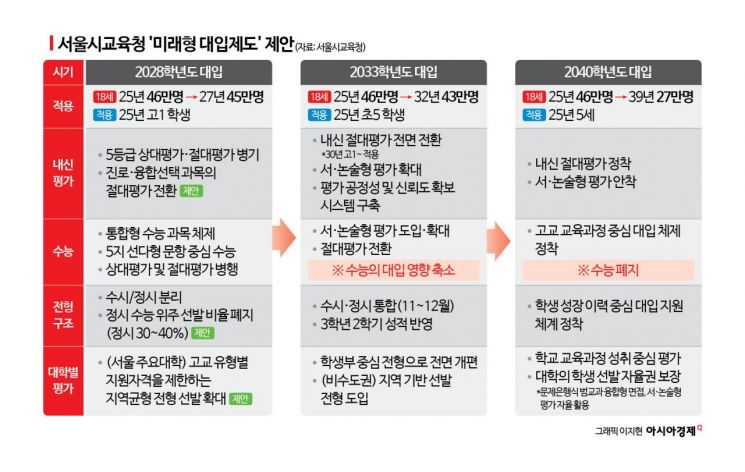
Starting with the 2028 college admissions cycle, which will affect current first-year high school students (born in 2009), universities in the Seoul metropolitan area will be required to lower their regular admissions quota from the current 30-40 percent, thereby reducing reliance on the College Scholastic Ability Test (CSAT). For the 2033 admissions cycle, which will affect current fifth-grade elementary students (born in 2014), essay-based and written-response assessments will be introduced into the CSAT, and both the CSAT and school records will shift to absolute grading. Ultimately, for the 2040 admissions cycle, which will apply to children currently aged five (born in 2021), the CSAT will be abolished entirely.
On the morning of December 10, Seoul Metropolitan Office of Education Superintendent Chung Geunsik held a press conference at the Seodaemun District Office of Education, where he proposed a "future-oriented college admissions system" containing these changes. He explained that the current CSAT-centered admissions system cannot resolve issues such as the normalization of public education and the excessive cost of private tutoring. He further emphasized that, given the sharp decline in the school-age population, the need to foster talent for the era of artificial intelligence (AI), and the implementation of the high school credit system, reforming the college admissions process is inevitable.
Superintendent Chung stated, "The crisis of a digital transformation era and the looming demographic cliff caused by a drastic drop in the school-age population demand a new educational paradigm that goes beyond traditional selection methods." He added, "We must create a learning environment where children can experience 'cooperation' instead of 'competition,' and focus on their own 'growth' rather than comparisons with others."
The main elements of the Seoul Metropolitan Office of Education's proposed admissions reform include: ▲restructuring the school records evaluation system, ▲reforming the CSAT, ▲improving admissions procedures, and ▲implementing high school education reforms. In particular, to ensure the stable operation of the high school credit system introduced this year, a three-stage overhaul is deemed necessary, beginning with the 2028 admissions cycle for current first-year high school students, followed by the 2033 and 2040 cycles.
According to the plan, the school records evaluation for "career and interdisciplinary elective subjects" will be immediately converted to absolute grading starting with the 2028 admissions cycle. The rationale is that the high school credit system, which was designed based on absolute grading, can only function as intended if the current practice of combining relative and absolute grading is abolished without delay.
The recommendation for the regular admissions quota at universities in the Seoul metropolitan area will also be abolished. Previously, the Ministry of Education had recommended that the 16 major universities in Seoul allocate at least 40 percent of their admissions to regular selection starting in 2022, following controversy over alleged admissions favoritism involving the children of former Justice Minister Cho Kuk. Eliminating this recommendation means the influence of the CSAT in college admissions will be reduced.
Additionally, in the early admissions process, the "regional balanced selection" system-which restricts eligibility for applicants from autonomous private high schools, foreign language high schools, international high schools, science high schools, and gifted schools-will be expanded to further diminish the influence of these specialized schools. The aim is to alleviate the hierarchy among high schools. The proposal also calls for amending the Enforcement Decree of the Elementary and Secondary Education Act to provide a legal basis for converting autonomous private, foreign language, and international high schools into general high schools.
Superintendent Chung remarked, "The increase in regular admissions has led not only to high school students dropping out to prepare for the CSAT, but also to university students dropping out, thereby increasing the burden of private tutoring due to the rise in repeat test takers." He continued, "It is now time for high school education to focus on student growth and competency development through an admissions system that aligns with the high school curriculum and allows students to pursue paths suited to their aptitudes."
 On the 13th, the day of the 2026 College Scholastic Ability Test, a mother is encouraging her examinee child at Yongsan High School in Seoul. 2025.11.13 Photo by Kang Jinhyung
The comprehensive overhaul of the admissions system will begin with the 2033 cycle, targeting current fifth-grade elementary students. From this point, both school records and the CSAT will be graded on an absolute scale, and essay-based and written-response assessments will be introduced and expanded.
The current nine-level relative grading system for the CSAT (excluding English, Korean History, and second foreign languages) will be replaced with a five-level absolute grading system. The admissions process will be completely restructured to focus on school records, with the CSAT serving only as a supplementary factor.
Essay-based and written-response assessments will be implemented in both school records and the CSAT. For school records, the proportion of such assessments in written exams for each subject will increase from 30 percent in the 2027 cycle to 40 percent in 2028, and to 50 percent in 2029. After the 2030 cycle, when current fifth graders enter high school, this proportion will be expanded to over 50 percent. The intention is to shift to competency-based assessments that can measure the multifaceted abilities required by the times. The Seoul Metropolitan Office of Education is developing an AI-based automatic grading model in preparation for this transition.
Essay-based and written-response assessments will also be introduced in the CSAT. In addition to multiple-choice questions for assessing basic academic achievement, questions requiring students to demonstrate thinking skills, inquiry processes, and problem-solving abilities will be included. The proportion of such questions will increase from 30 percent in the 2033 cycle to 40 percent in 2035, and exceed 50 percent in 2037.
Furthermore, the current dual-track system of early and regular admissions will be unified into a single process, with the admissions schedule set after the completion of the regular curriculum in the second semester of the third year of high school. This is intended to reduce the phenomenon of empty classrooms among third-year students. In connection with the national policy of "creating 10 universities equivalent to Seoul National University," the proposal also suggests introducing regional selection systems for national universities outside the Seoul metropolitan area, so that students with the competencies sought by these universities can be prioritized for admission.
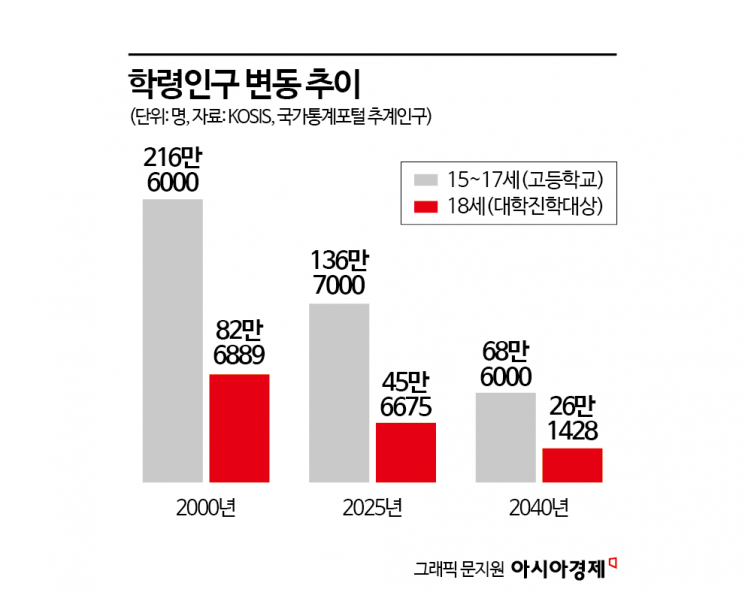
Through these stages, the ultimate goal is to completely abolish the CSAT from the college admissions process. This is scheduled for the 2040 admissions cycle, when the high school-age population (ages 15-17) is expected to drop to half its current size. Children currently aged five will be affected by this change.
Superintendent Chung stated, "In the 2040 admissions cycle, the high school-age population will have plummeted to about half of its current level. At that point, the differentiation function of college admissions for the purpose of selection will no longer be meaningful."
At that time, the CSAT will be abolished, and a college admissions support system centered on students' growth records will be established, based on the successful implementation of the high school credit and achievement evaluation systems. Universities will be able to use cross-disciplinary, problem-bank-style interviews or essay-based and written-response assessments as supplementary materials in the admissions process, and will have autonomy in deciding whether and how to utilize them.
Superintendent Chung strongly urged the National Education Commission, the Ministry of Education, universities, and civil society to build a broad-based governance system to ensure that this proposal does not remain just a single opinion. He also appealed to all stakeholders to work together so that college admissions become not the final stage of education for nurturing future talent, but a new starting point that opens the path to growth.

© The Asia Business Daily(www.asiae.co.kr). All rights reserved.
![Clutching a Stolen Dior Bag, Saying "I Hate Being Poor but Real"... The Grotesque Con of a "Human Knockoff" [Slate]](https://cwcontent.asiae.co.kr/asiaresize/183/2026021902243444107_1771435474.jpg)


















