Effects of Expansionary Fiscal and Accommodative Monetary Policies
South Korea's Inflation Rate Projected at 2.1% for Both This Year and Next
The Asian Development Bank (ADB) has revised its economic growth forecast for South Korea this year to 0.9%, an increase of 0.1 percentage point from its September projection. The ADB attributed this adjustment to factors such as increased consumer spending driven by stimulus measures, expanding global demand for semiconductors, and reduced uncertainty following the conclusion of tariff negotiations.
In its "Asian Economic Outlook December 2025" released on December 10, the ADB projected South Korea’s growth rate at 0.9% for this year and 1.7% for 2026. Both figures are up by 0.1 percentage point compared to the September forecast.
Previously, the ADB had forecast South Korea's economic growth rate for this year at 1.5% in April, then sharply downgraded it by 0.7 percentage point to 0.8% in July, and maintained the 0.8% forecast in September. The recent slight upward revision is attributed to the effects of the government’s expansionary fiscal policy, accommodative monetary policy, and the robust global semiconductor market.
However, the ADB also noted that downside risks remain, including a sluggish real estate market, a slowdown in global trade, and renewed geopolitical tensions.
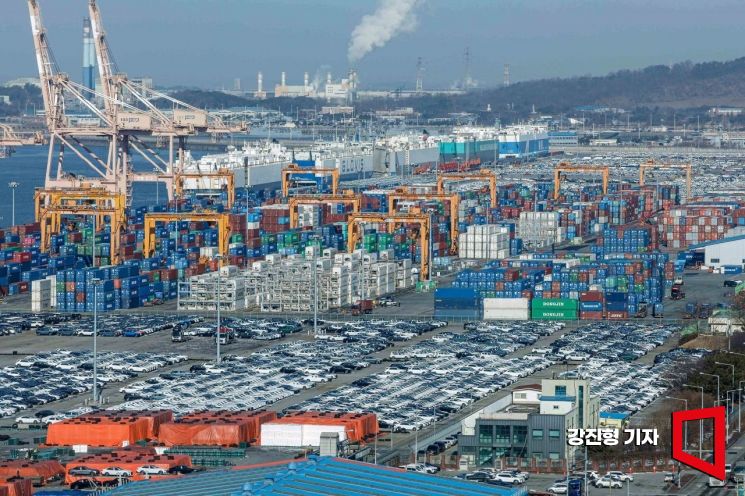 President Donald Trump signed a proclamation imposing a 25% tariff without exceptions on steel and aluminum products imported into the United States, and announced that tariffs on automobiles and semiconductors are also under consideration. On February 13, 2025, export vehicles were waiting to be loaded at Pyeongtaek Port in Gyeonggi Province. Photo by Kang Jinhyung
Inflation forecasts for South Korea have also been revised. The ADB now projects inflation rates of 2.1% for both this year and next year, which is 0.2 percentage point higher than the September forecast. This year’s inflation reflects rising food prices and international oil prices, while next year, the reduction of fuel tax subsidies and the weakening of the Korean won are expected to exert upward pressure on prices.
In contrast to South Korea, the growth outlook for the Asia-Pacific region has been revised upward more significantly. The ADB now projects the region’s growth rate at 5.1% for this year, up 0.3 percentage point from the September forecast. Notably, India recorded higher-than-expected growth due to strong domestic demand, and continued export growth among high-income, technology-driven exporters contributed to the overall upward revision.
The growth forecast for next year was also raised by 0.1 percentage point to 4.6%. However, the ADB pointed out that high tariffs imposed by the United States and the global economic slowdown remain constraints on growth.
On the other hand, inflation forecasts have been slightly lowered. The ADB now expects the Asia-Pacific region’s inflation rate to be 1.6% for this year, down 0.1 percentage point from the September forecast, mainly due to lower-than-expected food price inflation in India. The inflation forecast for next year remains unchanged at 2.1%.
This year’s and next year’s growth forecasts for major Asian countries are as follows: Vietnam at 7.4% and 6.4%, Taiwan at 7.3% and 4.0%, India at 7.2% and 6.5%, Indonesia at 5.0% and 5.1%, China at 4.8% and 4.3%, and Malaysia at 4.5% and 4.3%, all of which are higher than South Korea’s projections. Japan is forecast to grow by 1.1% this year and 0.6% next year.
The ADB stated, "While the easing of trade uncertainty following the conclusion of trade agreements has been reflected, there is a possibility that economic growth will slow due to weakened global economic activity caused by high tariff barriers."
© The Asia Business Daily(www.asiae.co.kr). All rights reserved.

















