Oral Wegovy Nears FDA Approval in the U.S.
Oral Mounjaro Also Set for Commercial Launch Next Year
The key trend in next year's global obesity treatment market, which has grown to 35 trillion won in 2024, is expected to be "oral obesity medications." Until now, the obesity treatment market has been dominated by injectable products such as Wegovy and Mounjaro. However, with the emergence of oral formulations offering greater convenience and price competitiveness, industry experts predict that the market structure will undergo another significant shift. Domestic companies are also accelerating their efforts to capture market share.
According to industry sources on December 9, Caregen recently signed supply contracts worth a total of 46 billion won for its GLP-1 (glucagon-like peptide-1) based weight loss solution "Coglutaide" in the Middle East and Southeast Asia. Coglutaide is a dual-action oral peptide that simultaneously stimulates GLP-1 and IGF1R (insulin-like growth factor 1 receptor). Unlike existing injectable GLP-1 products, it can be taken in the form of a health supplement, setting it apart from competitors.
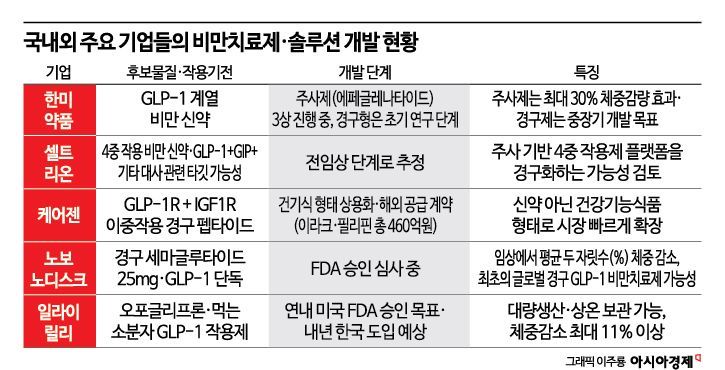
In the development of injectable new drugs, Hanmi Pharmaceutical is considered to be in the lead. Hanmi is conducting Phase 3 clinical trials for its long-acting GLP-1 injection "Efeglenatide," which has reportedly demonstrated up to 30% weight loss in interim topline results. The company is expediting the approval process with the goal of launching the product in Korea in the second half of next year. Celltrion has announced plans to develop a "quadruple-action obesity treatment" that simultaneously stimulates four receptors. This drug is also an oral obesity medication.
Globally, the market leaders are Novo Nordisk with Wegovy and Eli Lilly with Mounjaro. Earlier this year, Novo Nordisk applied to the U.S. Food and Drug Administration (FDA) for approval of a 25mg oral semaglutide for obesity and weight management indications. If approved, this would become the world's first oral GLP-1 obesity treatment. Phase 3 studies have reportedly demonstrated average double-digit percentage weight loss after more than one year of administration.
Eli Lilly is pursuing the market with "Oglufron," an oral GLP-1 receptor agonist known as the "oral Mounjaro." Taken once daily, this medication showed weight loss of over 11% after approximately 70 weeks of administration in Phase 2 and 3 clinical trials, demonstrating efficacy comparable to injectables. Eli Lilly plans to apply for FDA approval within this year, aiming for a U.S. launch next year. The company has already completed production of several billion doses. The domestic industry cautiously predicts that, considering the approval and reimbursement process, the product could be launched in Korea as early as the second half of 2026 or around 2027 at the latest.
The policy and regulatory environment is also moving in a direction that supports the spread of "oral obesity medications." Earlier this month, the World Health Organization (WHO) officially recognized GLP-1 as an obesity treatment and mentioned its inclusion in national public healthcare systems. The growing recognition among health authorities that obesity should be managed as a chronic disease, not merely a cosmetic issue, is providing momentum for these changes. In Korea, the eligible age for GLP-1 obesity medications has been expanded to include adolescents aged 12 and older. However, as the government continues to introduce measures to manage side effects and misuse, striking a balance between "improving accessibility" and "ensuring safety" remains a challenge.
The industry expects that, starting next year, the center of gravity in the obesity treatment market will partially shift from "specialist-prescribed injectables" to "primary care and pharmacy-based long-term oral use." An industry official stated, "As oral obesity treatments become more mainstream, there will be opportunities for the development of generics and combination drugs. At the same time, concerns about side effects, such as the abuse of appetite suppressants and misuse among adolescents, are growing. Therefore, attention must be paid to how insurance, prescription criteria, and monitoring systems are designed."
© The Asia Business Daily(www.asiae.co.kr). All rights reserved.

















