KDCA Releases Results of This Year's Community Health Survey
Monthly Alcohol Consumption Rate Drops by 1.2 Percentage Points from Last Year
One in Three Adults Obese Despite Increase in Weight Management Attempts
This year, while the smoking rate for conventional cigarettes decreased, the overall tobacco use rate remained largely unchanged due to an increase in e-cigarette use. Despite a significant rise in the proportion of people attempting weight control, the obesity rate actually increased compared to the previous year.

On December 8, the Korea Disease Control and Prevention Agency (KDCA) released the results of the "2025 Community Health Survey," based on health data collected from residents by 258 public health centers nationwide. The survey, conducted from May to July, analyzed smoking, alcohol consumption, obesity, mental health, and chronic disease management among 231,615 adults aged 19 and older across the country.
This year, the conventional cigarette smoking rate was 17.9%, down 1.0 percentage point from last year, but the e-cigarette usage rate increased by 0.6 percentage points to 9.3%. As a result, the overall tobacco product usage rate, including both conventional and e-cigarettes, decreased by only 0.5 percentage points to 22.1%. The agency explained that this reflects a shift between tobacco products rather than a significant increase in smoking cessation.
By region, North Chungcheong Province recorded the highest rate at 24.7%, followed by Gangwon and South Chungcheong Provinces at 23.8% each. In contrast, Sejong had the lowest rate at 17.3%, while Seoul and North Jeolla Province also showed relatively low rates at 19.7% each.
The agency stated, "To manage risk factors for chronic diseases, more detailed education and preventive management regarding e-cigarettes appear to be necessary."
The alcohol consumption rate showed a slight decline compared to last year. The monthly drinking rate-defined as drinking at least once a month in the past year-was 57.1%, down 1.2 percentage points from the previous year. The high-risk drinking rate also decreased by 0.6 percentage points to 12.0%. High-risk drinking is defined as consuming seven or more drinks (or five cans of beer) per session for men, and five or more drinks (or three cans of beer) per session for women, at least twice a week.
However, the agency pointed out that the overall drinking rate remains higher than before the COVID-19 pandemic. In 2020, the monthly drinking rate was 43.7% and the high-risk drinking rate was 10.9%, but these were temporary decreases due to reduced social activities during the pandemic. Since then, as daily life returned to normal, drinking rates increased again, although there has been a slight easing this year.
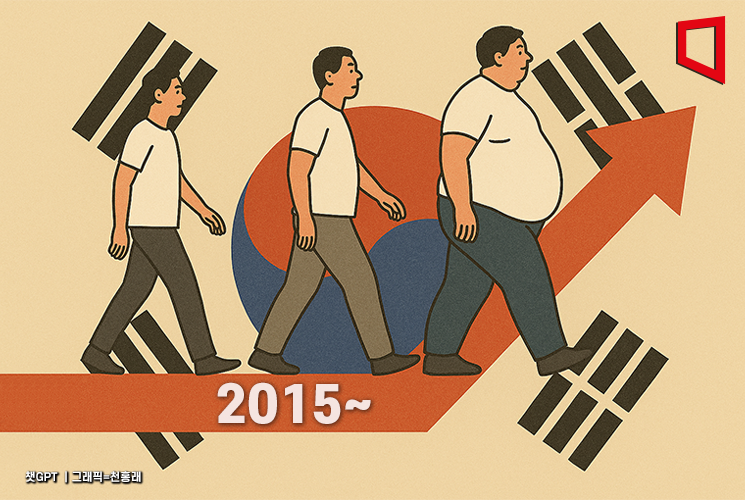
The obesity rate has continued to rise. This year, the obesity rate-defined as a body mass index (BMI) of 25 or higher-was 35.4%, up 1.0 percentage point from the previous year. The annual rate of attempts to lose or maintain weight over the past year increased by 3.5 percentage points to 68.5%. This means that nearly seven out of ten adults have tried to control their weight, but these efforts have not been sufficient to curb the rise in obesity.
Ulsan (38.2%) and South Jeolla Province (38.0%) had the highest obesity rates, while Sejong (29.4%) and Daejeon (29.8%) had the lowest.
The rate of practicing walking-defined as walking for at least 10 minutes at a time, at least 30 minutes a day, and at least five days a week-was 49.2%, and the rate of engaging in moderate or higher intensity physical activity was 26.0%. Both rates declined slightly from the previous year, by 0.5 and 0.6 percentage points, respectively.
The rates of being diagnosed with hypertension and diabetes both increased. The rate of people who had ever been diagnosed with hypertension rose by 0.1 percentage point to 21.2%, and the rate for diabetes increased by 0.2 percentage points to 9.6%.
Indicators for chronic disease management generally improved.
The rate of ever being diagnosed with hypertension was 21.2%, up 0.1 percentage point, and for diabetes, 9.6%, up 0.2 percentage points. However, the rates of receiving treatment after being diagnosed with hypertension and diabetes remained high at 93.5% and 93.2%, respectively.
Awareness of the importance of early detection and prompt treatment for myocardial infarction and stroke is rising. The rate of recognizing early symptoms of myocardial infarction increased by 1.8 percentage points to 51.5%, and for stroke, by 1.5 percentage points to 60.7%. However, while awareness of early stroke symptoms has now surpassed 60%, awareness for myocardial infarction remains in the low 50% range, indicating the need for further education and public awareness campaigns, according to the agency.
In terms of mental health indicators, the rate of experiencing depressive feelings fell by 0.3 percentage points to 5.9%, while the rate of perceived stress increased by 0.2 percentage points to 23.9%. The agency stated, "The rate of experiencing depressive feelings showed an upward trend until 2022, but has recently begun to decline, while the perceived stress rate has fluctuated but overall has improved."
Other findings include a breakfast consumption rate of 47.3%, which has continued to decline over the past 10 years, and a handwashing rate after going out of 92.2%. The rear seat seatbelt usage rate remained low at 29.5%.
The results of this year's Community Health Survey will be released on the Community Health Statistics website.
© The Asia Business Daily(www.asiae.co.kr). All rights reserved.
![From Bar Hostess to Organ Seller to High Society... The Grotesque Con of a "Human Counterfeit" [Slate]](https://cwcontent.asiae.co.kr/asiaresize/183/2026021902243444107_1771435474.jpg)

















