Last month, the number of job openings per job seeker was recorded at 0.43, marking the lowest figure since November 1998 during the International Monetary Fund (IMF) foreign exchange crisis. This decline is attributed to a reduction in manufacturing jobs.
According to the "November Labor Market Trends Based on Employment Administration Statistics" released by the Ministry of Employment and Labor on December 8, the job openings-to-applicants ratio last month was 0.43, down by 0.03 from 0.46 in November of the previous year. This is the lowest November figure since 1998, when it was 0.17.
The job openings-to-applicants ratio is calculated by dividing the number of job openings by the number of job seekers. Last month, the number of new job openings at companies decreased by 8,000 (-4.6%) compared to November of last year, while the number of new job seekers increased by 12,000 (3.3%) to 370,000. As a result, the ratio declined.
Cheon Kyunggi, Director of Future Employment Analysis at the Ministry of Employment and Labor, explained, "While demand for hiring in industries such as manufacturing, construction, and wholesale and retail trade is shrinking, the number of people seeking jobs is increasing."
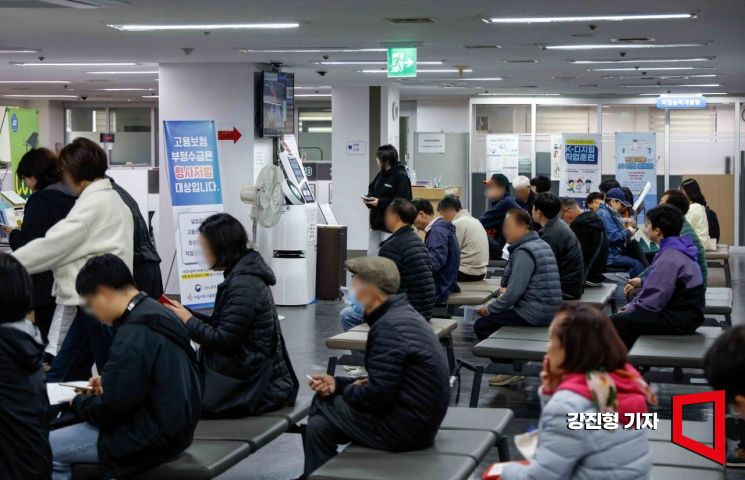 On October 13th, the number of employed people increased by 83,000 compared to the same month last year, dropping below 100,000 for the first time in four months. A Seoul employment center was crowded with unemployment benefit applicants. Photo by Kang Jinhyung
As of the end of last month, the number of regular employment insurance subscribers stood at 15,654,000, an increase of 178,000 (1.1%) compared to the same month last year. This is the smallest increase in regular employment insurance subscribers for November since November 2003, when the increase was 61,000.
By industry, the number of manufacturing subscribers fell by 16,000, marking a decline for the sixth consecutive month. The construction industry also saw a decrease of 16,000 subscribers, continuing a downward trend for 28 consecutive months, although the rate of decline is easing. The number of service industry subscribers increased by 208,000 year-on-year to 10,912,000.
By age group, the number of subscribers aged 29 and under decreased by 92,000, marking a decline for 39 consecutive months since September 2022. The number of subscribers in their 40s also decreased by 21,000, with notable declines in construction (-13,000), manufacturing (-8,000), and wholesale and retail trade (-5,000). In contrast, the number of subscribers aged 60 and over increased by 171,000 compared to the same month last year. The number of subscribers in their 50s (up by 42,000) and 30s (up by 78,000) also increased.
Last month, the amount of job-seeking (unemployment) benefits paid out was 792 billion won, a decrease of 6% (50.6 billion won). The number of new applicants and recipients of job-seeking benefits also declined. However, the cumulative amount paid from January to November this year reached a record high of 11.4715 trillion won. Since the cumulative total exceeded 11 trillion won by November, it is projected that, including this month, the annual payout will set a new all-time record.
© The Asia Business Daily(www.asiae.co.kr). All rights reserved.
![Clutching a Stolen Dior Bag, Saying "I Hate Being Poor but Real"... The Grotesque Con of a "Human Knockoff" [Slate]](https://cwcontent.asiae.co.kr/asiaresize/183/2026021902243444107_1771435474.jpg)











