President Lee Attends Local Era Committee Briefing
"Need to Find Growth Engines Through the Five Core Regions and Three Special Autonomous Provinces"
"Various Methods, Including Incentives Based on Distance from the Seoul Metropolitan Area, Are Needed"
"Should Also Study the Possibility of Multiple City and Provincial Government Office Locations"
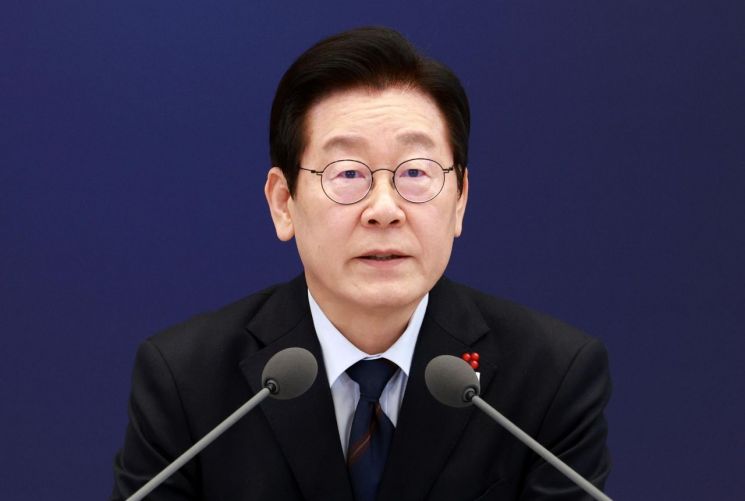 President Lee Jae-myung is speaking at the Local Era Committee briefing held at the Yongsan Presidential Office Building on the 8th. Photo by Yonhap News
On December 8, President Lee Jaemyung emphasized, "It is time for South Korea to newly secure its growth engine by establishing a multipolar system centered on the 'Five Core Regions and Three Special Autonomous Provinces'." The 'Five Core Regions and Three Special Autonomous Provinces' strategy divides the country into five major metropolitan areas-including the Seoul metropolitan area, the Southeast region, the Daegu-Gyeongbuk region, the Central region, and the Honam region-and three special autonomous provinces: Jeju, Gangwon, and North Jeolla. The aim is to pursue customized growth strategies tailored to the characteristics of each area.
During his opening remarks at the 'Local Era Committee Briefing' held at the Yongsan Presidential Office on the same day, President Lee stated, "Decentralization, balanced development, and the strengthening of local autonomy have now become unavoidable national survival strategies for South Korea's sustainable growth." This event was organized for President Lee to directly receive reports on the national spatial transformation strategy and measures to strengthen the foundation for local autonomy-key components for achieving balanced regional growth, a goal he has consistently emphasized.
President Lee acknowledged, "Historically, South Korea has pursued its growth strategy through a unipolar system centered on the Seoul metropolitan area and achieved significant results." However, he pointed out, "Recently, excessive concentration in the Seoul metropolitan area has reached a point where it is undermining the nation's growth potential." He added, "I hope that by thoroughly implementing the prepared policies, we can pave the way for South Korea’s renewed and sustainable growth."
Kim Kyungsoo, Chairperson of the Local Era Committee, expressed optimism that the 1,400 trillion won (approximately 1.4 quadrillion won) investment pledged by domestic conglomerates after the Korea-U.S. customs negotiations will serve as a catalyst for balanced growth across the Five Core Regions and Three Special Autonomous Provinces. Chairperson Kim explained, "The core challenge of the Five Core Regions and Three Special Autonomous Provinces initiative is how to revitalize local economies. To achieve this, we must foster strategic industries and growth engines in each region through investments from major corporations."
He emphasized the need for government support for companies investing in local areas. Chairperson Kim stated, "Companies do not move based on persuasion, but on conditions. We need a balanced growth 'big deal' where companies invest outside the Seoul metropolitan area, and the government provides them with bold support." He further promised, "We will create conditions that make it inevitable for companies to invest in local areas through a five-part package: nurturing talent to foster growth engines, easing regulations on research and development (R&D), providing financial and tax support, and supporting investment funds."
During the subsequent discussion, it was reiterated that various methods-such as providing additional incentives based on distance from the Seoul metropolitan area-should be employed. President Lee remarked, "Compared to countries with vast territories, a one- to two-hour high-speed rail journey is not a long distance, but in South Korea, areas outside the Seoul metropolitan area still feel far away. We must create new opportunities in regions such as Yeongnam, Honam, and Chungcheong."
He continued, "When allocating government finances under the same conditions, we should use methods that provide additional incentives based on distance from the Seoul metropolitan area, and make this approach more systematic. When making national policy decisions, we will also strongly pursue giving greater weight to regions that are farther from the Seoul metropolitan area."
There were also observations that political interests can be an obstacle to administrative district integration. President Lee stressed, "The need for integration is enormous, but despite persuasive arguments, it often does not happen in practice. This is due to the strong pull of the Seoul metropolitan area, which is why the role of the Local Era Committee is so important."
In particular, regarding the lack of progress in administrative district integration due to differences of opinion among residents, President Lee noted, "Whether it is administrative integration or alliances, political interests often become a stumbling block at the final stage. Although I am a politician myself, we need to step back from political considerations in this matter."
Regarding conflicts over the location of city and provincial government offices during the administrative district integration process, he suggested, "Consider studying whether it is possible to have multiple government office locations. There is no dogma that requires the office to be located in only one area. It could be spread across both sides."
© The Asia Business Daily(www.asiae.co.kr). All rights reserved.
![Clutching a Stolen Dior Bag, Saying "I Hate Being Poor but Real"... The Grotesque Con of a "Human Knockoff" [Slate]](https://cwcontent.asiae.co.kr/asiaresize/183/2026021902243444107_1771435474.jpg)
















