Investment in Shredder Facilities Through 2032
Ongoing Advancement of Low-Carbon Raw Materials
Stable Supply of High-Grade Ferrous Scrap Starting in Southern Gyeonggi
Hyundai Steel is making significant investments to enhance the efficiency and quality of scrap processing in order to secure high-quality ferrous scrap.
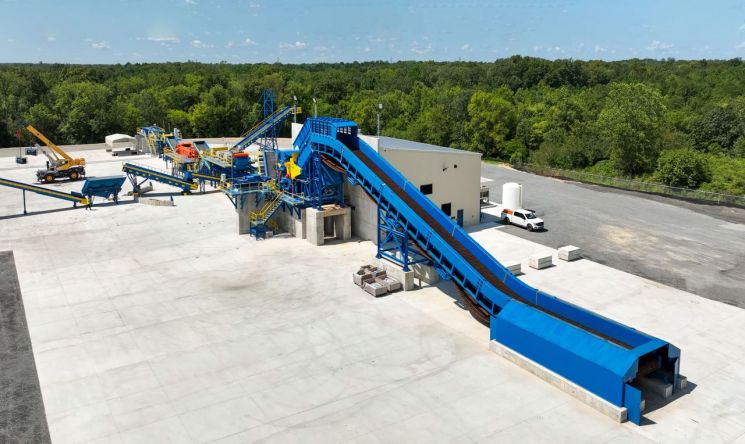 Photo of shredder equipment provided by Danieli Centro Recycling. This image is for readers' understanding and is not related to this investment. Hyundai Steel
On December 8, Hyundai Steel announced that it will invest a total of 170 billion won by 2032 to advance low-carbon raw materials, including the introduction of shredder equipment for processing ferrous scrap. This investment includes the installation of new shredder facilities as well as the establishment of scrap sorting lines at its Pohang and Dangjin plants.
A shredder is equipment that removes impurities from ferrous scrap recovered from end-of-life vehicles, home appliances, and construction waste by crushing them with high-speed rotating hammers. Ferrous scrap processed by a shredder is called "shredded scrap," which is a premium grade with high iron content and uniformity.
Hyundai Steel plans to invest 22 billion won initially to introduce advanced raw material processing facilities-including shredders and a "crushing-sorting-refining" system-in the southern Gyeonggi region. Through a specialized operator, the company will process obsolete scrap into high-grade ferrous scrap, and based on operational results, it intends to gradually expand additional shredder and refining lines in the future.
The new advanced raw material processing facility for the southern Gyeonggi area will be equipped with high-speed hammer shredders, non-ferrous and non-magnetic separators, dust collection systems, and quality inspection and transfer equipment. Construction is scheduled to begin in the first half of 2027, with full-scale operation set for 2028.
In addition to producing shredded scrap through shredder equipment, Hyundai Steel has also embarked on developing technology to upgrade ordinary ferrous scrap into high-quality scrap. To improve scrap quality, the company installed a pilot scrap sorting and refining facility at its Pohang plant last year and is conducting internal R&D. In 2026, Hyundai Steel plans to expand its research scope by applying for a national R&D project.
With the growing imperative for carbon neutrality, securing high-grade ferrous scrap has become a critical task in the steel industry. This is because the electric arc furnace method-which uses scrap as a raw material-generates only about one-quarter of the carbon emissions compared to the blast furnace method that relies on iron ore and coal.
However, South Korea's self-sufficiency rate for ferrous scrap, the main raw material for electric arc furnaces, is only 80 to 90 percent, resulting in a supply shortage relative to demand. Therefore, ensuring a stable supply of high-quality ferrous scrap has become essential for steelmakers to reduce carbon emissions and enhance product competitiveness. In response, Hyundai Steel is pursuing a strategy to upgrade raw materials by not only securing "new scrap"-high-grade scrap generated during the production and processing of metal products-but also by improving the quality of obsolete scrap to compensate for the shortage of premium scrap.
Additionally, the company is focusing on securing a stable supply of high-grade ferrous scrap through partnerships. Beginning with a partnership in 2023 with a major shredder supplier in Gimhae, North Gyeongsang Province, Hyundai Steel has provided investment support totaling 20 billion won to three scrap partners seeking to invest in shredder equipment through this year. The company has also established new support programs for waste treatment facilities for existing shredder partners, thereby expanding its purchasing base for high-quality ferrous scrap through mutually beneficial cooperation.
© The Asia Business Daily(www.asiae.co.kr). All rights reserved.
![Clutching a Stolen Dior Bag, Saying "I Hate Being Poor but Real"... The Grotesque Con of a "Human Knockoff" [Slate]](https://cwcontent.asiae.co.kr/asiaresize/183/2026021902243444107_1771435474.jpg)
















