Bae Hyungwon Directly Refutes at December 1 Subcommittee Meeting
Judge Selection Structure via External Recommendation Committee
"Undermines the Judiciary's External Independence"
"Judicial Vacancies Likely if Constitutional Review Is Requested"<
The legislative and judicial branches are heading toward an unprecedented direct confrontation over the “Special Tribunal for Insurrection Cases Act.” On December 5, the National Council of Court Presidents officially expressed concerns about the bill, stating that it is “highly unconstitutional.” Following this, on December 8, the National Council of Judges also placed the same issue on the agenda for its regular meeting. In contrast, the Democratic Party, during a closed-door policy caucus on the same day, reaffirmed its determination to push forward with a judicial reform package that includes the Special Tribunal for Insurrection Cases Act and the bill to introduce the crime of judicial distortion. Their goal is to pass the bill at the plenary session on December 9.
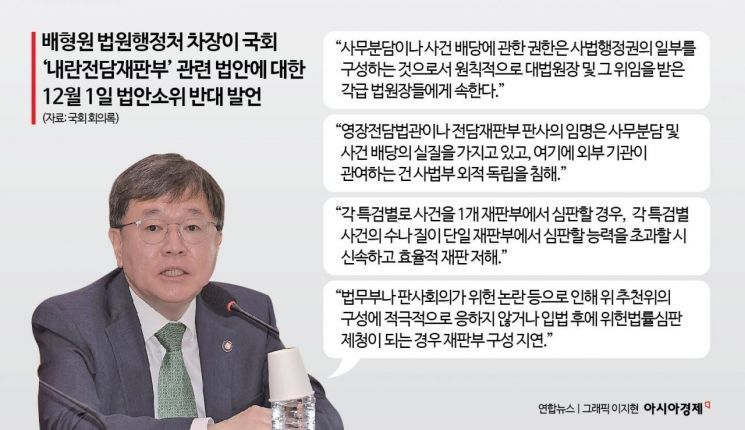
Meanwhile, during the 8th meeting of the National Assembly’s Legislation Review Subcommittee No. 1, held on December 1, Bae Hyungwon, Deputy Director of Court Administration at the Supreme Court, was confirmed to have specifically rebutted the core provisions of the proposal to establish a special tribunal for insurrection cases, calling it an “infringement of judicial administrative authority” and a “violation of the judiciary’s external independence.”
According to the transcript of the subcommittee meeting, Deputy Director Bae directly stated that the “procedure for forming a special tribunal,” which is central to the bill, is contrary to constitutional order. He first emphasized, “The authority over the allocation of duties and case assignment constitutes part of the judicial administrative authority and, in principle, belongs to the Chief Justice of the Supreme Court and the presidents of each court delegated by the Chief Justice.” This points out that the current structure of the bill, which allows an external committee to designate or recommend the tribunal for specific cases, infringes upon the “authority to assign cases,” a core element of judicial independence, by transferring it to the legislature.
He further stressed, “The appointment of judges exclusively for warrants or special tribunals is essentially a matter of duty allocation and case assignment,” and that any involvement by external bodies, whether the National Assembly, the Ministry of Justice, or the Korean Bar Association, “violates the judiciary’s external independence.” In other words, he explained that having the National Assembly create a “specific pool of judges” or establish a “special tribunal” by law for certain criminal cases is, in effect, an unconstitutional approach equivalent to setting up a special court.
Deputy Director Bae also pointed out that the very structure of having “a single tribunal exclusively handle insurrection cases” could realistically undermine the court’s ability to conduct trials. He stated, “If each special prosecutor’s case is tried by a single tribunal, the number and complexity of cases may exceed the tribunal’s capacity.” Since insurrection cases involve large volumes of digital evidence such as documents, recordings, and CCTV footage, as well as dozens to hundreds of witnesses, concentrating too many cases in one tribunal could lead to delays, biased trials, or distorted verdicts. He further argued that “swift and efficient trials could actually be hindered,” directly refuting the Democratic Party’s claim that establishing a special tribunal would ensure consistency and speed in trials.
Concerns were also raised about the bill’s effectiveness. The bill proposes to form a “recommendation committee” to select judicial candidates, with the Chief Justice of the Supreme Court appointing the special tribunal from among them. However, Deputy Director Bae noted, “There is a possibility that the Ministry of Justice or the judges’ council may not actively participate in forming the recommendation committee due to constitutional concerns or may, in effect, refuse to participate.” If the participating institutions refuse to join, the committee itself cannot be formed, potentially derailing the launch of the tribunal. He particularly warned, “If a request for a constitutional review is filed after this law is enacted, the formation of the tribunal could be delayed, leading to a judicial vacuum.” This suggests that even if the bill passes, there is a high likelihood that the special tribunal may become non-operational in practice.
© The Asia Business Daily(www.asiae.co.kr). All rights reserved.

















