Analysis by Jongro Academy, Megastudy, and Other Admissions Firms
Predicted Cut-off Scores Based on Combined Standardized Scores in Korean, Mathematics, and Inquiry Subjects
Major Medical Schools in Seoul: Cut-off Scores Range from 414 to 423 Points
"SKY" Universities: Average Cut-off Projected at 395 Points for Humanities, 392 Points for Science and Engineering
With the announcement of the grading results for the 2026 College Scholastic Ability Test (CSAT), the regular admission cut-off scores for major universities, including the pre-medical and business administration departments at Seoul National University, are expected to rise significantly compared to last year. This is due to an increase in standardized scores resulting from the so-called "difficult CSAT."
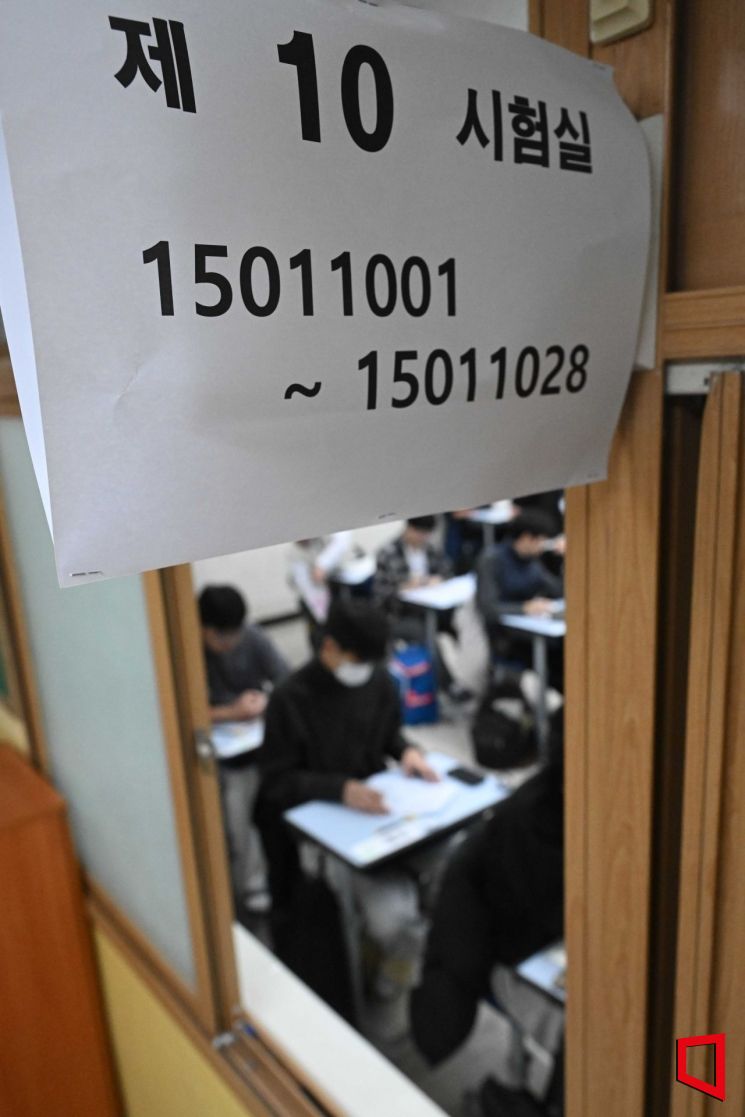 On the morning of the 13th, when the 2026 College Scholastic Ability Test (CSAT) was held, examinees were preparing for the exam at the testing site set up at Gyeongbok High School in Jongno-gu, Seoul. 251113. Photo by Joint Press Corps
According to analyses by admissions consulting firms such as Jongro Academy, Megastudy, and Uway on December 5, the predicted regular admission cut-off for Seoul National University's pre-medical program is estimated to be between 421 and 423 points, based on the combined standardized scores for Korean, Mathematics, and Inquiry subjects. This is up to 8 points higher than last year.
The cut-off for Seoul National University's business administration program is projected to be between 399 and 407 points. Megastudy suggested a cut-off of 399 points, Uway projected 407 points, and Jongro Academy forecasted 406 points.
The cut-off scores for other medical schools have also risen across the board. The predicted cut-off for Yonsei University's pre-medical program is 422 points, Korea University 418 points, Sungkyunkwan University and Catholic University of Korea 420 points each, Ulsan University 420 points, Hanyang University 418 points, and both Kyung Hee University and Chung-Ang University 418 points. The cut-off scores for major medical schools in Seoul are analyzed to range from a minimum of 414 points to a maximum of 423 points.
Medical schools in both the Seoul metropolitan area and other regions also saw an overall increase in cut-off scores. The four medical schools in the Gyeongin region are expected to have cut-offs between 414 and 420 points, while the 27 medical schools in non-metropolitan areas are projected to range from 408 to 420 points.
The cut-off scores for advanced science and engineering programs, such as semiconductor-related departments, have also increased. Seoul National University's Advanced Convergence Division is expected to have a cut-off of 407 points, Korea University's Department of Semiconductor Engineering 402 points, Yonsei University's System Semiconductor Engineering 402 points, Sungkyunkwan University's Semiconductor System Engineering 401 points, and both Sogang University and Hanyang University's Department of Semiconductor Engineering 398 points each.
The cut-off scores for top humanities programs have also shown an upward trend. Yonsei University and Korea University's business administration programs are each predicted at 403 points, Korea University's economics program at 403 points, Yonsei University's political science and international relations program at 402 points, Sungkyunkwan University's global business administration program at 402 points, and Sogang University's business administration program at 399 points.
The average cut-off score for humanities programs at Seoul National University, Yonsei University, and Korea University-collectively known as "SKY"-is analyzed at 395 points, while the average for science and engineering programs is 392 points. For the top 10 universities in Seoul, the average cut-off is 378 points for humanities and 383 points for science and engineering. For universities in Seoul overall, the predicted cut-offs are 338 points for humanities and 349 points for science and engineering.
This year's CSAT is widely regarded as a "difficult CSAT" due to its overall high level of difficulty. The highest standardized score in the Korean language section reached 147 points, up 8 points from last year, and the standardized scores for all six social studies subjects also increased overall. The percentage of students achieving the top grade in English, which is graded on an absolute scale, was 3.11%, the lowest since the 2018 academic year.
Lim Seongho, CEO of Jongro Academy, commented, "Due to the difficulty of the English section, there is a possibility that more students will apply to universities where the English score has a lower weighting," adding, "Korean language scores will be the key factor in determining whether students apply to higher or lower-ranked schools."
© The Asia Business Daily(www.asiae.co.kr). All rights reserved.

![Clutching a Stolen Dior Bag, Saying "I Hate Being Poor but Real"... The Grotesque Con of a "Human Knockoff" [Slate]](https://cwcontent.asiae.co.kr/asiaresize/183/2026021902243444107_1771435474.jpg)















