Eugene Investment & Securities Report: "Robots Entering a New Phase"
South Korea Focuses on Boston Dynamics and the Value Chain
As the robot industry is expected to enter the early stage of mass production next year, securities analysts report that expectations for benefits to robot component companies are rising. In particular, in South Korea, attention is focused on Boston Dynamics, owned by Hyundai Motor Company, as it prepares for mass production, and it is anticipated that the related value chain will attract significant attention.
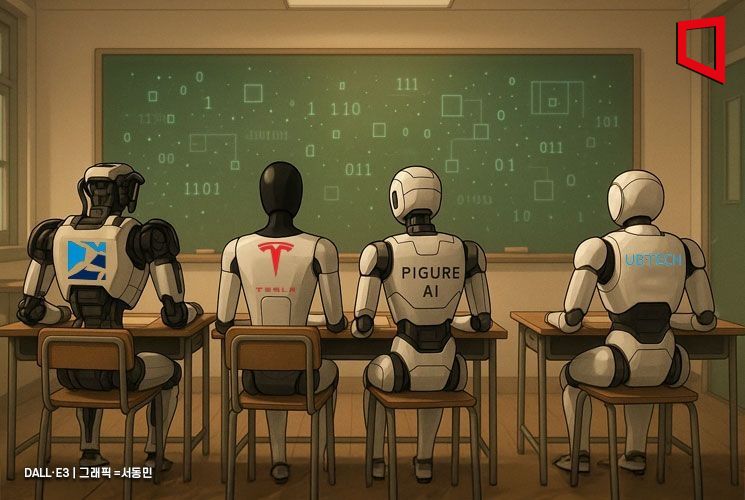
Yang Seungyoon, a researcher at Eugene Investment & Securities, stated in his report "Robots Entering a New Phase" on December 5 that, "From 2022 to the first half of 2025, the robot industry has mainly focused on technology development such as prototype production, but is now shifting toward mass production and commercialization." Both American robot companies such as Tesla and Figure AI, and Chinese companies such as Unitree and UBTECH, are preparing for mass production.
In particular, China’s UBTECH has achieved mass production orders exceeding 200 billion won this year, and has continuously raised its delivery guidance for this year from 300 units to 600-700 units. The company is also reaching a production capacity of 400 units per month. Tesla plans to secure an annual mass production capacity of 1 million units by 2026, and CEO Elon Musk mentioned, "Scaling up of mass production will take place starting next summer."
Researcher Yang emphasized that expectations for benefits to component companies are rising from the perspective of the robot supply chain, especially regarding humanoid mass production. He stated, "In the long term, demand for components such as sensors, chips, and batteries for the 'perception-judgment-execution' phases of robots will increase. However, since current robots are still focused on 'execution,' attention will continue to be on actuators and their subcomponents through next year." Japan’s Harmonic Drive Systems, a leading global component manufacturer, also provided a positive outlook in its recent earnings announcement, indicating that orders for humanoid robots will increase further next year.
In South Korea, attention is focused on Boston Dynamics’ preparations for mass production. Hyundai Motor Company plans to build a mass production plant in the United States with an annual capacity of 30,000 units by 2028. The company has also announced plans for domestic investment through 2030, including the construction of robot finished product manufacturing and foundry plants, as well as research and development support in the field of robot components. Additionally, there is growing anticipation for the unveiling of robot technologies at CES in January next year.
Researcher Yang noted that, in addition to Hyundai Mobis and other group affiliates officially announcing their intention to participate in mass production, media reports confirm that existing automotive component partners are also preparing to join. He stated, "Since automobiles and robots both fall under the category of 'machines,' there is inevitably a high degree of technological similarity. Therefore, expectations for automotive component companies to participate in robot component manufacturing as an investment theme will remain valid."
However, he added, "In niche component fields such as speed reducers, which have mainly been used in robots, the possibility of collaboration with specialized robot component companies also remains open."
Researcher Yang advised that it is necessary to take a conservative view regarding scaling up mass production and achieving a performance turnaround. Assuming the price of a robot actuator is 1 million won, actuator sales for 10,000 robots would amount to approximately 30 billion won. He emphasized that matching mass production with demand is a point that needs to be confirmed over the medium to long term.
© The Asia Business Daily(www.asiae.co.kr). All rights reserved.

















