Founder Kim Chulho Develops "3000riho"
"Brisa" Launched at Sohari Plant
Legacy Continues with Bongo and Pride
"Three Car" Effect After Joining Hyundai
Design Innovation Culminates in K Series
Emerging as an Electrification Leader in the 2020s
Kia's 80-year journey has been a history of challenge.
In the difficult postwar years, Kia became the "wheels" of Koreans with bicycles and three-wheelers. In the 1970s, with the launch of the Bongo and Pride, Kia laid the foundation for Korean industry. During the rapid growth of the 1990s, models like the Sportage and the K series brought convenient mobility to everyday life. After joining forces with Hyundai Motor Company, Kia grew into a world-class automotive brand representing Korea, and now stands at the forefront of a new transformation-electrification.

Founder Kim Chulho, who learned bicycle technology in Japan at the age of 17, returned to Korea and established "Kyungsung Precision Industry" in Dorim-dong, Yeongdeungpo-gu, Seoul, on December 11, 1944. He created Korea's first domestically produced bicycle, the "3000riho," and later changed the company name to "Kia Industry." The name "Kia" means "rising from Asia," and reflected his dream: "Once we master bicycles, we'll make cars; once we master cars, we'll make airplanes."
Although the ambitious bicycle business struggled with deficits, Kia found new opportunities with the launch of Korea's first domestically produced motorcycle, the "C-100," and the first three-wheeler, the "Kia Master K-360," in 1962. These vehicles were well-suited to Korea's narrow roads and difficult fuel conditions, becoming a driving force behind the development of domestic logistics. In 1973, Kia Industry built the Sohari Plant and, the following year, released its first passenger car, the "Brisa S-1000," taking a step toward automotive technology independence by localizing the engine.
In the 1980s, due to the government's automotive industry consolidation policy, Kia Industry was forced to withdraw from the passenger car business. However, by producing Mazda's "Bongo" under license, Kia sought new opportunities in the commercial vehicle market. Within three years of its launch, the Bongo surpassed 100,000 cumulative units sold in May 1984.
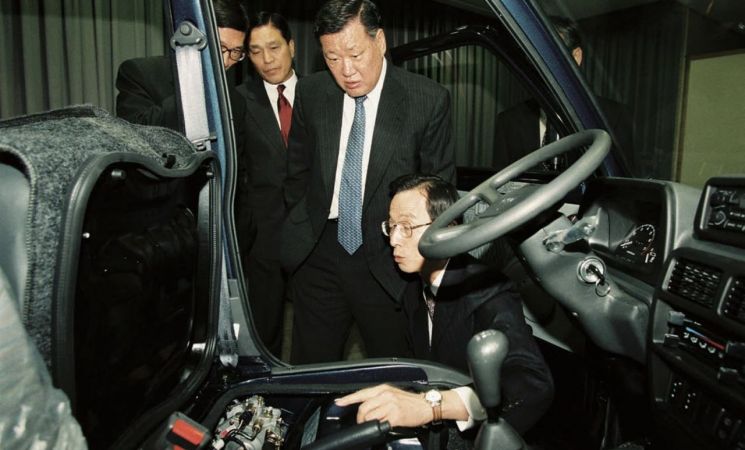
In 1990, Kia changed its name to "Kia Motors," solidifying its position as a specialized automotive company. Despite being recognized as a model for the separation of ownership and management, Kia faced court receivership in 1998 due to reckless business expansion and a lack of ownership leadership. Later, thanks to the decisive actions of Hyundai Group founder Chung Ju-yung and Honorary Chairman Chung Mong-koo, Kia joined the Hyundai Group.
Kia's DNA-always striving and finding opportunities in times of crisis-shone through once again. Thanks to the "Three Car" effect of the Carens, Carnival, and Carstar, Kia returned to profitability just one year after the Hyundai acquisition, and was able to exit court receivership in only two years, by 2000.

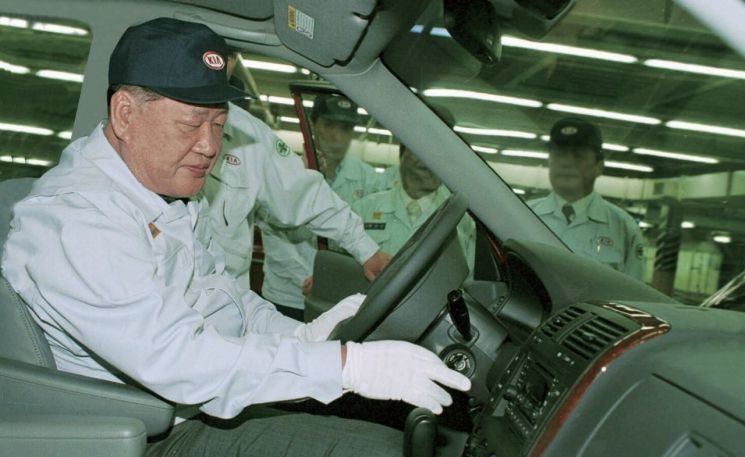
Chairman Chung Mong-koo instilled the mission of "quality first" at Kia. The story of him personally inspecting the quality of the Carnival for over three hours in front of employees is still widely shared. In 2004, he appointed then-Vice President Chung Euisun as CEO of Kia, laying the foundation for elevating the brand's value.
Under the leadership of CEO Chung Euisun, Kia established a new identity through "design management" and accelerated its global expansion. The "K series," launched from 2009, is considered the culmination of this design-driven approach.
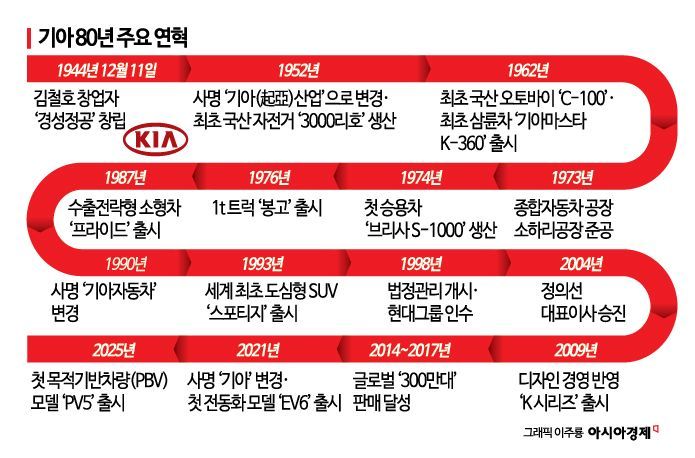
Entering the 2020s, Kia once again embraced change by changing its company name and embarking on a major transformation toward electrification. This transformation is ongoing. By expanding its electrified "EV series," Kia is restructuring its business around eco-friendly mobility and has introduced a new mobility concept: purpose-built vehicles (PBVs). The PBV "PV5," which continues the legacy of the multipurpose Bongo, has received positive reviews overseas since its launch, proving Kia's 80-year spirit of challenge.
© The Asia Business Daily(www.asiae.co.kr). All rights reserved.



















