People Power Party Holds Review Meeting on Special Act on Investment in the United States
"Many Flaws in the Special Act... Parliamentary Ratification Required"
"Joint Hearing by Strategy and Finance, Trade, and Foreign Affairs Committees Comes First"
It is expected that processing the Special Act on Investment in the United States, proposed by the Democratic Party of Korea to support the implementation of the Korea-U.S. tariff negotiations, will take some time. The People Power Party, which chairs the relevant standing committee, the Strategy and Finance Committee, is insisting on a parliamentary ratification process. The People Power Party has also announced its intention to scrutinize the issues of the special act through a hearing.
On December 2, Park Sooyoung, the opposition party whip of the Strategy and Finance Committee, told reporters after the People Power Party’s review meeting on the Special Act on Investment in the United States, "We have decided to hold a joint hearing with the Strategy and Finance Committee, the Trade, Industry, Energy, SMEs and Startups Committee, and the Foreign Affairs and Unification Committee to highlight the problems of the special act." He added that the aim is to persuade others of the need for parliamentary ratification.
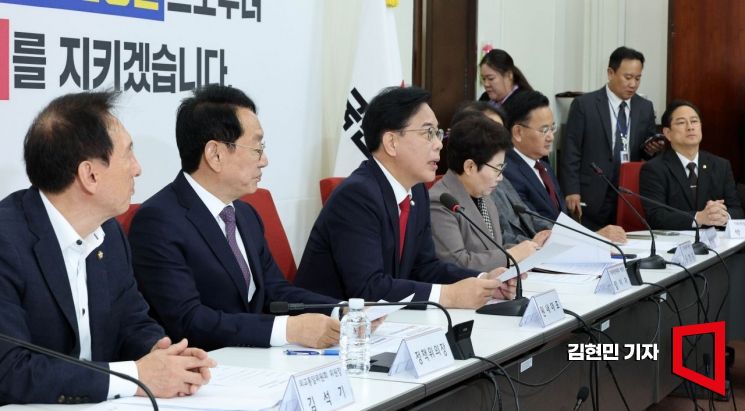 Song Eon-seok, Floor Leader of the People Power Party, is speaking at the Special Committee Chairpersons and Whips Meeting on the Special Act on Investment in the United States held at the National Assembly on December 2, 2025. Photo by Kim Hyun-min
The Democratic Party of Korea proposed the Special Act on Investment in the United States on November 26. The bill aims to systematize the decision-making structure for strategic investments and to establish the Korea-U.S. Strategic Investment Corporation to lead such investments. As a result, the conditions were met for the retroactive application of the reduction in automobile and parts tariffs (from 25% to 15%) as of November 1. However, for the special act to pass the National Assembly, it must first clear the hurdles of both the Strategy and Finance Committee and the Legislation and Judiciary Committee.
The People Power Party maintains its position that the process should go through parliamentary ratification rather than simply processing the special act. Their reasoning is that, since the scale of investment in the United States amounts to 350 billion dollars (approximately 500 trillion won), which is a significant fiscal burden, parliamentary approval is essential.
On this day, the People Power Party pointed out the flaws of the special act and emphasized the necessity of the ratification process. Floor Leader Song Eon-seok criticized, "Contrary to the government’s explanation that the entire U.S. investment will be covered by returns from foreign currency assets, the special act allows for the mobilization of all fiscal resources," and added, "A separate corporation that is not subject to management evaluation or parliamentary audits is also highly likely to become a vehicle for government-appointed executives." Lim Ija, Chairperson of the Strategy and Finance Committee, also expressed concern, saying, "Unlike the special act, the memorandum of understanding (MOU) stipulates that if Korea refuses to provide funds, the United States may impose tariffs on Korean products, and there is a possibility that investment decisions in the United States could be made without transparency."
If the processing of the special act is delayed, there is also speculation that the Democratic Party of Korea may push it through unilaterally or submit it as a fast-track (expedited) bill. Heo Young, Senior Deputy Floor Leader for Policy of the Democratic Party of Korea, stated on November 26, "We are not considering the fast-track option," and added, "We expect the People Power Party to cooperate actively." Park Sooyoung commented, "Since the tariff on automobiles has already been reduced by the proposal of the special act, there is no need for the government or the ruling party to rush the process unnecessarily," and added, "I hope the ruling party does not proceed unilaterally."
© The Asia Business Daily(www.asiae.co.kr). All rights reserved.

















