Spokesperson: "Secretary of Defense Granted Authority... Admiral Carried Out Mission"
Trump Meets with Advisors to Discuss Venezuela
The U.S. White House has acknowledged that, following the sinking of a suspected Venezuelan drug trafficking vessel by the U.S. military in September, survivors were killed in a "second attack." However, controversy has arisen over the White House's claim that the order for the attack did not come from President Donald Trump or Secretary of Defense (Secretary of War) Pete Hegseth, but rather from the Navy admiral who commanded the operation on site, raising suspicions of scapegoating.
Caroline Levitt, White House Press Secretary, said during a briefing on the 1st (local time), "President Trump and Secretary Hegseth ordered a lethal strike against organizations designated as 'narco-terrorists' in accordance with the laws of war," adding, "Secretary Hegseth granted Admiral Frank Bradley the authority to carry out physical strikes at that time."
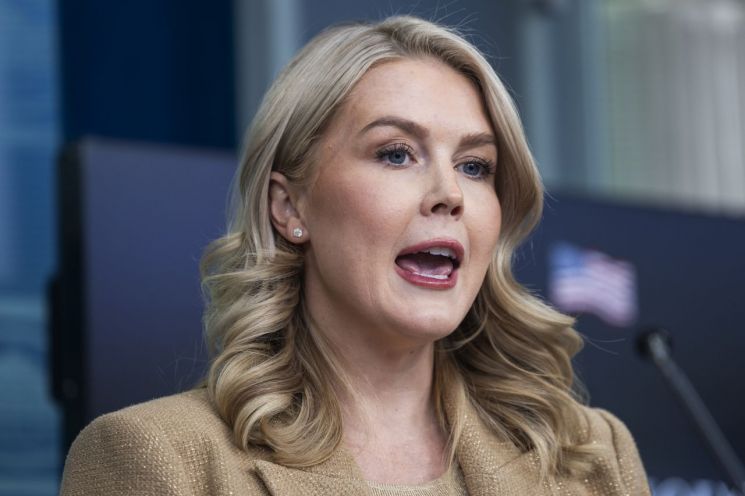
Levitt stated, "Admiral Bradley carried out his mission to destroy the vessel and eliminate threats to the United States within the authority and legal scope given to him." When asked whether Admiral Bradley had ordered the second attack, Levitt responded, "He acted within his own authority."
The Washington Post reported that, on September 2, the U.S. Navy sank a Venezuelan-flagged vessel suspected of drug trafficking and, following Secretary Hegseth's directive to "kill them all," conducted a second attack to eliminate two survivors.
Levitt emphasized the legitimacy of the action, stating, "The U.S. administration has designated these narco-terrorists as a foreign terrorist organization, and the President has the authority to eliminate them if he determines they pose a threat to the United States."
However, it is difficult to regard such an attack as occurring in a combat situation, and there is no definitive evidence that the sunken vessel was a drug trafficking ship. A second attack on unarmed survivors violates both international and domestic law. Critics also point out that, during the attack on October 16, two surviving crew members were rescued and sent home, further undermining the justification for the action.
According to Reuters, President Trump met with his advisors on the same day to discuss military operations in Venezuela, apparently out of concern that the incident could lead to political backlash.
The previous day, President Trump told reporters that Secretary Hegseth claimed he had not ordered the killing of survivors, and that he trusted him. He also distanced himself by stating that he would not have wanted a second attack.
Meanwhile, Venezuela has criticized the second attack as a violation of the Geneva Convention and international law. The Venezuelan National Assembly has classified it as a war crime and established a special committee to investigate "serious extrajudicial civilian executions" in the Caribbean region related to the incident.
© The Asia Business Daily(www.asiae.co.kr). All rights reserved.