Korea Credit Data Q3 Small Business Trends Report
Profit Down 4.63% from Previous Quarter
Slight Increase in Individual Business Loan Delinquencies
"Once the consumer coupon effect wore off, sales were cut in half. This is the worst November ever."
Recently, in the self-employed community "Because I'm a Boss, I'm Hurting," there have been a series of complaints about the current situation for small business owners. Many have lamented, "I survived even during COVID-19, but since September this year, the economy has truly been at its worst," "This is my 11th year in business, and except for the COVID-19 period, this is the biggest blow I've ever taken," and "Business sentiment has never felt worse." Another user shared a news headline about the Korea Foodservice Industry Association holding a large-scale rally near the National Assembly in Yeouido, Seoul, on the 1st to protect the restaurant industry's right to survive, commenting, "If things continue like this, we will all go under, and that's tomorrow."
"Why Are Sales Like This?" "We'll All Go Under at This Rate"-Cries of Distress Everywhere
In fact, in the third quarter of this year, the government's livelihood recovery consumer coupons drove an increase in sales for small businesses, but rising operating costs due to high inflation led to a decline in profits compared to the previous quarter. According to the "2025 Q3 Small Business Trends" report by Korea Credit Data (KCD) released on the 1st, the average sales per small business location in the third quarter was 45.6 million won.
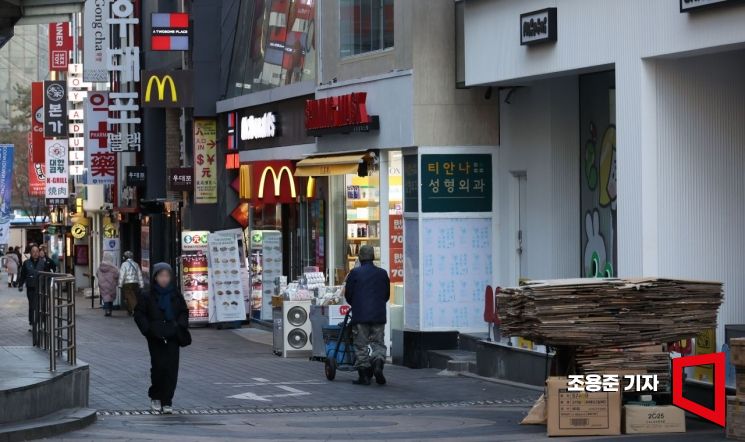 Myeongdong Street, Jung-gu, Seoul. Photo is not related to the specific content of the article. Photo by Jo Yongjun
Thanks to the consumer coupon program, which was distributed in two rounds after July, sales increased by 1.16% compared to the previous quarter. Compared to the third quarter of last year, sales were up 5.28%.
However, the average profit per business in the third quarter was 11.79 million won, down 4.63% from the previous quarter. Due to factors such as high inflation, average expenditures rose by 3.22% to 34.35 million won. The average profit margin also dropped by 1.5 percentage points to 24.7% compared to the previous quarter. However, both profit (up 10.22%) and profit margin (up 1.11 percentage points) improved compared to the third quarter of last year.
By industry, within the food service sector, most businesses saw sales increase compared to the second quarter, including fast food (5.8%), cafes (3.6%), Chinese restaurants (2.0%), and Japanese restaurants (1.5%). However, sales fell for buffets (-11.8%), bakeries and dessert shops (-2.0%), and snack bars (-1.0%). In the service sector, sales growth was particularly strong in arts, sports, and leisure-related businesses (8.2%), transportation services (6.0%), accommodation and travel services (4.5%), and educational services (3.1%).
In the general retail sector, including supermarkets and convenience stores, sales jumped by 8.8% compared to the second quarter, the highest growth rate among all sectors.
On the other hand, sales in specialized retail sectors such as furniture stores and optical shops fell by 0.9% compared to the second quarter.
In the third quarter, the consumer coupon effect helped boost sales, especially in the retail sector, but due to high store operating costs, the actual profit for small business owners decreased compared to the previous quarter.

Clear Impact from Consumer Coupons... Retail Sales Up 16.5%
Analyzing the effects of the first and second rounds of consumer coupon distribution separately, nationwide small business sales rose by 6.4% year-on-year during the four weeks following the start of the first round on July 21. The retail sector saw the highest sales growth rate at 16.5%.
The second round of consumer coupons, which was distributed during the Chuseok holiday period, also had a significant impact. During the four weeks before and after this period, the average sales per small business nationwide increased by 3.1% compared to the same period last year. Comparing average sales during the Chuseok holiday period this year and last year, sales were up by the same 3.1% this year.
Individual Business Loans Reach 726 Trillion Won... Delinquent Amount Up 10.7%
Looking at the financial status of small businesses in the third quarter, the outstanding loan balance for individual business owners totaled 726.6 trillion won. By sector, banks accounted for 433.5 trillion won, while non-bank lenders such as mutual finance institutions accounted for 293.1 trillion won. The amount of delinquent individual business loans was 13.5 trillion won, up 0.7% from the previous quarter. Delinquency rates were relatively higher at savings banks (6.0%) and mutual finance institutions (3.2%).
In the third quarter, there were a total of 3,621,000 business locations holding individual business loans, of which 494,000, or 13.6%, were closed businesses. The average outstanding loan balance for closed businesses was 62.37 million won, and the average delinquent amount was 6.65 million won.
Korea Credit Data's Small Business Trends report analyzes sales and other data from a sample of 2 million self-employed business locations nationwide that use the Cash Note business management service. The data is collected via Cash Note and linked with data from the Credit Finance Association and Hometax for each business. Financial status, including loans, is based on data received from the Korea Credit Information Services.
© The Asia Business Daily(www.asiae.co.kr). All rights reserved.
!["The Woman Who Threw Herself into the Water Clutching a Stolen Dior Bag"...A Grotesque Success Story That Shakes the Korean Psyche [Slate]](https://cwcontent.asiae.co.kr/asiaresize/183/2026021902243444107_1771435474.jpg)

















