140 Trend Books Published Over Five Years
"This Year, Growth Slows as Readers Turn Away"
Korea's Unique Annual Trend Book Culture
International Trend Books Focus on 4- to 5-Year Long-Term Outlooks
The "trend book craze" that heated up bookstores at the end of the year is showing signs of losing momentum. Annual trend outlook books, which used to attract significant attention each year, are also failing to elicit the same response from readers as in previous years. Although Korea has established a unique culture of publishing annual trend outlook books-something rarely seen globally-analysts say that this trend is also gradually slowing down.
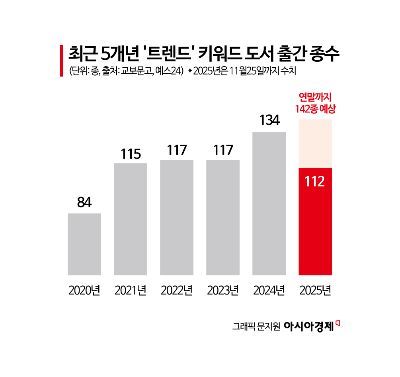
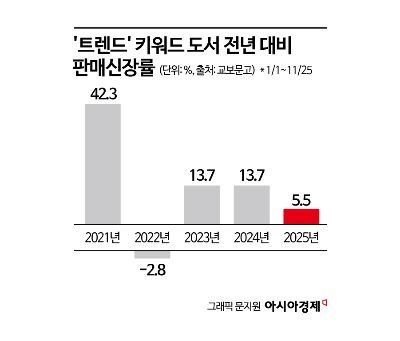
According to the industry on December 2, the number of trend-related books published over the past five years has steadily increased, but sales have actually declined. Based on Kyobo Bookstore data, the number of titles published rose from about 80 in 2020 to 134 last year, and is expected to exceed 140 this year. In contrast, the sales growth rate peaked at 42% in 2021 but plummeted to the 5% range as of November this year.
The starting point for domestic trend analysis books was "Trend Korea 2008," published in 2007 by Kim Nando, Professor Emeritus at Seoul National University. The approach of presenting the following year's trends through ten keywords was considered innovative and helped the book become a steady seller. When released at the end of the year, it was influential enough to be referenced in corporate business plans. Its engaging storytelling style gained widespread popularity, leading to a culture in which trend analysis books across various fields are published every year-end and New Year.
Such a phenomenon is rarely seen abroad. While international trend outlooks typically focus on mid- to long-term forecasts spanning four to five years, Korea is virtually the only market where annual outlook books are regularly published and consumed as bestsellers. One industry insider with extensive international publishing experience commented, "It's hard for those overseas to understand how books with a strong storytelling element are even cited in corporate business plans." Hong Sooncheol, CEO of BC Agency, also explained, "Since the success of Trend Korea, a structure has formed in which numerous similar books are released every year."
Experts offer differing interpretations. Baek Wonkeun, head of the Books and Society Research Institute, said, "Analyses based on consumer studies have been applied in actual business practices, forming a self-sustaining market," and described it as "a case of Korean-style hit content." On the other hand, publishing critic Jang Eunsu analyzed, "It's the result of the combination of rapid change and anxiety in Korean society," adding, "The culture of naming and narrating trends serves as both a driving force for development and a factor that amplifies anxiety." He further noted, "Trends are originally a mid- to long-term concept, so abroad, such books are published only once every few years, and since society is relatively stable, the need is not as great as in Korea."
Some experts explain that trend books function as a "self-fulfilling prophecy" (Pygmalion effect) that actually moves the market. CEO Hong stated, "Frequently mentioned keywords are consumed as if they are real trends, creating a prophetic effect," and added, "Ultimately, this reflects the anxiety and performance pressure present in Korean society."
Although the Trend Korea series lost its position as the overall bestseller after 2021, it rebounded by ranking first for two consecutive weeks last year and for nine consecutive weeks this year. A bookstore official observed, "Last year, the ranking temporarily dropped due to the impact of author Han Kang winning the Nobel Prize in Literature, but this year, various factors seem to be at play as economic uncertainty has increased."
A publishing industry source commented, "During the uncertainty of the COVID-19 period, demand for outlook books surged, but recently, reader fatigue has led to a noticeable decline in readership. However, in years like this one, where uncertainty is high, trend books attract renewed attention and the sense of anxiety resurfaces."
© The Asia Business Daily(www.asiae.co.kr). All rights reserved.



















