Stagnant for Two Years
There are projections that this year’s gross domestic product (GDP) in US dollar terms will decline. This is because the surge in the won-dollar exchange rate has more than offset the increase in GDP.
According to the annual consultation report by the International Monetary Fund (IMF) released on November 30, South Korea’s nominal GDP for this year, calculated in US dollars, is estimated at 1.8586 trillion dollars.
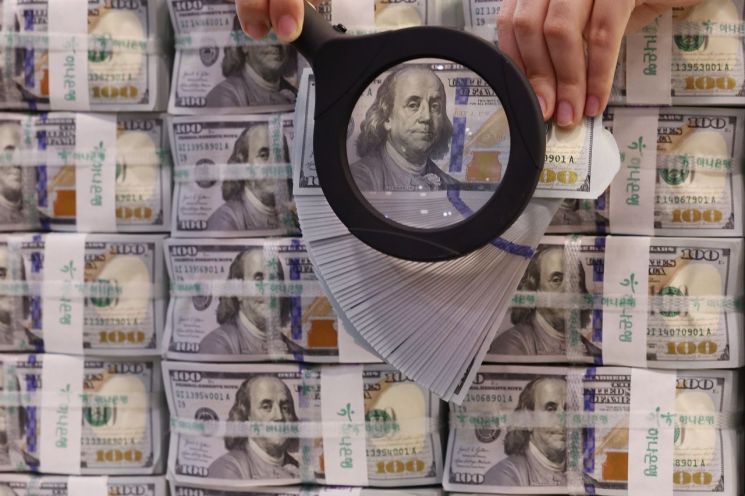
This represents a decrease of 16.8 billion dollars (0.9%) from last year’s 1.8754 trillion dollars. Compared to the 1.8448 trillion dollars recorded in 2023, the GDP has increased by only 13.8 billion dollars (0.7%) over two years, effectively remaining stagnant.
The IMF analyzed that, in terms of Korean won, the nominal GDP is expected to grow by 2.1%, from 2,557 trillion won last year to 2,611 trillion won this year. This figure reflects the real economic growth rate projection (0.9%) along with the impact of inflation.
Although the IMF did not present an average exchange rate, the decline in the dollar-converted GDP is due to the rise in the won-dollar exchange rate, which has outpaced the increase in GDP.
Based on weekly closing prices, the average exchange rate from January to November this year was 1,418 won per dollar, up 54 won (4.0%) from last year’s annual average of 1,364 won. With the exchange rate recently nearing 1,500 won, the annual average could rise further once December figures are included.
With assessments that South Korea has entered a phase of structural low growth, the exchange rate is expected to become a key variable determining the size of the country’s dollar-denominated GDP.
The IMF projects that South Korea’s nominal GDP will increase by 4.1% annually, reaching 1.9366 trillion dollars next year, 2.017 trillion dollars in 2027, 2.0997 trillion dollars in 2028, and 2.1848 trillion dollars in 2029.
However, if the trend of a weaker won does not reverse, these projections may prove overly optimistic. Depending on the exchange rate, the achievement of a per capita GDP of 40,000 dollars, which is expected as early as the year after next, could be delayed. Apart from the macroeconomic impact of a high exchange rate, it could also act as a negative factor in various international comparisons.
In the report, the IMF stated, “Exchange rate volatility is not expected to pose significant economic risks,” but also cautioned that foreign exchange market liquidity could temporarily thin and exchange rate movements could become steep. The IMF cited December of last year and April of this year as notable examples. At that time, political uncertainty was heightened due to events such as the December 3 Martial Law and the adoption of the presidential impeachment motion.
© The Asia Business Daily(www.asiae.co.kr). All rights reserved.
![Clutching a Stolen Dior Bag, Saying "I Hate Being Poor but Real"... The Grotesque Con of a "Human Knockoff" [Slate]](https://cwcontent.asiae.co.kr/asiaresize/183/2026021902243444107_1771435474.jpg)
















