Symposium to Be Held at Leeum Museum of Art on December 5
The Leeum Museum of Art announced on November 27 that it will hold a symposium on December 5 at its auditorium in Yongsan, Seoul, focusing on the current status and future preservation directions of the oldest domestic sutra, the "Silla White Paper Ink Manuscript of the Avatamsaka Sutra."
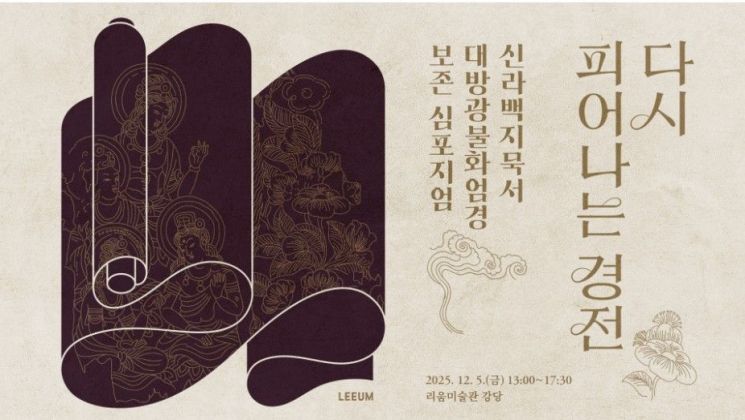 The Leeum Museum of Art will hold a symposium on the current status and future preservation directions of the oldest domestic sutra, the "Silla White Paper Ink Manuscript of the Avatamsaka Sutra," on the 5th of next month at the auditorium of the Leeum Museum of Art in Yongsan, Seoul. Provided by Leeum Museum of Art
The "Silla White Paper Ink Manuscript" is a sutra that was started by Monk Yeongi of Hwangnyongsa Temple in the 13th year of King Gyeongdeok of Unified Silla (754) and completed on February 14 of the following year. It is the only extant Silla sutra with a clearly verified production date. The manuscript holds immense historical value for research on Korean Buddhist art, the history of sutra transcription, and traditional papermaking.
This artifact was first introduced to the public in 1978 and was designated as National Treasure No. 196 in 1979. One scroll, after preservation treatment in 1989, has been on display at the Leeum Museum of Art's antique art gallery (M1), while the other scroll (untreated) is preserved in its original state. At this symposium, detailed information about the condition and materials of both artifacts-previously undisclosed-will be shared for the first time, and preservation experts will discuss future preservation strategies.
The hanji (mulberry paper) used for the manuscript demonstrates an extremely advanced level of papermaking technology for its time, to the extent that it is considered difficult to fully replicate even with modern techniques. The production record (josaenggi) remaining at the end of the scroll lists in detail the individuals involved in its creation, including the patron, the papermaker, the scribe, and the painter of the cover illustration, offering insight into the dedication and craftsmanship invested in its production.
The symposium will begin with Lee Seunghye, Assistant Professor at Dong-A University, explaining the background of how sutra faith and relic worship combined in 8th-century Silla Buddhism to produce such manuscripts. This will be followed by Reio Fujita, former Chief Cultural Property Investigator for Books, Ancient Documents, and Manuscripts at the Agency for Cultural Affairs of Japan, who will introduce the characteristics and preservation cases of ancient Japanese sutras.
Nam Yumi, Head of the Conservation Research Office at the Leeum Museum of Art, will present on the current status and preservation challenges of the artifacts, and Yutaka Suzuki, Honorary Director of the Japan National Treasure Mounting and Restoration Association, will propose future-oriented preservation strategies to maintain the original form of the artifacts. The comprehensive discussion will be chaired by Jeong Jaegyu, Standing Expert Commissioner of the National Heritage Administration, who will lead an in-depth debate on key issues such as preservation standards and the scope of intervention.
Nam Yumi, Head of the Conservation Research Office at the Leeum Museum of Art and organizer of the symposium, stated, "The Silla White Paper Ink Manuscript is not only a sutra but also a complex heritage that combines outstanding production techniques, literature, and painting. I hope this symposium will serve as an opportunity to deepen our understanding of the original form of Silla sutras and to seek preservation directions that will ensure their value is passed down for generations to come."
Anyone can apply to participate in the symposium through the Leeum Museum of Art's website.
© The Asia Business Daily(www.asiae.co.kr). All rights reserved.
!["The Woman Who Threw Herself into the Water Clutching a Stolen Dior Bag"...A Grotesque Success Story That Shakes the Korean Psyche [Slate]](https://cwcontent.asiae.co.kr/asiaresize/183/2026021902243444107_1771435474.jpg)
















