UNIST Develops Integrated Analysis Technology Combining Passive Air Sampling, 3D Modeling, and Probability-Based Risk Assessment
Provides Scientific Basis for Policies Such as Stack Height Optimization and Buffer Zone Establishment
Published in Journal of Hazardous Materials
An integrated air pollution analysis technology has been developed that enables a more accurate assessment of exposure risks to polycyclic aromatic hydrocarbons (PAHs), carcinogens primarily generated in industrial complexes.
This new approach is expected to identify exposure blind spots to hazardous substances that conventional analysis methods often miss, and to support the establishment of scientifically grounded environmental management policies for industrial complexes.
The research team led by Professor Seongdeuk Choi from the Department of Urban and Environmental Engineering at UNIST announced on November 27 that they have developed an air pollution analysis technique integrating passive air sampling, a three-dimensional dispersion model, and a probability-based risk assessment method.

The passive air sampling (PAS) technique collects samples by naturally adsorbing airborne pollutants onto a porous medium resembling a sponge. While this method is economical and efficient-allowing for the dense installation of PAS devices across wide areas to create high-resolution pollution maps-it is difficult to determine the origin and pathways of the measured pollutants.
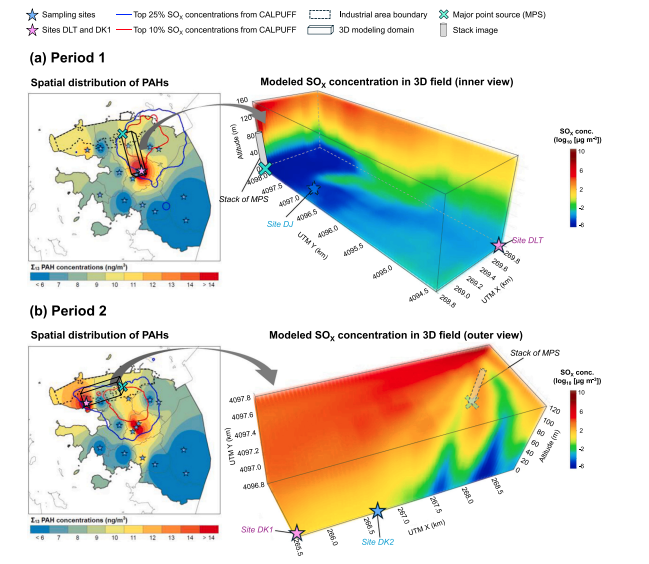
The research team addressed this limitation by utilizing a three-dimensional dispersion model, a technology that simulates how smoke from factory stacks spreads with the wind using computer modeling. This allows not only the measurement of pollution levels at specific locations but also the tracking of how pollutants disperse aloft and descend several kilometers away, depending on factors such as stack height and wind direction.
Additionally, the team employed a probability-based risk assessment method to account for the risks faced by high-exposure groups, which are often overlooked in average-based evaluations. Traditional risk assessments typically rely on average values, such as "adults spend an average of nine hours outdoors per day." In contrast, the probability-based approach calculates variables like outdoor time and frequency as probability distributions ranging from 0 to 100, enabling the estimation of cancer risk for the "top 1% high-risk group"-those who, by chance, are exposed to high pollution levels during extended outdoor activities on particularly polluted days.
Professor Seongdeuk Choi stated, "This technology reveals hidden health risks in residential areas near industrial complexes that are masked by average figures and will provide crucial scientific evidence for future environmental policies to protect public health, such as adjusting stack heights, managing emission pathways, and establishing buffer zones."
First author Dr. Sangjin Lee explained, "This integrated analysis method can also be applied to track the movement and exposure characteristics of various hazardous air pollutants, including not only PAHs but also volatile organic compounds (VOCs), persistent organic pollutants (POPs), and heavy metals."
This research was supported by the National Institute of Environmental Research and the National Research Foundation of Korea. The results were published online on November 14 in the Journal of Hazardous Materials, a top-tier academic journal in the field of environmental science.
© The Asia Business Daily(www.asiae.co.kr). All rights reserved.


















