Paju City Signs Women-Friendly City Redesignation Agreement with Ministry of Gender Equality and Family
Women-Friendly City Status Renewed... Leaping Forward as a "Gender-Equal City"
Paju City in Gyeonggi Province announced on the 27th that it had signed a "Women-Friendly City Designation Agreement" with the Ministry of Gender Equality and Family on the 26th and would make a bold leap forward to create a "gender-equal city" based on its achievements over the past five years.
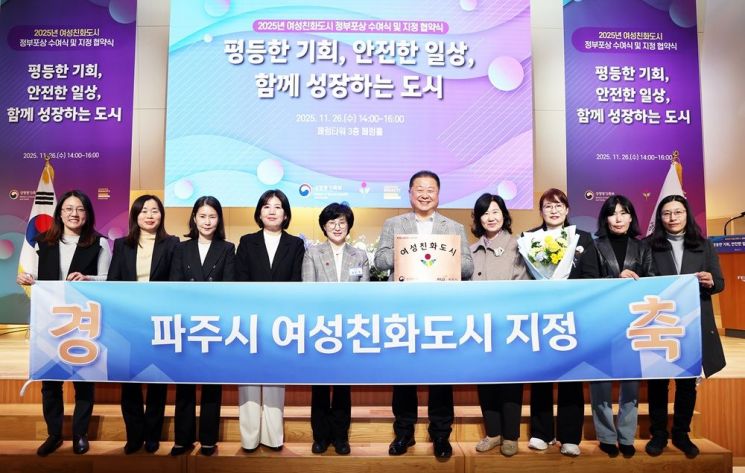 Paju City signed a "Women-Friendly City Designation Agreement" with the Ministry of Gender Equality and Family on the 26th. Provided by Paju City
The "Women-Friendly City" initiative is a system introduced to establish a foundation for equal participation of women and men in the process of formulating, implementing, and evaluating local policies. It also aims to strengthen the capabilities of women, whose social activities have been relatively limited due to caregiving responsibilities, and to expand their participation.
In 2019, the city enacted the "Ordinance on the Creation of a Women-Friendly City in Paju." In recognition of the excellence of its specialized projects-such as establishing a foundation for gender equality policies, expanding women's economic and social participation, enhancing community safety, creating a family-friendly environment, and strengthening women's capacity for community engagement-Paju was newly designated as a Women-Friendly City in December 2020.
Over the past five years, Paju City has carried out a variety of specialized projects, including expanding gender sensitivity education for public officials and citizens, regularly compiling gender-disaggregated statistics, operating citizen participation groups, public-private councils for women's employment support, "gender governance," and "safety governance," training feminist oral history teams, a women's lecturer group discussing peace, and a gender-based violence prevention lecturer group, creating women-friendly streets unique to Paju, and closing down prostitution zones.
Going forward, the city plans to complete the creation of women-friendly spaces by fully closing prostitution zones and resolving gender-based occupational segregation in the labor market by training women as village bus drivers and construction machinery operators, based on a public-private cooperation system for each project. In addition, Paju will expand "customized gender-based violence prevention education" for future generations and will annually add new "Paju-Style All Together Care Centers," which were introduced for the first time in the country to address after-school care gaps for elementary school children.
Paju Mayor Kim Kyungil said, "Creating an environment where women can actively participate in social activities is an important foundation for regional development," and added, "We will build a living environment where work and caregiving coexist, making Paju a women-friendly city where gender equality is fundamental, so that all citizens can have equal access to opportunities."
© The Asia Business Daily(www.asiae.co.kr). All rights reserved.

















