National Institute of Health Cohort Study Targets Patients Aged 5 to 15
Worsened Airway Inflammation and Asthma Severity in Children Keeping Dogs or Cats
A recent study has found that even asthma patients without pet allergies should be cautious when keeping pets, as it can worsen airway inflammation and increase the severity of asthma.
The Korea Disease Control and Prevention Agency (KDCA) National Institute of Health announced on November 27 that a multi-center study using the Korean Asthma Study (KAS) pediatric cohort confirmed this trend. The research was conducted to examine, from multiple perspectives, how the daily exposure environment of pediatric asthma patients affects the course of the disease, considering the rapid increase in households with pets in recent years.
The research team led by Professor Yoo Jin Ho at Asan Medical Center in Seoul systematically analyzed data from 975 pediatric asthma patients aged 5 to 15, including pet ownership status, allergic sensitization, lung function, airway inflammation markers such as fractional exhaled nitric oxide, history of hospitalization in the past 12 months, and asthma severity. The team also used follow-up data at 6 and 12 months from the start of the study to observe the relationship between exposure and response over time.
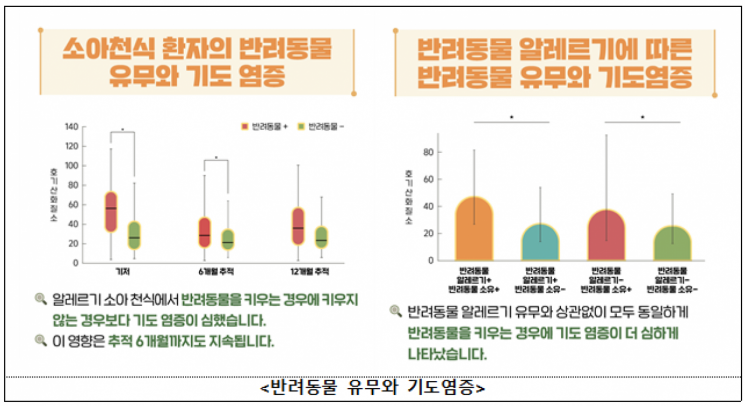
The results showed that pediatric asthma patients with allergies who kept pets had more severe airway inflammation than those who did not, and this effect persisted for up to six months of follow-up. These patients also experienced more frequent hospitalizations in the past 12 months and showed lower lung function. Regardless of whether or not they had a pet allergy, those who kept pets exhibited more severe airway inflammation.
Furthermore, pediatric asthma patients with allergies who kept pets not only had more severe asthma than those who did not, but also showed a tendency for increased asthma severity regardless of pet allergy status. This suggests that even if a patient tests negative for pet allergy, actual exposure to pets in daily life can increase airway inflammation and make disease management more challenging for pediatric asthma patients with allergies.
Regarding changes over time, the increase in airway inflammation among the pet-owning group persisted at the 6-month follow-up, while the difference between groups decreased somewhat at 12 months. This may be due to a combination of factors such as seasonality, changes in lifestyle, treatment adjustments, and variations in exposure, indicating the need for more precise exposure assessment and long-term follow-up.
The research team emphasized the significance of the study, noting that it provides large-scale, multi-center evidence to answer a common clinical question: "Why do symptoms worsen even when allergy tests are negative?" The findings show that exposure to pets can affect inflammatory responses and clinical severity even in the absence of a pet allergy.
In particular, for pediatric asthma patients with allergies, the strong association between allergic inflammation and airway hyperresponsiveness means that exposure to various environmental antigens and fine particles from pet hair, saliva, feces, and microbiota can act together to amplify airway inflammation.
The results of this study were published in a leading international journal in the field of allergic diseases (Allergy Asthma & Immunology Research, IF 5.1). Kim Wonho, Director of the National Institute of Health, stated, "Previously, we only advised patients with pet allergies to avoid keeping pets, but this study shows that even without a pet allergy, keeping pets can worsen airway inflammation and asthma in allergic asthma patients, so caution is necessary."
Meanwhile, the KDCA operates Atopy and Asthma Education Information Centers in 11 cities and provinces nationwide to provide various information on asthma and other allergic diseases. Next month, the agency plans to announce 'Pet Allergy Prevention and Management Guidelines' to help prevent and manage the onset and worsening of allergies caused by pets.
© The Asia Business Daily(www.asiae.co.kr). All rights reserved.
![User Who Sold Erroneously Deposited Bitcoins to Repay Debt and Fund Entertainment... What Did the Supreme Court Decide in 2021? [Legal Issue Check]](https://cwcontent.asiae.co.kr/asiaresize/183/2026020910431234020_1770601391.png)

















