Electric Vehicle Leaders Forum Hosted by the Korea Electric Vehicle Association on the 26th
The government is considering introducing "eco-friendly vehicle production incentives" linked to employment scale and the localization rate of parts in order to prevent the hollowing out of domestic automobile production. While previous support measures have focused on investments such as eco-friendly vehicle facilities or research and development (R&D), this is the first time that incentives for the production of eco-friendly vehicles themselves are being considered. This move is seen as a concrete government strategy to safeguard the foundation of the automobile industry, a core pillar of the domestic manufacturing sector.
Additionally, to expand the domestic electric vehicle market, the government plans to advance the timing of next year's subsidy payments as much as possible and establish a new subsidy program supporting the conversion of 180,000 vehicles to electric vehicles. The government also intends to increase subsidies for medium and large electric trucks to accelerate the adoption of electric vehicles in the commercial vehicle sector.
At the "2025 Electric Vehicle Leaders Forum" held in the main conference hall of the National Assembly Members' Office Building on the 26th, Kim Hyosun, Deputy Director of the Automotive Division at the Ministry of Trade, Industry and Energy, stated, "We are reviewing a redesign of the incentive structure for eco-friendly and future vehicle (advanced automobile) parts," adding, "Whereas government incentives have so far focused on R&D and facility investment, we now aim to consider a comprehensive system that also takes into account employment contributions and the localization rate of parts."
This redesign of the incentive system is a measure to prevent the hollowing out of domestic automobile factories. As protectionism intensifies in major countries such as the United States, Europe, and China, global automobile factories are increasingly relocating to local markets where sales are generated. Recently, the United States imposed a 15% tariff on Korean automobiles, prompting domestic automakers such as Hyundai Motor and Kia to increase their local production share in the United States.
As of 2024, domestic automakers produced 4.13 million vehicles in Korea and 3.59 million vehicles overseas. The government anticipates that overseas production by domestic companies will soon surpass domestic production. Nevertheless, the government maintains that domestic production of at least 4 million vehicles must be preserved, as the automobile industry is the sector that contributes most significantly to the domestic economy in terms of production, employment, and exports.
Deputy Director Kim said, "Japan has introduced a tax incentive system for strategic industries, and while the United States has eliminated the IRA electric vehicle subsidy, it is still maintaining subsidies for battery production. We also need to introduce incentives to maintain domestic finished vehicle production." He added, "When designing the system, we will consider not only simple production volumes but also employment and localization rates, so that support extends beyond finished vehicle manufacturers to include parts suppliers as well."
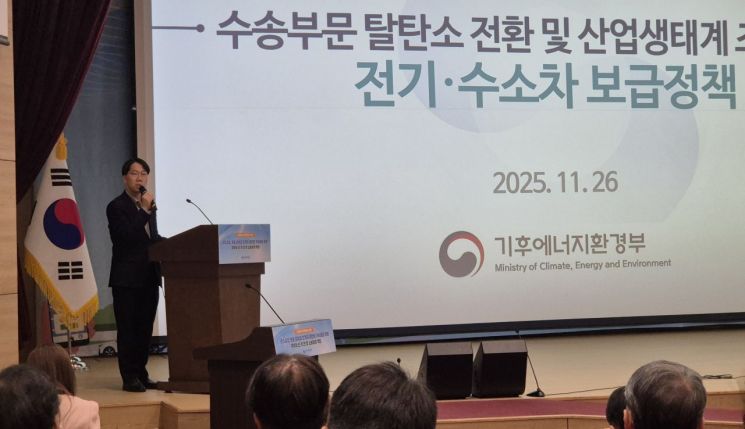 Ryu Pilmu, Director of the Decarbonization and Green Transportation Innovation Division at the Ministry of Climate, Energy and Environment, is giving a presentation at the Electric Vehicle Leaders Forum held at the National Assembly on the 26th. Photo by Woo Suyeon
At the event, next year's electric vehicle subsidy policies also emerged as a key topic. After the confirmation of the "2035 Nationally Determined Contribution (NDC) for Greenhouse Gas Reduction" on November 11, confusion spread throughout the industrial sector, including the automotive industry. In response, the Ministry of Climate, Energy and Environment, the responsible ministry, stated that it expects the cumulative number of electric vehicles in Korea to reach 1 million next year and will consider comprehensive measures to achieve the NDC targets.
The Ministry has set the passenger electric vehicle subsidy at the same level as this year, supporting 260,000 units, but has newly allocated subsidies for the conversion of 180,000 internal combustion vehicles to electric vehicles. Regarding the zero-emission vehicle supply target system, the Ministry announced an administrative notice to set the target at 50% of new vehicles by 2030, but explained that it would also recognize a portion of hybrid vehicle supply performance to reduce the burden on manufacturers.
To revitalize the domestic electric vehicle market, the government emphasized that it would advance the timing of electric vehicle subsidy payments as much as possible. In addition, the government announced plans to expand the supply of new electric vehicle models expected to be launched next year, such as small vans and medium and large trucks, in order to promote electrification in the commercial vehicle market.
Kang Chan, Deputy Director of the Decarbonization and Green Transportation Innovation Division at the Ministry of Climate, Energy and Environment, stated, "This year, we advanced the subsidy payment timing as much as possible and executed it in February," adding, "We are discussing with local governments whether there is a way to advance the payment even further next year."
© The Asia Business Daily(www.asiae.co.kr). All rights reserved.

















