"English Is a 'Digital Survival Tool' in the AI Era"
Self-Directed Learning on Tablets Two to Three Times a Week
Applications Open for Interested Centers Starting on the 28th
Before formal English education begins in the third grade of elementary school, a pilot customized English education program using "Seoul Learn" will be conducted for first and second graders at local children's centers.
The Seoul Metropolitan Government announced on the 26th that it will implement the "Seoul Learn 3.0 - Seoul-Style English Education" program for about 100 first and second graders at local children's centers in Seoul. The program will run for six months starting next month.
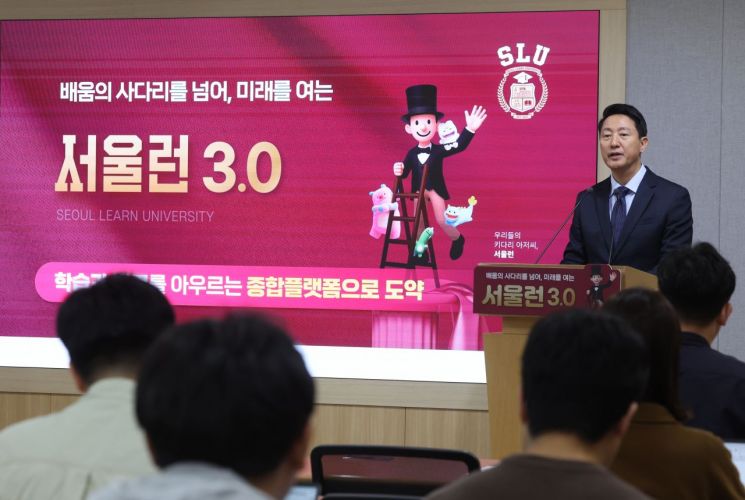
The city explained, "Although these children do not meet the income criteria for Seoul Learn, which is set at 60% or less of the median income, we aim to reduce the burden on vulnerable households by providing high-quality English education opportunities to children at local centers who have limited access to educational resources."
The focus on "English" is due to recent environmental changes. With the spread of AI and the growing importance of English as a "digital survival tool" for accessing information, the city seeks to provide a solid educational ladder through equitable English education. According to the latest statistics from web technology research firm W3Techs, 49.3% of global website content is in English, meaning that English proficiency can directly translate into disparities in information acquisition.
For this pilot project, an English education specialist institution will design an optimized learning model tailored to children's developmental stages, while private English education companies will provide high-quality content. University researchers will directly analyze the learning outcomes of participants to verify the effectiveness of public English education.
The program will be conducted two to three times a week, with each session lasting 20 to 30 minutes on a tablet, allowing for self-directed learning. Teachers at the local children's centers will regularly monitor students' progress and adaptability to the difficulty level, providing support as needed.
Depending on the local center's conditions and children's characteristics, participants can choose between "Khan Academy Kids + Smartree English" and "Todo English" as their learning content. "Khan Academy Kids + Smartree English" is linked to the global free platform "Khan Academy Kids," used in U.S. public schools, and supports reading English books and phonics learning. "Todo English" offers game-based interactive learning, allowing students to enjoyably master everything from the alphabet to basic conversation.
Local children's centers wishing to participate in the Seoul-Style English Education program should compile a list of recommended children and submit it via the designated email address between the 28th of this month and the 4th of next month.
The city plans to analyze the accumulated learning data, pre- and post-diagnostic assessments, and achievement results from this pilot operation to further refine the "Seoul-Style English Education Model." Based on these results, the city will gradually expand the scope of support.
Jinwoo Jung, Director of Lifelong Education at the Seoul Metropolitan Government, stated, "In the era of AI, English proficiency is an essential foundation for children to communicate with a broader world and pursue their dreams. In particular, during the first and second grades of elementary school-when there is a gap in the public education curriculum-we will take responsibility for boosting our children's confidence in English through the Seoul-Style English Education Model, helping to narrow the English proficiency gap caused by environmental factors."
© The Asia Business Daily(www.asiae.co.kr). All rights reserved.

![Clutching a Stolen Dior Bag, Saying "I Hate Being Poor but Real"... The Grotesque Con of a "Human Knockoff" [Slate]](https://cwcontent.asiae.co.kr/asiaresize/183/2026021902243444107_1771435474.jpg)















