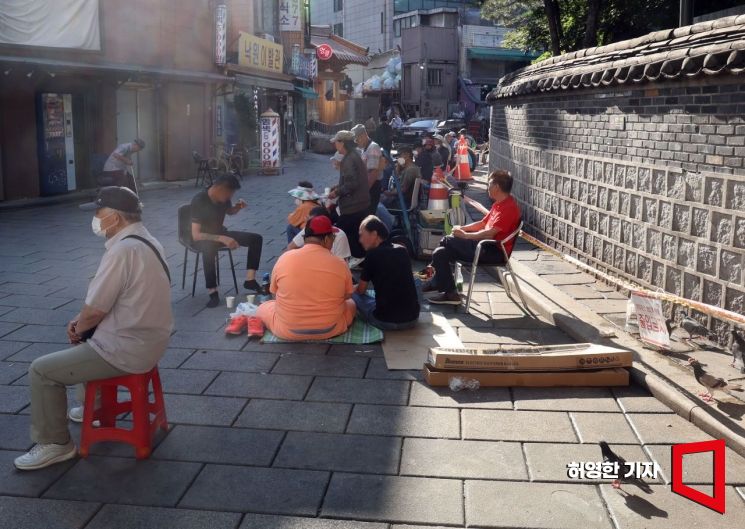
 Elderly people are sitting in a line waiting for meal time in front of the free meal service at Wongaksa Temple behind Tapgol Park in Jongno-gu, Seoul. Photo by The Asia Business Daily DB
It has been found that elderly people in South Korea work the most and for the longest period among member countries of the Organisation for Economic Co-operation and Development (OECD). Analysts say that rather than enjoying work, many are struggling to survive.
According to the report "National Pension and Labor Supply of the Elderly" by Oh Yujin, Senior Researcher at the National Pension Research Institute, released on the 26th, South Korea entered a super-aged society in 2025, with 20.3% of its population aged 65 or older. The employment rate for those aged 65 and above in South Korea is 37.3% (as of 2023), far exceeding the OECD average of 13.6%, ranking first among member countries. This figure is also significantly higher than that of Japan, which has already become a super-aged society (25.3%).
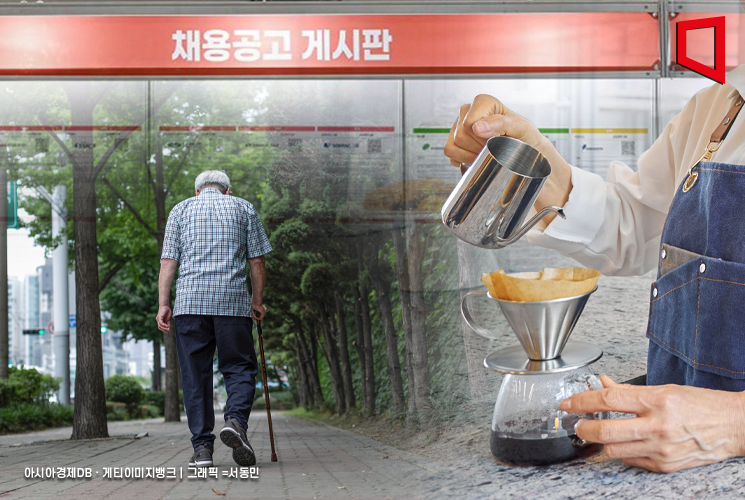
According to a survey by Statistics Korea, the average age at which elderly people in South Korea hope to work is as high as 73.4 years. The main reason for continuing to work is "to help with living expenses" (54.4%). The proportion of those working for subsistence overwhelmingly surpasses those working for "the joy of working" (36.1%) or "to relieve boredom" (4.0%).
The report points to the extremely insufficient level of public pension as the root cause of this phenomenon. As of 2024, the average monthly National Pension payment is only about 660,000 won. This is less than half of the minimum monthly cost of living for a single-person household in the same year, which is 1.34 million won.
 A job seeker participating in the 'Gyeonggi-do 5070 Job Fair' held at KINTEX in Goyang, Gyeonggi-do, is taking a photo for their resume. 2025.10.14 Photo by Kang Jinhyung
The "income gap period" that arises from the discrepancy between the statutory retirement age and the actual age of retirement is also a problem. Currently, the statutory retirement age is 60, but the average age of retirement from main jobs is only 52.9 (as of 2025). Meanwhile, the age at which people begin to receive the National Pension is being gradually delayed: 63 for those born between 1961 and 1964, and 65 for those born in 1969 or later. This means that after leaving the workforce, people must endure at least a decade or more of hardship before receiving their pension benefits.
Elderly people in South Korea have to work even if they have a pension, and must continue working while waiting to receive their pension. The report suggests that, in order to address labor shortages caused by population decline, it is necessary to actively utilize the labor force of the elderly.
© The Asia Business Daily(www.asiae.co.kr). All rights reserved.



















