Revision of the Basic Space Development Plan:
A New Policy Framework Reflecting a Changing Environment
The government has revamped its future space development strategy, focusing on reusable launch vehicles, advanced satellite technology, the private space industry ecosystem, investment infrastructure, and research infrastructure. This marks the start of full-scale policy adjustments to respond to the changing global space environment.
On November 25, the Space Agency convened the 4th National Space Committee meeting, where it deliberated and finalized the revised 4th Basic Plan for Space Development Promotion and the Republic of Korea Space Science Exploration Roadmap, both reflecting this new direction.
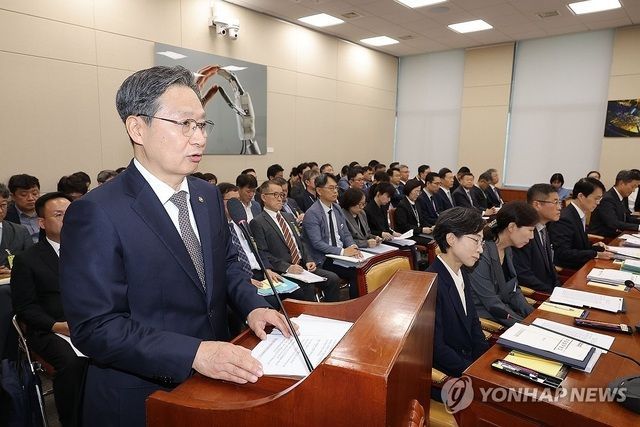 Yoon Youngbin, Administrator of the Space Agency, is delivering a greeting at the National Assembly Science, Technology, Information and Broadcasting and Communications Committee's audit of the Space Agency on the 16th of last month. Photo by Yonhap News
Restructuring Mid- to Long-Term Strategy: From Reusable Launch Vehicles to Space Exploration Roadmap
The National Space Committee serves as the highest decision-making body for Korea’s space development policy. With the launch of the Space Agency last year and the elevation of the committee chair to the President, the policy status of the committee has been significantly strengthened. Through this meeting, the government conducted an “interim review” of the 4th Basic Plan for Space Development Promotion, covering 2023 to 2027, and revised its mid- to long-term strategy to reflect recent changes in the global space industry and domestic policy environment.
The revised plan includes: ▲ the development of reusable launch vehicles for low-cost, high-frequency launches; ▲ strengthening advanced satellite platform technology for high-resolution Earth observation and space exploration; ▲ fostering a nationwide private space industry ecosystem; ▲ establishing a private investment base, such as the “New Space Fund”; and ▲ expanding research and testing infrastructure.
The results reflect feedback collected by the Space Agency from expert meetings and public hearings held between July and September. There is growing consensus that the national policy for advancing launch vehicles, satellites, and the industrial ecosystem has become more clearly defined.
In the field of space science, the “Republic of Korea Space Science Exploration Roadmap” was newly presented. The Space Agency has set its vision as “Becoming a Top 5 Space Power” and announced its goal to promote scientific exploration programs in five key areas-low-Earth orbit and microgravity research, lunar exploration, solar and space environment observation, planetary system exploration, and astrophysics-by 2045. This move responds to the global trend of expanding space exploration beyond basic scientific research into future economic domains.
Additionally, strategies for strengthening military space capabilities, such as the development of Military Reconnaissance Satellite-II and Military Satellite Communication System-III, were also discussed. As the linkage between civil and military space technologies is reinforced, the role of cross-ministerial space policy coordination is expected to become even more important.
Bang Hyochung, Vice Chair of the National Space Committee, who presided over the meeting, emphasized, “We must move away from policies and systems that merely follow the environment and instead establish a structure that can proactively reflect the changing space environment.” Yoon Youngbin, Administrator of the Space Agency, also stated, “With the fourth launch of Nuri, we will further solidify the goal of ‘launching our satellites with our own launch vehicles.’ We will focus on the overall coordination role so that policies can earn the public’s trust and remain flexible amid rapid change.”
The government expects that this decision will provide a foundation to support the domestic technology ecosystem in various fields, including reusable launch vehicles and launch service industries, satellite platforms, private space companies, and research in space medicine and the space environment.
© The Asia Business Daily(www.asiae.co.kr). All rights reserved.
![Clutching a Stolen Dior Bag, Saying "I Hate Being Poor but Real"... The Grotesque Con of a "Human Knockoff" [Slate]](https://cwcontent.asiae.co.kr/asiaresize/183/2026021902243444107_1771435474.jpg)
















