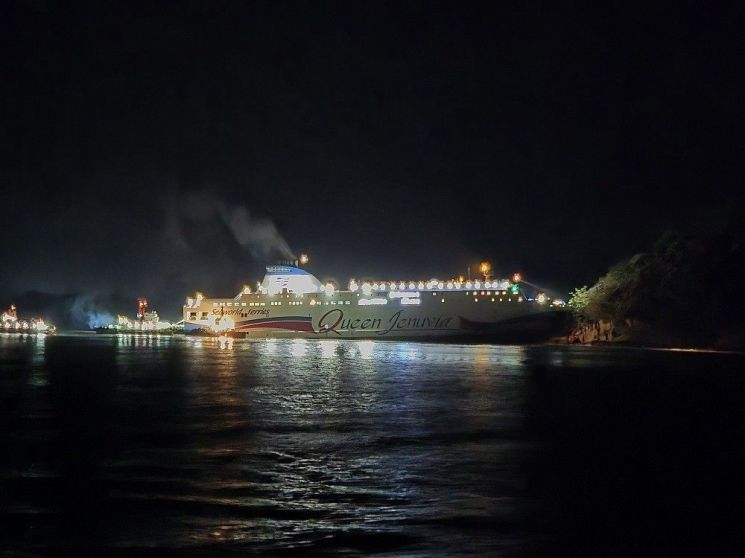
The captain of the large car ferry Queen Zenobia II, which ran aground off the coast of Shinan, South Jeolla Province, is reported to have never entered the wheelhouse during more than 1,000 voyages through the accident area.
According to the Mokpo Coast Guard Station on the 24th, the Coast Guard suspects that Captain A (in his 60s), who has been booked on charges of gross negligence resulting in injury and violation of the Seafarers Act, failed to fulfill his duty of direct command of the ferry while navigating the accident area in the past.
After questioning seven ferry employees as witnesses, authorities confirmed that Captain A, who boarded the Queen Zenobia II when it began operations on February 28 last year, had never entered the wheelhouse during over 1,000 passages through the accident area.
Under the Seafarers Act, the captain is required to directly command the vessel in narrow waterways such as the accident area. However, it was found that this obligation was not fulfilled during the ship's voyages through the area.
The Coast Guard also planned to investigate compliance with operation management regulations and crew training by requesting related documents from the ferry operator, Seaworld Express Ferry. However, the investigation has been delayed as the company requested to be accompanied by legal counsel during questioning.
The controller B at the Mokpo Regional Vessel Traffic Service (VTS) Center, which oversees maritime traffic in the accident area, has also been booked on charges of occupational negligence resulting in injury, and the investigation will continue.
It has been reported that Controller B failed to detect any abnormal signs from the Queen Zenobia II after it deviated from its normal route prior to the grounding, stating that the route deviation alarm had been turned off from the beginning.
The Coast Guard will further investigate when the route deviation alarm was disabled and why it was not functioning.
However, the West Sea Coast Guard explained that the alarm was turned off because frequent entry and exit by vessels under 20 meters, which are not required to comply with the route, caused excessive alarm notifications that interfered with monitoring.
A simulation conducted by Mokpo Maritime University at the request of the Coast Guard showed that in order to avoid collision with the island, the vessel must maintain a minimum distance of 500 meters, and that unless a course change is made at least 190 meters before deviating from the route (with the distance between Jukdo and the end of the route being 310 meters), an accident would be unavoidable.
According to maritime law experts consulted by the Coast Guard, the timing of a vessel's course change may vary depending on the judgment of the officer on watch, and recommendations regarding the vessel may also be determined based on the controller's experience.
However, in the case of passenger ferries, if the usual speed and route differ, this must be confirmed; failure to recognize such changes would be considered negligence on the part of the controller.
On November 19, at approximately 4:45 p.m., the Queen Zenobia II departed Mokpo carrying 267 people, including 246 passengers and 21 crew members. At 8:16 p.m. the same day, the vessel ran aground near Jukdo, off Jangsan Island in Shinan County.
The Coast Guard has determined that the chief mate and the helmsman, who were distracted by activities such as using their mobile phones, are directly responsible for the accident. They have been arrested and are under investigation on charges of gross negligence resulting in injury.
© The Asia Business Daily(www.asiae.co.kr). All rights reserved.
![Clutching a Stolen Dior Bag, Saying "I Hate Being Poor but Real"... The Grotesque Con of a "Human Knockoff" [Slate]](https://cwcontent.asiae.co.kr/asiaresize/183/2026021902243444107_1771435474.jpg)
















