"2025 KPBMA Communication Forum"
Exports Expected to Drop 66.1% Even With 25% Tariff
As expectations grow that the Donald Trump administration in the United States may raise trade barriers even in the pharmaceutical sector, claims have emerged that if a tariff rate of just 25% is imposed, South Korea’s pharmaceutical and bio industries could see their exports to the U.S. drop by as much as 66%.
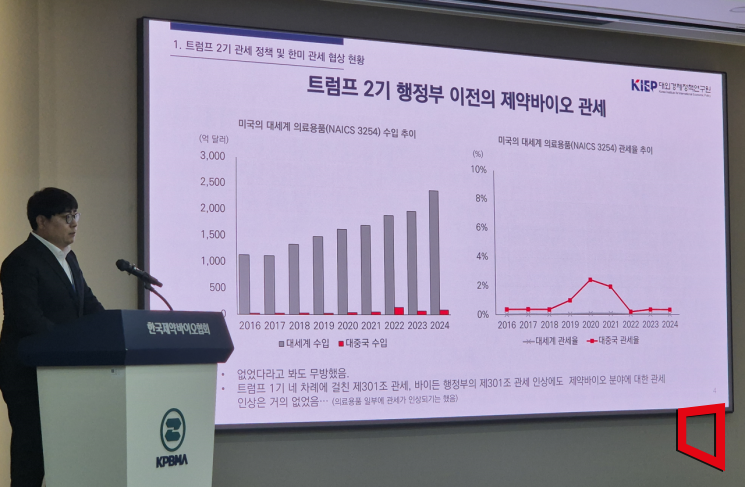 Kim Hyukjung, Associate Research Fellow at the Korea Institute for International Economic Policy (KIEP), is explaining the scenario of imposing tariffs on American pharmaceuticals at the "2025 KPBMA Communication Forum" held at the Korea Pharmaceutical and Bio-Pharma Manufacturers Association (KPBMA) building in Seocho-gu, Seoul, on the 24th. Photo by Choi Taewon
Kim Hyukjung, Associate Research Fellow at the Korea Institute for International Economic Policy (KIEP), made this statement as he presented the results of his analysis on tariff imposition scenarios and their impact on exports at the "2025 KPBMA Communication Forum" held at the Korea Pharmaceutical and Bio-Pharma Manufacturers Association (KPBMA) building in Seocho-gu, Seoul, on the 24th.
Kim pointed to Section 232 of the Trade Expansion Act as a key risk factor in trade policy for a potential second Trump administration. In the past, while the U.S. imposed tariffs on various countries including China, it maintained tariffs on pharmaceuticals and bio products at below 3% or even 0%. However, he argued that concerns over new tariffs can no longer be ignored.
He noted, "As of April 1 this year, the U.S. Department of Commerce initiated an investigation under Section 232 of the Trade Expansion Act into pharmaceuticals and active pharmaceutical ingredients (APIs)," adding, "Although no specific measures have been announced yet, there is a possibility that high tariffs could be imposed under the pretext of national security."
Regarding the tariff rate, he explained that even a 25% rate would result in significant damage. According to his analysis, which applied the most realistic scenario of a 25% tariff, South Korea’s pharmaceutical exports to the U.S., which stood at $4.316 billion (about 6.3704 trillion won) in 2024, would decrease to $1.462 billion (about 2.1579 trillion won). This represents a decline of about 66.1% compared to the previous export figure, effectively blocking export opportunities worth approximately $2.854 billion (about 4.2125 trillion won).
He also emphasized that optimism would be unwarranted even if tariff negotiations between South Korea and the U.S. are concluded. Kim stated, "Through negotiations, we may be able to reduce tariff-related damages by about $1.8 billion (about 2.66 trillion won), but ultimately, the total export volume to the U.S. will inevitably decrease compared to 2024."
There were also arguments that negotiations on pharmaceutical tariffs with the U.S. should be aimed at finding mutually beneficial solutions for both countries. He said, "It is important to appeal to the Trump administration that cooperation can lead to a win-win outcome," and added, "We should approach the issue by emphasizing that we can help resolve the shortage of pharmaceuticals in the U.S."
He continued, "The U.S. is suffering from a chronic shortage of essential pharmaceuticals, which is largely due to problems in the active pharmaceutical ingredient (API) supply chain," and explained, "We need to leverage the fact that South Korea can be a reliable API supplier and contribute to U.S. health security as a bargaining chip in tariff negotiations."
© The Asia Business Daily(www.asiae.co.kr). All rights reserved.

















