The 1st Science and Technology Ministers' Meeting Held
Cross-Ministerial AI Policy Coordination Begins, Led by the Deputy Prime Minister for Science and Technology
The government will significantly expand AI-powered public services that can be directly experienced in the daily lives of citizens. On November 24, the Ministry of Science and ICT announced that it had finalized the "Top 10 AI Public Welfare Projects" with the goal of pioneering the application of AI in everyday life, safety, and convenience sectors.
On the same day, the 1st Science and Technology Ministers' Meeting was held at the Government Seoul Office, presided over by Prime Minister Kim Minseok, where comprehensive cross-ministerial AI and AX strategies were discussed.
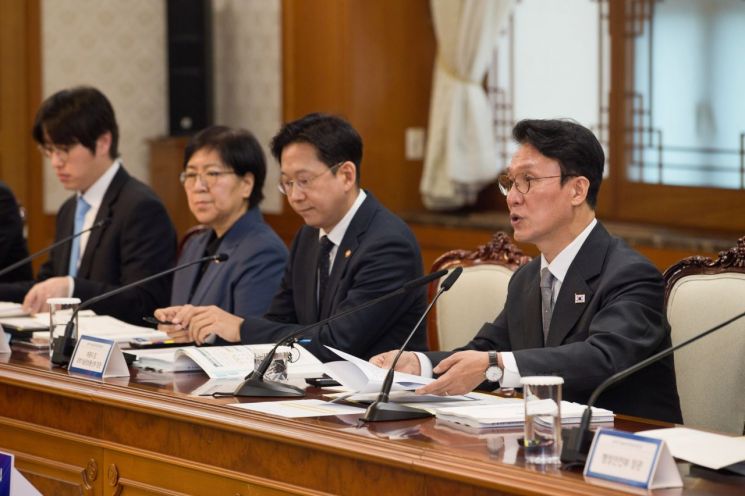 Prime Minister Kim Minseok is presiding over the "1st Science and Technology Ministers' Meeting" on the morning of the 24th at the main conference room of the Government Seoul Office in Jongno-gu, Seoul. Provided by the Ministry of Science and ICT
This meeting was the first since the establishment of the position of Deputy Prime Minister for Science and Technology following the government reorganization in October. Ministers and vice ministers from a total of 20 ministries and agencies, including the Ministry of Science and ICT, Ministry of Economy and Finance, Ministry of Education, Ministry of National Defense, Ministry of Trade, Industry and Energy, and the Ministry of SMEs and Startups, attended to coordinate and discuss policies responding to the AI transformation, establishing a control tower for such efforts.
Top 10 AI Public Welfare Projects: "Solving Everyday Issues from Agricultural Product Prices to Voice Phishing"
The "Top 10 AI Public Welfare Projects," directly connected to citizens' daily lives, was a core agenda item at the meeting.
The government explained that, based on public perception surveys and expert reviews, it had selected areas with a high need and significant benefits for AI adoption. For example, through an agricultural product price and smart consumption information platform, AI will compare regional agricultural product prices, recommend optimal purchasing locations, and even suggest alternative ingredients. The government expects that, especially in the volatile agricultural markets, AI can help reduce the burden on consumers.
In addition, to counter the increasing sophistication of voice phishing crimes, a real-time data-sharing and automatic blocking platform will be established, connecting telecom operators, manufacturers, and investigative agencies. This AI-based voice phishing response platform aims to automatically block malicious lines and accounts, with the goal of reducing recurring telecommunication financial fraud.
Other services to enhance daily convenience include an AI-based national tax information consultant to reduce waiting times for tax consultations, and a national heritage AI guide that explains cultural heritage sites tailored to users' interests and languages. The government plans to complete the development of relevant data and AI models by 2026 and, starting in 2027, expand these services nationwide to lay the foundation for an "AI-based society."
Defense, Manufacturing, Science and Technology, SMEs: 10 Cross-Ministerial Agenda Items Submitted
In addition to the public welfare projects, the meeting addressed 10 agenda items covering all sectors, including defense, manufacturing, science and technology, and small and medium-sized enterprises.
In the defense sector, the "Defense AX Strategy" will be promoted, focusing on seven major projects such as AI combat advisors, AI policy advisors, and unmanned/autonomous weapon systems to respond to rapidly changing battlefield environments. In the manufacturing sector, the direction was set to convert the entire manufacturing process to an AI-based system through the operation of the M.AX Alliance, which involves over 1,000 industry-academia-research participants, and by expanding leading AI factory projects.
In science and technology, the "Science and Technology × AI National Strategy" was reported, which aims to develop AI foundation models in six fields-bio, materials and chemistry, earth science, mathematics, semiconductors and displays, and secondary batteries. It also includes the implementation of AI Co-Scientists and the establishment of automated and autonomous laboratories.
Additionally, discussions were held on forming five working groups to expand AI cooperation between Korea and the UAE, fostering innovative AI and deep-tech companies, and strengthening AI education for small business owners as part of strategies to promote and expand AI use among SMEs. Furthermore, final decisions were made on measures to innovate the R&D ecosystem, secure science and technology talent, report on the adoption of the APEC AI Initiative, and the operation plan for the Science and Technology Ministers' Meeting, thereby comprehensively refining the cross-ministerial AI policy system.
"AI Is the Engine of National Transformation... Uniting Ministerial Capabilities"
Prime Minister Kim Minseok stated at the meeting, "AI is a new growth engine that will drive economic innovation and is key to sustainable development," adding, "I expect that cross-ministerial cooperation will be systematically advanced through the Science and Technology Ministers' Meeting."
Deputy Prime Minister for Science and Technology Bae Kyunghoon said, "It is impossible to leap forward as a powerhouse in science, technology, and AI with the capabilities of a single ministry alone," and emphasized, "As Deputy Prime Minister, I will actively play a role in coordinating and integrating the government's AI strategy."
© The Asia Business Daily(www.asiae.co.kr). All rights reserved.
![User Who Sold Erroneously Deposited Bitcoins to Repay Debt and Fund Entertainment... What Did the Supreme Court Decide in 2021? [Legal Issue Check]](https://cwcontent.asiae.co.kr/asiaresize/183/2026020910431234020_1770601391.png)