Increasing the Weight of Party Members' Votes in Next Year's Local Elections
"Strategy That Ignores Public Sentiment Is Doomed to Fail," Concerns Inside and Outside the Party
The People Power Party is facing growing concerns both inside and outside the party as it focuses on consolidating its core supporters, such as by increasing the proportion of party member votes in next year's June local elections. Critics point out that if the party continues to concentrate on retaining its base, leading to alienation of centrist voters, it will be difficult to expect not only a rebound in approval ratings but also victory in the June 2025 local elections.
On November 24, the People Power Party held a general assembly at the National Assembly, where it shared evaluation plans devised by the "Task Force for Innovation in the Evaluation of Elected Officials" and discussed future political strategies.
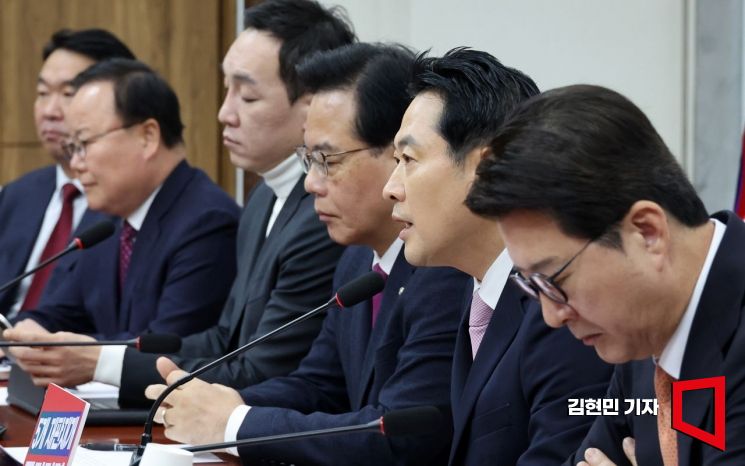 Jang Donghyuk, leader of the People Power Party, is speaking at the Supreme Council meeting held at the National Assembly on the 24th. November 24, 2025 Photo by Kim Hyunmin
The task force is emphasizing the "party loyalty assessment," which evaluates the ability to confront the opposition. Ahead of next year's local elections, the task force announced that the evaluation of incumbent local government heads for nomination will reflect factors such as ▲ efforts for regional economic development and innovation ▲ leadership ▲ contributions to the party. Contributions to the party will be assessed based on overall party activities, including policy cooperation with the central and local party organizations, participation in party-government consultations, and responses to the government.
Previously, the People Power Party's Party Affairs Audit Committee decided to introduce a new "party contribution assessment" category in the party affairs audit scheduled to begin next month. The party contribution category includes ▲ independent statements and actions that differ from party lines or the central party's stance, along with explanations ▲ attendance at large-scale events organized by the central party, such as protest rallies and party member training sessions ▲ compliance with central party guidelines regarding on- and offline promotional activities, such as picketing and dissemination of card news.
The party's Local Election Planning Committee also plans to soon report a proposal to change the nomination rules for the June 2025 local elections to the Supreme Council. The committee previously announced its intention to change the weighting from the current 50% party member votes and 50% public opinion polls to 70% and 30%, respectively.
The party leadership is reportedly in agreement with expanding the influence of party member votes, as leader Jang Donghyuk has consistently emphasized "party loyalty." Park Sunghoon, chief spokesperson of the People Power Party, told reporters after the Supreme Council meeting, "We understand this as an idea to select candidates who are strong contenders," adding, "We will listen to various opinions."
The leadership is making every effort to rally the party base. Starting in Busan on November 22, the party has been holding nationwide rallies criticizing the prosecution's decision to forgo an appeal in the Daejang-dong case. At a rally held the previous day in Changwon, South Gyeongsang Province, leader Jang stated, "The decision to forgo the 780 billion won appeal is not just giving up an appeal, but giving up the Republic of Korea and its people," emphasizing, "Now is the time to end this monstrous regime that is devouring the freedom of the people."
However, concerns are being raised both within and outside the party about the strategy focused on party loyalty. The prevailing view is that, given the significant gap between party sentiment and public sentiment, a strategy targeting only the hardline base will not be effective. Accordingly, on the first anniversary of the December 3 Martial Law and the 100th day of Jang's leadership, some argue that the party should declare a break with former President Yoon Sukyeol and revise its strategy to broaden its appeal. Yang Hyangja, Supreme Council member of the People Power Party, said on YTN Radio that day, "It is true that Jang's actions and messages raise questions among centrist voters," adding, "He should draw a clear line from former President Yoon and focus more on upholding the rule of law and addressing people's livelihoods."
The party's alienation from the center is also reflected in approval ratings. According to a poll released by Gallup Korea on November 21 (survey conducted November 18-20; for details, refer to the website of the National Election Survey Deliberation Commission), 44% of centrist respondents said that "the ruling party's candidates should win the majority" in next year's June 3 local elections,
while only 30% said that "the opposition party's candidates should win the majority." In the same survey a month earlier, 38% of centrists supported a ruling party majority and 36% supported an opposition party majority, indicating that the gap has widened. A People Power Party official commented, "To perform well in local elections, where we need to win the public's votes, we must make greater efforts to embrace public sentiment."
© The Asia Business Daily(www.asiae.co.kr). All rights reserved.
![Clutching a Stolen Dior Bag, Saying "I Hate Being Poor but Real"... The Grotesque Con of a "Human Knockoff" [Slate]](https://cwcontent.asiae.co.kr/asiaresize/183/2026021902243444107_1771435474.jpg)










